Tidal Gravity and Relative Acceleration
Scrollable formula. Use Left and Right arrow keys to reveal hidden content.
Scrollable table. Use Left and Right arrow keys to reveal additional columns.
Scrollable figure. Use Left and Right arrow keys to inspect hidden content.
A uniformly accelerating frame can cancel a uniform gravitational acceleration, because both enter a test body’s equation as the same position-independent vector. It cannot cancel tides: the relative acceleration of separated freely falling bodies depends on spatial derivatives of the field. The symmetric Hessian is the Newtonian tidal tensor.
Required background. Calculus and Linear Algebra provides multivariable differentiation, linear maps, inner products, and basis changes. Helpful background. Ordinary Differential Equations provides initial-value problems, linearization, and asymptotic solution methods.
Relative acceleration and the tidal tensor
Section titled “Relative acceleration and the tidal tensor”Let two test particles have positions and , with small compared with the scale on which varies. Subtraction of their equations gives
Since , the equation to first order in the separation is
The tensor is symmetric wherever is twice differentiable, so it has real eigenvalues and orthogonal principal axes. Its trace is
Vacuum therefore means traceless, not zero: stretching in one direction can be balanced by compression in the others.
Gibbons 2006, §3, pp. 8–12, especially p. 10, PDF obtains this same Newtonian relative-acceleration equation, Hessian tidal tensor, and Poisson trace. Its sign agrees with the convention used here.
Under a time-independent rotation of Cartesian axes, transforms as . Its matrix entries depend on the axes, but its eigenvalues, trace, and determinant do not. Translating the origin changes the point at which the field is sampled, not the tensorial rule at that point. A gradiometer can therefore compare principal relative accelerations per unit separation without first selecting a preferred global orientation.
Why uniform gravity disappears
Section titled “Why uniform gravity disappears”Under a translating frame change with nonrotating axes, the assigned field is
If is uniform, choosing makes . The potential gains a linear term as well as the translated spatial argument, but the linear term has no Hessian:
so no translating accelerated frame removes . This is the precise Newtonian distinction between removable uniform acceleration and measurable tidal gravity. It anticipates, but does not replace, spacetime curvature and relativistic geodesic deviation.
Point-mass eigenvalues
Section titled “Point-mass eigenvalues”For ,
The radial eigenvalue is ; each tangential eigenvalue is . Because relative acceleration is , the relative acceleration per unit separation is radially and in either tangential direction. These signs initially stretch radial pairs and compress transverse pairs that begin at relative rest. The sum vanishes, as required outside the source. The eigenvalues have dimension , identifying the dynamical time ; they are acceleration gradients, not velocities or strain rates.
In the diagram, compare each proof mass with the central freely falling particle . The nearer radial particle falls more strongly toward , while the farther one falls less strongly: both move away from relative to its free fall. Transverse particles fall along slightly converging directions. The arrows show these differences after subtracting the acceleration of .
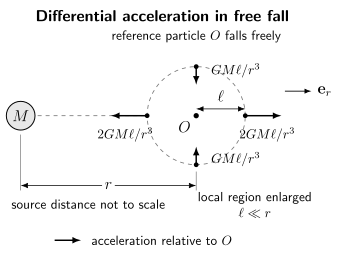
Relative to a freely falling particle at radius , equal small radial offsets accelerate apart twice as strongly as transverse offsets accelerate together. Arrows show differential acceleration, not velocity or total gravitational force. The second transverse direction behaves identically; , with the local region enlarged and source distance not to scale.
Inside a uniform-density sphere, , hence
All three directions compress and the trace is . The vacuum and uniform-density examples independently verify both the eigenvalue signs and Poisson trace. The field, potential, and Poisson inputs are developed in Tong, Vector Calculus, §§5.1–5.2, pp. 92–100, PDF; the tidal result above follows by subtracting and linearizing two nearby trajectories, and its point-mass eigenvalues by differentiating .
The tensor determines instantaneous relative acceleration, not by itself the eventual shape of an extended object. Deformation also depends on elasticity, pressure, self-gravity, rotation, and the duration and orientation of the applied tide. A freely falling gradiometer measures through the motion of proof masses, whereas a supported laboratory superposes tidal response with stresses that prevent free fall. This distinction is essential when translating an eigenvalue pattern into a physical strain or disruption criterion.
Higher spatial derivatives enter across a finite apparatus. Expanding one order further gives corrections of size roughly compared with the leading . Thus the linear approximation is controlled by , where is the scale over which the tide changes. Near a point-mass singularity or across a material boundary, that condition can fail even if the separation looks small in absolute units.
Exercise: a three-axis gradiometer
Section titled “Exercise: a three-axis gradiometer”At radius outside a spherical mass, three bead pairs have equal small separations along one radial and two tangential directions. What relative accelerations do they measure, and which combination diagnoses vacuum?
Solution
In an orthonormal principal basis,
The nearer radial bead falls more strongly, so the pair stretches; tangential pairs compress. Dividing by and summing the three signed eigenvalues gives , diagnosing locally. A nonzero traceless signal still reveals gravity.
The linear equation requires to be small enough that third derivatives of are negligible. Rotating-frame gradients must be calibrated separately, and Newtonian theory contains no finite propagation speed.
Conservation Laws, Scaling, and the Virial Theorem turns from local distortion to global information about bound systems.
References
Section titled “References”- Gibbons, G. W. Part II General Relativity. University of Cambridge lecture notes, 2006. §3, pp. 8–12, PDF.
- Tong, David. Vector Calculus. University of Cambridge lecture notes, n.d. §§5.1–5.2, pp. 92–100, PDF.