Boulware, Hartle–Hawking, and Unruh States
Scrollable formula. Use Left and Right arrow keys to reveal hidden content.
Scrollable table. Use Left and Right arrow keys to reveal additional columns.
Scrollable figure. Use Left and Right arrow keys to inspect hidden content.
The Boulware, Hartle–Hawking, and Unruh states answer three different boundary-value questions on a stationary black-hole exterior. The boundary-mode comparison here uses a free massless scalar on Schwarzschild. The states are distinguished by positive-frequency choices, horizon regularity, incoming populations, and asymptotic flux. For an isolated black hole formed by collapse, the Unruh state is the stationary late-time idealization; the other two model an empty static exterior or thermal equilibrium.
Helpful background. Flat-Spacetime Quantum Field Theory provides mode vacua and thermal occupation. Partial Differential Equations and Green Functions supplies characteristic data and two-point solutions. Causality and Global Structure develops past and future horizons. Quantum Fields in Curved Spacetime provides Hadamard regularity. Black-Hole Geometry and Mechanics supplies the horizon generator and surface gravity. Black-Hole Perturbation Theory provides separated scattering modes and flux normalization.
State data on an eternal exterior
Section titled “State data on an eternal exterior”For Schwarzschild, write for the gravitational length. Then
Killing frequency is defined with . Near the horizon, outgoing and ingoing modes depend on and , where . Schwarzschild is singular at the horizons, so regularity must be tested in affine Kruskal coordinates or in a freely falling frame.
A centered quasifree state is fixed by its two-point function or, equivalently in a stationary mode construction, by the populations and correlations of independent incoming and outgoing sectors. For this massless field, past null infinity and the past horizon supply the two incoming families. Massive fields require a different characterization of the modes approaching timelike infinity; their scattering data cannot simply be placed on null infinity Wald 1984, §14.3, p. 401. “Vacuum” therefore requires a named generator and boundary. A state can be empty for static observers at infinity yet singular for freely falling observers at the horizon.
The three standard choices
Section titled “The three standard choices”| State | Incoming data at infinity | Horizon regularity | Late asymptotic interpretation |
|---|---|---|---|
| Boulware | empty in static Killing modes | singular on both past and future horizons | vacuum polarization around a static star; no thermal flux at infinity |
| Hartle–Hawking | thermal incoming bath at | regular on both horizons in the static bifurcate case | equilibrium: equal ingoing and outgoing thermal flux |
| Unruh | empty incoming sector on past null infinity | regular on the future horizon, singular on the past horizon of the eternal extension | collapse state: outgoing Hawking flux with no compensating incoming bath |
The Boulware state is physically useful outside a horizonless static body and far from a black hole, but its renormalized stress tensor diverges in an orthonormal freely falling frame as . The Hartle–Hawking state is KMS with respect to horizon-generating Killing evolution at
and describes a black hole in a thermal reservoir. Its net Killing flux vanishes because incoming and outgoing populations balance.
The Unruh state selects positive affine frequency on the past horizon for the outgoing sector and positive Killing frequency on past null infinity for incoming modes. It is regular where a collapse geometry has a future horizon and produces positive outgoing flux at future null infinity. Its singularity on the past horizon of the maximally extended geometry is not an obstruction for a spacetime formed by collapse, because that past horizon is absent.
The three exterior diagrams below place these choices on their corresponding boundaries. Each diamond is only the right exterior: and supply the two independent incoming mode families, while and are its future boundaries. Read the regularity labels separately from the population labels. In particular, zero net flux does not distinguish Boulware from Hartle–Hawking.
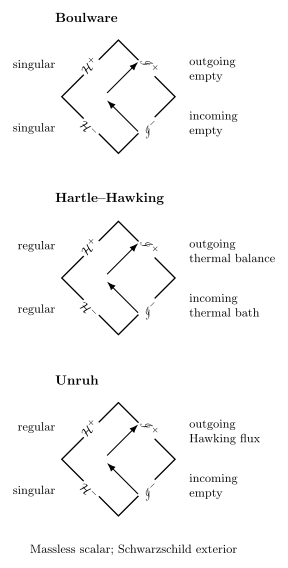
Mode populations and horizon regularity specify different aspects of a free massless scalar state on Schwarzschild. The arrows label incoming and outgoing mode sectors, including when their occupation is zero; they are not arrows of nonzero energy flux. The singular past horizon in the Unruh panel belongs to the eternal extension and is absent in collapse. Schematic comparison, not to scale.
The mode and stress-tensor comparison is carried out in Candelas 1980, §§II–IV, pp. 2185–2202.
Regularity is stronger than finite coordinates
Section titled “Regularity is stronger than finite coordinates”The proof strategy for state classification is geometric. Construct the two-point function from normalized modes, continue it across the relevant horizon using an affine null coordinate, and test whether its short-distance singularity has Hadamard form in a regular chart. A finite in Schwarzschild null coordinates is not sufficient because gives
Future-horizon regularity requires the state-dependent part to cancel the geometric polarization strongly enough that the transformed component remains finite. This same distinction is made executable on the chapter’s stress-tensor page.
The Kay–Wald analysis places existence, uniqueness, symmetry, and thermal properties on a rigorous algebraic footing for quasifree states on spacetimes with bifurcate Killing horizons; see Kay and Wald 1991, pp. 49–136. Its conclusions have hypotheses on the field, isometries, horizon structure, and state regularity and should not be quoted as unconditional statements about every stationary black hole.
Rotation and superradiance
Section titled “Rotation and superradiance”For Kerr, the horizon generator is , and thermal weights involve . Bosonic superradiant modes with obstruct a naive globally regular, isometry-invariant Hartle–Hawking state having all the Schwarzschild properties. This is a decisive counterexample to extrapolating the static table unchanged.
One may define state constructions adapted to restricted regions, mirrors, fermionic fields, or modified equilibrium prescriptions, but each changes the hypotheses. The Unruh state for rotating collapse also requires careful superradiant occupation and flux signs. “Hartle–Hawking on Kerr” without the field spin, algebra, boundary, and regularity class is therefore incomplete.
Checks and physical scope
Section titled “Checks and physical scope”At infinity, Boulware has no incoming or outgoing thermal population, Hartle–Hawking has equal populations, and Unruh has outgoing population only. At a future horizon, Boulware fails the regular-frame check while Hartle–Hawking and Unruh pass. Conservation then pairs Unruh’s positive outward Killing flux with negative Killing energy crossing the horizon.
These are fixed-background states. The Unruh state describes the leading field state over times short compared with appreciable mass change. It does not calculate the evolving metric, evaporation endpoint, or fine-grained information recovery.
Exercise
Section titled “Exercise”A numerical result has zero net flux at infinity, a thermal outgoing occupation, and a finite freely falling stress tensor on both horizons. Which state does it represent in static Schwarzschild, and what extra check prevents confusing it with Boulware?
Solution
The stated properties identify the Hartle–Hawking state: zero net flux comes from equal thermal incoming and outgoing populations, and regularity holds on both horizons. Boulware also has zero net flux, so flux alone is insufficient. One must inspect the individual populations or the regular-frame stress tensor. Boulware is empty in static modes and its polarization diverges at the horizons, whereas Hartle–Hawking contains a thermal bath and is regular.
This diagnostic illustrates why a conserved difference of two flux components cannot determine a state. One must compare horizon analyticity and boundary occupation because they provide independent data; without them, two physically inequivalent states can share the same net asymptotic current.
References
Section titled “References”- Boulware, David G. “Quantum Field Theory in Schwarzschild and Rindler Spaces.” Physical Review D 11 (1975): 1404–1423. DOI.
- Candelas, Philip. “Vacuum Polarization in Schwarzschild Spacetime.” Physical Review D 21 (1980): 2185–2202. DOI.
- Hartle, James B., and Stephen W. Hawking. “Path-Integral Derivation of Black-Hole Radiance.” Physical Review D 13 (1976): 2188–2203. DOI.
- Kay, Bernard S., and Robert M. Wald. “Theorems on the Uniqueness and Thermal Properties of Stationary, Nonsingular, Quasifree States on Spacetimes with a Bifurcate Killing Horizon.” Physics Reports 207 (1991): 49–136. DOI.
- Unruh, William G. “Notes on Black-Hole Evaporation.” Physical Review D 14 (1976): 870–892. DOI.
- Wald, Robert M. General Relativity. University of Chicago Press, 1984. Publisher record.