Hawking Radiation from Gravitational Collapse
Scrollable formula. Use Left and Right arrow keys to reveal hidden content.
Scrollable table. Use Left and Right arrow keys to reveal additional columns.
Scrollable figure. Use Left and Right arrow keys to inspect hidden content.
Hawking radiation in a collapse spacetime follows from an exponential relation between affine null coordinates. Outgoing rays received at increasingly late retarded time trace backward ever closer to the forming event horizon, so equal late-time intervals correspond to exponentially compressed early-time intervals. Fourier transforming that redshift mixes positive and negative early frequencies and yields on a fixed, asymptotically stationary background.
Helpful background. Flat-Spacetime Quantum Field Theory provides Bogoliubov transformations. Partial Differential Equations and Green Functions supplies geometric-optics propagation. Causality and Global Structure develops event horizons and null infinity. Quantum Fields in Curved Spacetime provides Hadamard in-states. Black-Hole Geometry and Mechanics supplies surface gravity and horizon generators. Black-Hole Perturbation Theory provides scattering modes and flux normalization.
Ray tracing through collapse
Section titled “Ray tracing through collapse”Consider a free massless scalar on a collapse geometry with a late stationary, nonextremal black-hole exterior. Let be retarded time on future null infinity, normalized to asymptotic stationary time; it labels outgoing rays and is not an affine parameter along each ray. Trace an escaping radial wave packet backward through the exterior, through the regular center before collapse, and to past null infinity, whose affine advanced coordinate labels the incoming rays. Massive fields require a different asymptotic scattering description because their particles do not reach null infinity.
There is a critical early ray whose outgoing continuation becomes the event horizon. In a collapse model with exponential late peeling, the leading relation is
For a differentiably controlled remainder, is positive and tends to zero. The constant and subleading terms depend on collapse details, while the leading exponent is fixed by the surface gravity normalized to the asymptotic time generator. A stronger remainder estimate requires more assumptions about how the exterior settles; it is not implied by smoothness alone.
The figure isolates the causal structure in an idealized spherical null-shell collapse. Follow each incoming ray from past null infinity to the regular center, then outward to future null infinity . The last escaping rays approach the dashed event horizon. Radial light rays are at in this conformal drawing; neither their drawn spacing nor a coordinate distance measures the exponential redshift.
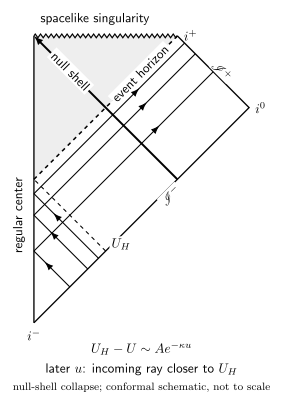
Escaping rays in null-shell collapse reflect before the critical incoming ray and remain outside the event horizon. The exponential relation concerns the early affine label and late retarded time , not compactified distances. denote null infinity, timelike infinity, and spatial infinity. Fixed-background radial conformal schematic, not to scale; no evaporation is modeled.
Positive frequency becomes a branch cut
Section titled “Positive frequency becomes a branch cut”A late outgoing mode has phase with . Using the leading map and tracing it to the early region gives
The logarithmic phase has a branch point at . It is not purely positive frequency with respect to the regular affine coordinate . Expand it in early modes and their conjugates:
To see the thermal factor explicitly, set , , and regulate the two Fourier integrals by :
The harmless phase and common flux-normalization factors cancel from the ratio. Projection onto positive early frequency gives ; projection onto negative early frequency gives . On the principal branch, for . Thus contains and contains , yielding
up to the common continuum normalization. Combining this ratio with the Bogoliubov norm identity produces the Planck factor
before the exterior scattering potential is included. The original collapse calculation and its wave-packet normalization are in Hawking 1975, §2, Eqs. (2.16)–(2.29), pp. 208–211, with the published correction in Hawking 1976, erratum p. 206.
Temperature, packets, and normalization
Section titled “Temperature, packets, and normalization”Comparison with gives
For Schwarzschild with physical mass , and in the site’s units. In SI units the temperature is . Its factor of shows that the radiation is a quantum effect even though the exponential ray map comes from classical geometry.
Exact monochromatic modes run for infinite time and carry delta-function normalization. Hawking wave packets localize both frequency and retarded time, making the late-time limit and particle count finite per packet. The calculation must use the same affine normalizations in the Klein–Gordon product, the ray-tracing map, and the definition of .
The exterior angular-momentum barrier multiplies the occupation by a transmission probability. It does not change the near-horizon temperature, but it makes the spectrum at infinity nonblackbody. That step is treated on Greybody Factors and Asymptotic Flux.
Assumptions and checks
Section titled “Assumptions and checks”The derivation assumes a regular in-vacuum of Hadamard short-distance form, smooth collapse, a nonextremal horizon, a late approximately stationary exterior, and geometric optics for the large backward blueshift. A dimension check requires to be dimensionless. A sign check requires and from the escaping side as . Reversing the exponential sign would spread rather than compress late rays and destroy the thermal continuation.
The large backward frequency
is the trans-Planckian precursor of a fixed late frequency. The leading result is robust under a class of ultraviolet modifications only when additional adiabaticity and state assumptions hold; it is not an unconditional proof of ultraviolet independence.
Backreaction is absent. The calculation is reliable over intervals short compared with order-one change of and does not derive an evaporation endpoint or information recovery. It describes field propagation on the specified collapse geometry.
Exercise
Section titled “Exercise”Two rays arrive separated by at late time. Using the exponential map, find the ratio of their early affine separations when the second pair is shifted later by an additional interval .
Solution
For a small fixed arrival separation, the corresponding early separation is approximately . Shifting both arrivals later by multiplies this separation by . Therefore equal detector-time bins sample exponentially finer early affine intervals. This calculation checks the redshift directly and explains why a logarithmic phase, rather than the detailed trajectory of the matter surface, controls the late spectrum.
References
Section titled “References”- Hawking, Stephen W. “Black Hole Explosions?” Nature 248 (1974): 30–31. DOI.
- Hawking, Stephen W. “Erratum: Particle Creation by Black Holes.” Communications in Mathematical Physics 46 (1976): 206. DOI.
- Hawking, Stephen W. “Particle Creation by Black Holes.” Communications in Mathematical Physics 43 (1975): 199–220. DOI.