Rindler Coordinates and Acceleration Horizons
Scrollable formula. Use Left and Right arrow keys to reveal hidden content.
Scrollable table. Use Left and Right arrow keys to reveal additional columns.
Scrollable figure. Use Left and Right arrow keys to inspect hidden content.
Uniform acceleration creates a causal horizon without creating spacetime curvature. A worldline of constant proper acceleration remains in one Rindler wedge of Minkowski spacetime and approaches two null lines asymptotically. Rindler coordinates adapt time to Lorentz boosts, making the horizon and its surface-gravity normalization explicit while covering only one part of the global geometry.
Required background. Special Relativity provides Minkowski intervals, hyperbolic motion, and Lorentz boosts.
Helpful background. Flat-Spacetime Quantum Field Theory provides positive-frequency modes. Partial Differential Equations and Green Functions supplies causal support. Causality and Global Structure develops horizons and domains of dependence. Quantum Fields in Curved Spacetime provides the volume map from geometry to states and detectors.
Hyperbolic motion in Minkowski spacetime
Section titled “Hyperbolic motion in Minkowski spacetime”Use inertial coordinates with
A worldline with constant proper acceleration in the direction is
It satisfies and remains in the right wedge
Differentiation gives the unit four-velocity and acceleration . Hence . The orbit approaches only as and never crosses either null line.
Rindler coordinates and boost time
Section titled “Rindler coordinates and boost time”On , choose and define
The constant normalizes the boost-time coordinate; it is not the proper acceleration of every orbit. Substitution gives
Along , proper time satisfies and the proper acceleration is . Only the orbit has . The boost Killing field is
It is timelike inside the wedge and becomes null at . The coordinate degeneracy there is a horizon, not a curvature singularity: the Riemann tensor remains identically zero because this is still Minkowski spacetime. The derivation and four-wedge extension are detailed in Crispino, Higuchi, and Matsas 2008, arXiv version, §II.B, pp. 6–7, PDF, whose opposite metric signature must be translated to the convention used here.
Four wedges and two horizons
Section titled “Four wedges and two horizons”The two null lines divide the plane into right, left, future, and past wedges. Inspect the hyperbolae and boost arrows in the figure: constant- trajectories never leave a lateral wedge, while the same global boost generator reverses its time orientation between the right and left wedges.
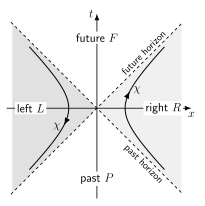
Null lines divide Minkowski space into four wedges. Constant-acceleration hyperbolae remain in the right or left wedge and approach the acceleration horizons; the arrows follow the same boost generator , futureward on the right and pastward on the left. The horizon names refer to the right-wedge observer. Schematic and not to scale.
The two horizons encode different signal questions. Put and . On the complete accelerated orbit, and . An event can send a signal to some point of the orbit only if : is the observer’s future event horizon. An event can receive a signal from some point of the orbit only if : is the past horizon. Their intersection is the right wedge.
Thus an event in the past wedge can send a signal to the accelerated observer even though the observer cannot send one back; an event in the future wedge can receive a signal from the observer but cannot return one. The right-wedge boundary branches are and . These observer-dependent restrictions do not remove any region from Minkowski spacetime: inertial observers cross the null lines regularly.
The left-wedge chart may be chosen with and if is to follow the same global boost field. Its future orientation is then opposite to the right-wedge convention. Stating this orientation prevents a sign error in left-wedge frequencies and in the analytic continuation used for Unruh modes.
Horizon normalization and checks
Section titled “Horizon normalization and checks”Near , the metric has the static form . With , its Killing-horizon surface gravity is . Rescaling rescales both and ; the physical temperature measured on an orbit uses proper time and becomes .
Three checks guard the construction. First, verifies the wedge and constant-acceleration hyperbolae. Second, locates the null horizon. Third, transforming the metric back to removes the apparent degeneracy and confirms zero curvature. No stress tensor, quantum state, or emitted radiation has been invoked yet; this page establishes geometry alone.
Exercise
Section titled “Exercise”For the orbit , derive its proper acceleration and show that the local norm of the boost generator gives the redshift relation between boost temperature and proper-time temperature.
Solution
Proper time is , so the orbit can be written as and . Differentiating twice gives acceleration norm . The Killing norm is ; dividing the boost temperature by this redshift factor gives .
The cancellation of the arbitrary coordinate normalization is the key check. Two authors may choose different boost parameters and quote different values for the coordinate KMS temperature, yet an observer on the same hyperbola obtains the same proper-time response because the Killing norm changes by the matching factor.
References
Section titled “References”- Crispino, Luís C. B., Atsushi Higuchi, and George E. A. Matsas. “The Unruh Effect and Its Applications.” Reviews of Modern Physics 80 (2008): 787–838. DOI. Open PDF.
- Fulling, Stephen A. “Nonuniqueness of Canonical Field Quantization in Riemannian Space-Time.” Physical Review D 7 (1973): 2850–2862. DOI.