Gravitational Dressing
Scrollable formula. Use Left and Right arrow keys to reveal hidden content.
Scrollable table. Use Left and Right arrow keys to reveal additional columns.
Scrollable figure. Use Left and Right arrow keys to inspect hidden content.
A coordinate-local matter insertion is not invariant under gravitational gauge transformations. In weak-field gravity it can be completed by shifting its argument with a metric-dependent functional—a gravitational dressing. The dressing carries the excitation’s constraint field to a reference or boundary, which explains both its noncompact support and the appearance of small nonlocal commutators. This is a perturbative statement about gauge-invariant operators, not a claim that arbitrary information can propagate outside a light cone.
Required background. Variational and Symplectic Geometry supplies constraint generators and surface charges. Equivalence Principles and Gravitational Measurement supplies relational localization.
Helpful background. Flat-Spacetime Quantum Field Theory supplies local fields and commutators, Einstein Equations supplies weak-field constraints, Quantum Information supplies subsystem tests, and Quantum Gravity supplies the regime hierarchy.
Perturbative gauge variation
Section titled “Perturbative gauge variation”Work about four-dimensional Minkowski spacetime with
and retain terms through first order in . Choose the infinitesimal convention ; it is related to the plus-sign generator used in the graviton chapter by :
The bare scalar therefore depends on a coordinate point that shifts along the gauge orbit. Introduce a functional satisfying
Then define
Its first-order variation cancels:
Donnelly and Giddings construct explicit line and Coulomb dressings and verify this cancellation in perturbative gravity Donnelly and Giddings 2016, “Diffeomorphism-Invariant Observables,” §§III A–B, PDF. Their general obstruction to compact support follows from the asymptotic charges Donnelly and Giddings 2016, “Observables, Gravitational Dressing,” §II, PDF.
Why the dressing reaches the boundary
Section titled “Why the dressing reaches the boundary”The Hamiltonian and momentum constraints are gravitational Gauss laws. In an asymptotically flat sector, total energy and momentum can be written as surface integrals of the asymptotic metric. Suppose a gauge-invariant operator were exactly supported in a bounded region and commuted with all asymptotic fields. Then it would commute with the surface charge . But an operator that creates an excitation of nonzero energy–momentum must satisfy . The assumptions are incompatible: such an operator must change the field extending to infinity or be defined relative to some other physical anchor.
The argument fixes a necessity, not a unique dressing. A gravitational line can connect the insertion to infinity; a Coulomb-like dressing spreads the field more symmetrically. Their difference solves the homogeneous linearized constraint and can contain radiative data, so the same leading asymptotic energy–momentum need not fix the field profile or commutators. This equality is order dependent: radiation itself carries energy at quadratic order. An infinitely thin line is singular and requires smearing; it is not a stable finite-energy equilibrium configuration.
This boundary reasoning also has a compact-space caveat. On a closed universe there is no asymptotic infinity and total constraints vanish. One must instead use relational matter, a finite boundary, or correlations among excitations; simply transplanting an asymptotic Coulomb dressing is not defined.
The sketches show what the charge argument leaves undetermined: the spatial distribution of the attached field. Compare where each dressing reaches the asymptotic reference, rather than reading the lines as trajectories.
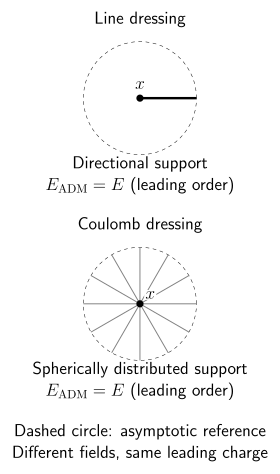
A line dressing concentrates spatial support; a Coulomb dressing distributes it spherically. Both reach the asymptotic reference and carry the same leading ADM energy. The circle represents infinity at finite drawing radius, and the ideal line requires smearing. Schematic, not to scale; no signal trajectory or higher-order equality of energies is asserted.
Constraint-field check
Section titled “Constraint-field check”The linearized Hamiltonian constraint relates a spatial derivative of to the matter energy density. Integrating it over a volume converts the derivative term to a surface flux. If an insertion increases the integrated matter energy, the surface metric flux must change. This independently recovers the long-range conclusion without using the operator commutator.
The Newtonian limit makes the scaling transparent. A localized energy produces
outside a slowly moving source in a Newtonian gauge. It is the dimensionless metric perturbation that scales with the potential; the canonical field has mass dimension one. The field is small for but is not compactly supported. Sending removes the gravitational tail and recovers the local matter operator. At fixed , taking makes the local field vanish while its properly normalized surface flux remains the total energy. A massive excitation with therefore cannot be created without changing asymptotic data.
Dressing algebra and its limits
Section titled “Dressing algebra and its limits”For two dressed scalars,
contains the ordinary matter commutator plus terms involving . Since each dressing begins at , the new term generally starts at even when and are spacelike with respect to the background. Explicit results depend on line versus Coulomb dressing, equal-time prescription, and boundary conditions; a fixed gauge-invariant observable must agree across consistent gauge choices Donnelly and Giddings 2016, “Diffeomorphism-Invariant Observables,” §IV B, PDF.
This does not mean that the background causal cone is irrelevant. The commutator partly records the shared constraint field and the nonlocal definition of the observables. To infer signalling one would need a preparation-and-readout protocol, a state, retarded dynamics, and control of all terms. Nor does the perturbative construction settle exact locality in a microscopic theory when or curvature invariants become large.
The retained approximation is weak field about Minkowski space through the first nontrivial dressing order. The first omitted terms include nonlinear gauge transformations, graviton self-interactions, loop renormalization, and state-dependent backreaction. Near a black-hole horizon, on compact topology, or in a nonperturbative phase, a different anchor and expansion may be required.
Exercises
Section titled “Exercises”Exercise. Let and through the displayed order. Verify directly that is invariant through . Then replace by , where , and explain what changes.
Solution
Because , variations of inside contribute only at . Hence
For , still holds, so is equally gauge invariant at this order. The difference is , a gauge-invariant change of the gravitational field attached to the matter insertion. Gauge invariance fixes the required transformation law but not a unique dressing; boundary conditions or a physical preparation select among the possibilities.
References
Section titled “References”- Donnelly, William, and Steven B. Giddings. “Diffeomorphism-Invariant Observables and Their Nonlocal Algebra.” Physical Review D 93 (2016): 024030; erratum 94 (2016): 029903. DOI. Open PDF.
- Donnelly, William, and Steven B. Giddings. “Observables, Gravitational Dressing, and Obstructions to Locality and Subsystems.” Physical Review D 94 (2016): 104038. DOI. Open PDF.