Expansion, Shear, and Vorticity
Scrollable formula. Use Left and Right arrow keys to reveal hidden content.
Scrollable table. Use Left and Right arrow keys to reveal additional columns.
Scrollable figure. Use Left and Right arrow keys to inspect hidden content.
The deformation tensor of a timelike congruence contains three geometrically distinct effects: isotropic change of a small rest-space volume, trace-free distortion of its shape, and local rotation. Separating them prevents coordinate expansion, rigid rotation, and genuine volume change from being conflated.
Each part is an instantaneous rate with dimensions of inverse proper time. The scalar expansion is basis independent. The shear and vorticity are tensors on the rest space; a chosen orthonormal triad turns them into matrices, but rotating that triad changes their components without changing contractions such as their squared norms. This distinction lets a calculation use convenient axes while retaining an invariant physical statement.
Required background. The Riemann Curvature Tensor fixes the curvature convention used when this decomposition is evolved on the next page; Affine and Variational Geodesics supplies affine geodesics and the curve-variation setup; Jacobi Fields and Geodesic Deviation explains how connecting fields arise and when they obey the Jacobi equation—the present decomposition itself applies more generally. Helpful background. Calculus and Linear Algebra for Relativity supplies symmetric, antisymmetric, and trace-free matrix decompositions; Frames, Coframes, and Anholonomy supplies orthonormal rest-space components.
Irreducible spatial decomposition
Section titled “Irreducible spatial decomposition”For a unit timelike tangent , define
Write for the rest-space dimension. The unique decomposition is
where
All three tensors are spatial; is symmetric and trace-free, and is antisymmetric. Their independent components add correctly:
the number of entries in a linear map on the rest space. This component count is a useful check that no mode has been lost or counted twice.
Volume, shape, and rotation
Section titled “Volume, shape, and rotation”Take the rest-space projections of linearly independent connecting vectors Lie transported with the congruence and let be their infinitesimal spatial volume. These projected separations obey , including for accelerated curves, as derived on Timelike Congruences and Spatial Projection. Jacobi’s determinant identity gives
Positive expansion means that the chosen material volume grows toward the future; negative expansion means that it shrinks. The statement is local and refers to the specified congruence, not to a coordinate-grid volume.
The shear changes shape at fixed first-order volume. If a unit spatial vector identifies one principal direction, then its fractional length rate is
Different eigenvalues of stretch and compress different axes, while their sum vanishes. Vorticity rotates a connecting-vector frame and does not change the norm of a single separation at first order because .
For a small initially spherical ball, pure positive expansion enlarges every principal axis equally. Pure shear turns the ball into an ellipsoid whose first-order volume is unchanged. Pure vorticity rotates the connecting-vector pattern without changing either its volume or its principal lengths at that instant. A general flow superposes all three effects, while acceleration describes the bending of the central worldline and is not a fourth part of the spatial map.
These interpretations and their tensorial definitions are developed in Kar and SenGupta 2007, §§II.A–II.B, pp. 6–10, PDF. The normalization here is , without an extra factor of one half.
A two-dimensional model of the three actions
Section titled “A two-dimensional model of the three actions”In a nonrotating orthonormal rest frame, freeze the components of a two-dimensional deformation map over an interval . Then a separation evolves as
For , an initial unit circle grows to radius and its area grows by . For , it becomes an ellipse with semiaxes and : its area stays exactly fixed in this model. For
the exponential is a rotation through . A marked radius reveals this rotation even though the circle’s outline is unchanged.
This is a rest-space illustration, so its expansion trace is ; a three-dimensional isotropic cloud has trace . The finite maps are exact for the stated constant matrices. A general congruence supplies an instantaneous that changes along the flow, so freezing it is only a local approximation; in particular, constant pure shear need not obey a specified geodesic curvature-evolution problem.
The figure compares these three maps separately. Follow the dashed initial outline and the marked radius: the radius makes rotation visible even when the circle’s boundary does not change.
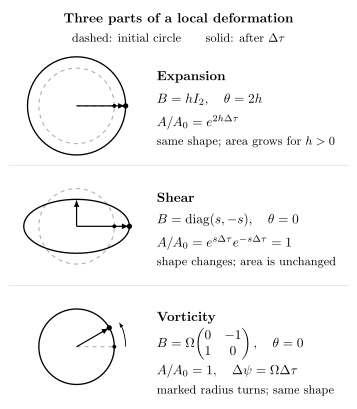
Three constant two-dimensional deformation maps carry the same marked unit circle into an expanded circle, an equal-area ellipse, and a rotated circle. The marked radius reveals rotation even though the circular boundary is unchanged. These are exact model maps , shown for , , and ; a general congruence has a varying .
Vorticity and hypersurface orthogonality
Section titled “Vorticity and hypersurface orthogonality”The one-form is locally proportional to a gradient precisely when its orthogonal distribution is integrable. Frobenius’ condition can be written
For a unit timelike congruence this is equivalent to . Vanishing vorticity therefore permits local spacelike slices orthogonal to the worldlines. It does not guarantee a global foliation: topology, boundary behavior, or caustics may obstruct extending the slices.
Conversely, nonzero vorticity is not a coordinate artifact that can be removed by relabeling the same worldlines. It expresses nonintegrability of their local rest spaces. A rotating coordinate system may describe a nonrotating congruence, or inertial coordinates may describe a rotating one; the projected tensor decides.
Three diagnostic congruences
Section titled “Three diagnostic congruences”In Cartesian Minkowski coordinates, gives . For Milne observers, and . Hence
The congruence expands isotropically despite zero spacetime curvature.
Uniform rotation supplies an independent separation. In its timelike domain, the normalized rotational Killing flow is Born-rigid: and . Nevertheless , and the centripetal acceleration is nonzero. The local rest spaces cannot be assembled into surfaces orthogonal to all rotating worldlines.
Rindler observers have but . Their example demonstrates that the deformation tensor classifies relative motion, whereas acceleration describes bending of each individual worldline.
Common pitfalls
Section titled “Common pitfalls”Expansion is not every scale factor. A coordinate metric may depend on time while a chosen congruence has zero expansion, or a time-independent chart may contain an expanding flow. Compute for a normalized tangent.
Shear is trace-free. Subtract after spatial symmetrization. Omitting the factor contaminates the shear with isotropic expansion.
Vorticity is not angular speed alone. It measures antisymmetric relative deformation and the failure of orthogonal rest spaces to integrate. Its value depends on the congruence, but once that field is specified it is covariant.
Exercises
Section titled “Exercises”In a three-dimensional rest space, suppose the symmetric part of the deformation map has orthonormal-frame components
Find the expansion and shear eigenvalues, and verify that the shear is trace-free.
Solution
The trace is , so the isotropic part has eigenvalue . Subtracting it gives
The three eigenvalues sum to zero. A small volume grows initially as , while one principal length has no shear correction and the other two receive equal and opposite corrections.
References
Section titled “References”- Kar, Sayan, and Soumitra SenGupta. “The Raychaudhuri Equations: A Brief Review.” Pramana 69 (2007), 49–76. arXiv:gr-qc/0611123.