Lorentzian Causal Cones and Time Orientation
Scrollable formula. Use Left and Right arrow keys to reveal hidden content.
Scrollable table. Use Left and Right arrow keys to reveal additional columns.
Scrollable figure. Use Left and Right arrow keys to inspect hidden content.
At each point of a Lorentzian manifold, the metric divides nonzero tangent vectors into timelike, null, and spacelike classes. The null vectors form a double cone, and the timelike vectors occupy its two open convex interiors. Choosing one component continuously as future is a time orientation. These are pointwise and bundle-level structures: they do not, by themselves, establish global causal relations between distinct events.
Required background. Tensor Fields and Natural Operations supplies tangent and cotangent fields and their coordinate-independent interpretation.
Helpful background. Calculus and Linear Algebra for Relativity supplies quadratic forms; Exterior Algebra and Differential Forms supplies covectors and orientation; Events, Intervals, and Minkowski Geometry supplies the flat cone model.
Causal classes in one tangent space
Section titled “Causal classes in one tangent space”Let have Lorentzian signature . For ,
The zero vector is usually called causal only by convention; it has no future direction and should be excluded when a direction matters. A vector is causal if it is timelike or null. In an orthonormal basis at , , so the null cone obeys . In spacetime dimension at least three, its complement has three connected pieces: two timelike components and one spacelike region. In dimensions the spacelike set instead has two components, distinguished by the sign of the single spatial coordinate, so the complement has four pieces. The two timelike components—and therefore the future-versus-past choice—exist in either case.
The comparison below makes both the geometric cone and the dimensional exception visible. In the left panel, inspect the two timelike interiors and the future vector ; in the right panel, count the four connected regions outside the two null lines rather than importing the higher-dimensional count.
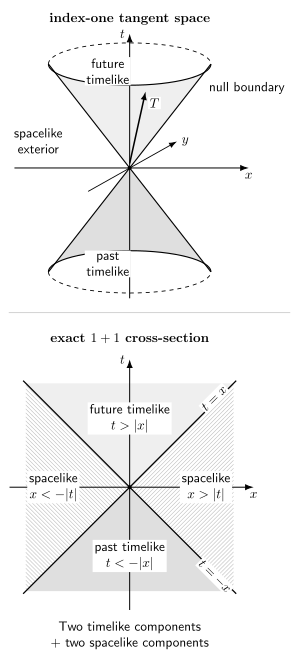
An index-one tangent metric has two timelike components bounded by the null cone. The 1+1 cross-section makes the low-dimensional exception explicit: the spacelike set has separate left and right components, so the cone complement has four pieces. Schematic and not to scale.
The same classification applies to a nonzero covector using the inverse metric, . Raising the index maps covector cones to vector cones, but confusing a normal covector with its raised vector becomes especially dangerous on null hypersurfaces.
Future cones and time orientation
Section titled “Future cones and time orientation”A time orientation is a continuous choice of one of the two timelike components at every point. Equivalently, on a time-orientable Lorentzian manifold there exists a continuous, and hence a smooth, nowhere-zero timelike vector field ; the equivalence, including the smoothing step, is proved in Bär 2020, §2.1, Proposition 2.2, pp. 23–24, PDF. A causal vector is future directed when
for the adopted signature; it is past directed when the sign is positive. Replacing by any other future timelike field leaves this classification unchanged.
One direction of the equivalence is immediate: a timelike field labels the component containing it. Conversely, a continuous cone choice permits smooth future timelike fields on small neighborhoods. A smooth partition of unity combines them into a global field. Convexity of the future cone ensures that this weighted sum remains timelike and never vanishes, explaining why the local choices can be joined.
The future timelike cone is convex. To see this, choose an orthonormal basis with future defined by . Future timelike vectors obey . For positive ,
Thus is again future timelike. Allowing equality gives convexity of the closed future causal cone. This algebraic fact underlies many local causal estimates, but it says nothing yet about long causal curves.
Tong gives the pointwise cone classification and sign conventions in Tong 2019, §3.1, pp. 91–99, PDF; the discussion here deliberately stops before global chronological sets and domains of dependence.
Minkowski and degenerate checks
Section titled “Minkowski and degenerate checks”In Minkowski coordinates, take
Then , , and . Moreover and , so both and are future directed. Their sum is timelike:
This verifies the convex-cone statement without relying only on a drawing.
The Lorentzian hypothesis is essential. A positive-definite metric has no nonzero null vectors and no timelike region. A degenerate form may have a linear null kernel rather than a cone; then the inverse metric and the dual classification fail. In signature with more than one negative direction, the set is connected, so there is no two-component choice analogous to future versus past. The double cone is specific to index one.
Pointwise structure versus global causality
Section titled “Pointwise structure versus global causality”Time orientability is already a global topological condition because the choice must be continuous around every loop. A concrete obstruction comes from two-dimensional Minkowski space with the identification
The identification has no fixed points, and is unchanged, so it defines a smooth Lorentzian metric on the quotient. But along , a lifted timelike field would have to satisfy . Continuity would force through zero somewhere on the interval, which is impossible for a timelike vector since . Every point has two timelike cones, yet their labels cannot be chosen consistently around this loop.
Once a time orientation exists and has been chosen, however, the labels future and past still concern individual tangent vectors. Questions such as whether lies in the chronological future of , whether causal curves can close, or whether a hypersurface determines all causal evolution depend on curves and the whole manifold. They belong to global Lorentzian geometry, not to the cone at one point.
Likewise, the null cone determines local propagation directions but not an affine scale along a null curve. A positive conformal rescaling preserves the cone while changing lengths, volume, and the affine parametrization of null geodesics. The distinction is developed in Conformal Metrics and Preserved Causal Structure.
Exercises
Section titled “Exercises”Let and be future-directed causal vectors in a Lorentzian vector space of index one. Show that , with equality only when both are null and proportional. Deduce that is future causal and is timelike unless and lie on the same null ray.
Solution
In an orthonormal basis, future causality gives and . Therefore
Equality requires equality in both inequalities: both vectors are null and their spatial parts point in the same direction, so the vectors are positive multiples. Finally, . The time component is positive, so the sum is future causal; equality occurs precisely in the proportional-null case.
References
Section titled “References”- Bär, Christian. Lorentzian Geometry. Lecture notes, Summer Term 2004, version of January 7, 2020, University of Potsdam. Course PDF.
- Tong, David. General Relativity. University of Cambridge lecture notes, 2019. Official course PDF.