Ryu–Takayanagi and HRT Surfaces
Scrollable formula. Use Left and Right arrow keys to reveal hidden content.
Scrollable table. Use Left and Right arrow keys to reveal additional columns.
Scrollable figure. Use Left and Right arrow keys to inspect hidden content.
Ryu–Takayanagi (RT) and Hubeny–Rangamani–Takayanagi (HRT) turn the leading large-N entropy of a boundary region into a codimension-two area problem. The static prescription minimizes on a preferred time-reflection slice; the covariant prescription extremizes in spacetime and then selects the least-area admissible branch. Anchoring, homology, causal hypotheses, and a common regulator are part of the statement, not optional decorations.
Required background. Quantum Information supplies reduced states and von Neumann entropy, while Gauge Theory and String-Theory Preparation supplies the large-N holographic saddle and boundary-region dictionary. Helpful background. Quantum Gravity supplies the semiclassical expansion, and Black-Hole Information supplies the general information-theoretic questions to which these surfaces will later be applied.
Anchored homologous surfaces
Section titled “Anchored homologous surfaces”Let be a spatial region on a complete boundary Cauchy slice, with entangling surface . An admissible bulk surface is smooth except for allowed controlled corners, has codimension two, approaches at the conformal boundary, and is homologous to . Homology means that some bulk achronal region satisfies
after regulating the asymptotic boundary. This condition removes extremal surfaces that happen to share the right anchor but enclose the wrong bulk region. For a thermal black-hole exterior, it also determines when a horizon component must accompany another component of . A pure state formed by collapse is a different global problem; its entire boundary has zero fine-grained entropy even if its coarse-grained exterior looks thermal.
The area diverges near . Both the geometric calculation and the boundary entropy must use compatible cutoffs; universal terms and properly renormalized differences are meaningful, whereas an unqualified bare area is not. Throughout this page, Einstein gravity is used in the bulk, the geometry is asymptotically AdS, and the entropy formula is retained only at order .
Static and covariant statements
Section titled “Static and covariant statements”Statement (leading RT/HRT prescription). Assume a semiclassical asymptotically AdS state with a controlled large-N expansion, a specified boundary region , a common UV regulator, the homology constraint, and an admissible set of smooth surfaces.
In a static or time-reflection-symmetric geometry, let be the least-area homologous surface on the invariant bulk slice. In a general Lorentzian geometry, let be an extremal homologous surface, with the least area chosen among the admissible extremal branches. Then
with in the static case. Ryu and Takayanagi introduced the static formula and its black-hole entropy check Ryu and Takayanagi 2006, complete article, pp. 1–4. The Lorentzian extension, including anchoring and extremality in time-dependent spacetimes, is developed by Hubeny, Rangamani, and Takayanagi 2007, §§ 2–4.
“Least area” must be read in the right order. A Lorentzian surface is not globally minimized over deformations in time: a spacelike surface can approach a null configuration with very small area, so unrestricted minimization does not select HRT. One first imposes stationarity in both independent normal directions, then compares the areas of the resulting real, homologous branches. Phase transitions occur when the selected branch changes. The leading entropy is continuous at a simple crossing, but a derivative with respect to region size or state parameter can jump.
Proof architecture and what it proves
Section titled “Proof architecture and what it proves”The prescription has two complementary supporting arguments, neither of which removes its domain assumptions.
Replica architecture. Prepare the boundary state by a Euclidean path integral and compute integer Rényi entropies by cyclic gluing along . When a replica-symmetric bulk saddle admits a smooth continuation near replica number one, the quotient contains a codimension-two fixed locus. Varying the conical defect position forces that locus to be extremal; differentiating the on-shell action supplies its area divided by . This derives the area term under replica symmetry, analytic continuation, and saddle dominance Lewkowycz and Maldacena 2013, §§ 2–4. It does not prove that every holographic state has one smooth replica family.
Maximin architecture. Fix the boundary Cauchy slice containing . On each compatible bulk achronal slice , minimize area among surfaces homologous to and call the minimizer . Then maximize this minimum over :
Under global-hyperbolicity-type conditions, suitable stability, the null curvature condition, and the generic focusing assumptions stated in the theorem, a stable maximin surface is the HRT surface. The construction controls causal placement and permits a covariant cut-and-reglue proof of strong subadditivity Wall 2014, §§ 2–4. The key steps are: minimize on a common slice; exchange pieces along their intersections; compare the rejoined competitors; then use focusing to relate the maximin representatives to the extremal surfaces. Dropping the focusing or existence hypotheses invalidates those inequalities even if a numerical extremum can still be found.
Vacuum interval check
Section titled “Vacuum interval check”For an interval at in Poincaré AdS3,
the anchored geodesic on the reflection slice is the semicircle
Cutting it off at gives
Using the Brown–Henneaux relation yields , exactly the vacuum-CFT interval entropy. The complement has the same geodesic in a pure global state, so follows geometrically. This is an independent normalization and complement check, not a proof for arbitrary shapes or states.
The diagram makes the regulator and homology condition explicit. The two cutoff intersections are at . Call the segment joining them and the truncated curve . Together they bound the shaded region , so . As the cutoff tends to zero, their endpoints approach the original anchors. The drawing uses equal coordinate scales; a segment’s physical length must still be computed with .
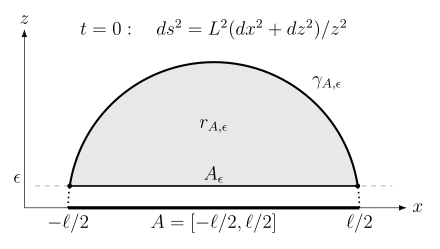
The regulated interval and geodesic bound the shaded homology region on a static vacuum AdS slice. The cutoff is exaggerated; coordinate shapes are exact, while proper distances use the hyperbolic metric. This is a spatial slice, not a spacetime diagram or a prescription for unconstrained Lorentzian minimization.
Homology, horizons, and phase changes
Section titled “Homology, horizons, and phase changes”Homology becomes visible in a thermal state. For a sufficiently large boundary region, the complement’s connected surface together with a horizon section can be homologous to . Comparing that disconnected candidate with the connected branch produces an entropy transition; taking to the entire boundary leaves the horizon area and recovers the Bekenstein–Hawking entropy. A surface anchored correctly but omitting the required horizon component fails the homology hypothesis and gives the wrong thermal limit.
Causal placement is equally consequential. Under the maximin assumptions, lies outside the causal influence of the boundary domains that would contradict entropy causality. This does not mean that every extremal surface in a time-dependent spacetime is acceptable. Complex extrema, surfaces on the wrong homology class, and extrema passing through singular regions outside the theorem’s domain must be separately rejected.
The area statement is only the leading term. Bulk entanglement and gravitational loop terms enter at order and are developed on Bulk Entanglement and Quantum Corrections. Higher-curvature gravity replaces area by the appropriate entropy functional. A violation of classical focusing also blocks a direct use of the classical maximin proof; quantum extremal-surface methods require a different generalized-entropy analysis.
Exercises
Section titled “Exercises”Show the interval normalization. Parametrize the upper semicircle by , , impose , and recover the logarithmic term in its length.
Solution
On the curve, , so the induced line element is . The cutoff occurs at and symmetrically at . Integrating gives . Expanding the cotangent for small cutoff produces plus terms suppressed by . The factor of two comes from the two symmetric halves of the geodesic, and the logarithm records the asymptotic boundary divergence. Dividing by and substituting therefore yields the required coefficient . This comparison checks both the gravitational normalization and the regulator dependence; changing only one side’s cutoff would spoil it.
References
Section titled “References”- Hubeny, Veronika E., Mukund Rangamani, and Tadashi Takayanagi. “A Covariant Holographic Entanglement Entropy Proposal.” Journal of High Energy Physics 07 (2007): 062. DOI. Open PDF.
- Lewkowycz, Aitor, and Juan Maldacena. “Generalized Gravitational Entropy.” Journal of High Energy Physics 08 (2013): 090. DOI. Open PDF.
- Ryu, Shinsei, and Tadashi Takayanagi. “Holographic Derivation of Entanglement Entropy from the Anti-de Sitter Space/Conformal Field Theory Correspondence.” Physical Review Letters 96 (2006): 181602. DOI. Open PDF.
- Wall, Aron C. “Maximin Surfaces, and the Strong Subadditivity of the Covariant Holographic Entanglement Entropy.” Classical and Quantum Gravity 31 (2014): 225007. DOI. Open PDF.