Post-Newtonian Power Counting and Near-Zone Expansion
Scrollable formula. Use Left and Right arrow keys to reveal hidden content.
Scrollable table. Use Left and Right arrow keys to reveal additional columns.
Scrollable figure. Use Left and Right arrow keys to inspect hidden content.
The post-Newtonian (PN) approximation turns the two-body problem into a hierarchy ordered by slow orbital motion and weak interaction between the bodies. Its control parameter is not merely “a small metric perturbation”: for a bound, self-gravitating binary, the virial relation ties powers of the potential to powers of the velocity. That connection, together with the separation between orbital and radiation wavelengths, explains both the usefulness of PN calculations and their sharply defined limits.
Required background. Weak Metric Perturbations and Gauge Freedom supplies linearized fields and gauge transformations; Presymplectic Potentials and Currents supplies the variational language used to compare reduced actions. Helpful background. The Einstein Equation supplies the nonlinear field equations; Gravitational Radiation and Waveforms supplies wave-zone boundary conditions and flux language.
The post-Newtonian hierarchy
Section titled “The post-Newtonian hierarchy”For counting purposes only, restore the speed of light , while retaining . Let
Here is a characteristic orbital separation, a characteristic relative speed, and . A bound orbit obeys the Newtonian virial estimate . Consequently,
An PN correction is smaller than the Newtonian term by . Thus the Newtonian acceleration scales as , a 1PN correction as , and a conservative 4PN correction as . Odd half-integer orders require more care. The leading dissipative radiation-reaction force is 2.5PN, but conservative hereditary effects can also produce half-integral powers in appropriate gauge-invariant quantities at sufficiently high order. “Odd” therefore does not by itself mean “dissipative.”
The virial relation is an orbital statement, not an identity for every field configuration. Inside a compact body its internal potential may be order unity even while the interbody parameter is small. The effacement principle allows the external motion of sufficiently compact, nonspinning bodies to be organized in the interbody PN parameter; finite-size operators enter at their own parametrically determined orders. A systematic asymptotic formulation uses a one-parameter family of solutions rather than assigning smallness after the fact, as emphasized in Futamase and Itoh 2007, § 2.1, eqs. (3)–(4).
For circular motion it is advantageous to replace the coordinate-dependent by
At Newtonian order Kepler’s law gives . Beyond Newtonian order, depends on the coordinate definition of , whereas , constructed from the asymptotically measured orbital frequency and total mass, is invariant under ordinary near-zone coordinate changes. PN series for circular binding energy are therefore most cleanly presented as , not .
Orbital, near, and radiation scales
Section titled “Orbital, near, and radiation scales”Let denote the source’s orbital size and its dynamical time. The reduced radiation wavelength is
Three regions then have different expansions. The orbital region has distances of order . The near zone satisfies , so retardation across the field point can be expanded. The radiation zone has , where outgoing propagation and retarded time must remain intact. An overlap exists when ; it permits asymptotic matching of a near-zone PN solution to an exterior multipolar solution. The current all-orders construction and its overlap assumptions are stated in Blanchet 2024, §§ 2.2.1 and 2.3.1, especially eqs. (115) and (147)–(155).
This division is physical, not a choice to call one radius “near.” A PN coefficient obtained by expanding retardation generally grows with , so the expansion is not uniform at spatial infinity. It cannot impose a no-incoming-radiation condition by itself. Matching imports that global boundary condition without pretending that a near-zone series is valid in the wave zone.
The same scale separation appears naturally in effective field theory. Write for angular frequency and for spatial wave number, so both and have inverse-length units. Potential modes responsible for binding have
Radiation modes instead have . Potential modes are off shell: their frequency and wave number do not obey the wave dispersion relation. Radiation modes propagate on shell and belong to the long-distance theory. This mode split implements the near/radiation-zone distinction; it is not a second independent approximation. Its power counting is constructed explicitly in Goldberger and Rothstein 2006, § II C, eqs. (13)–(16).
The figure shows where both field descriptions can be used. Inspect the overlap between the source size and reduced wavelength: slow orbital motion is what makes that interval parametrically wide.
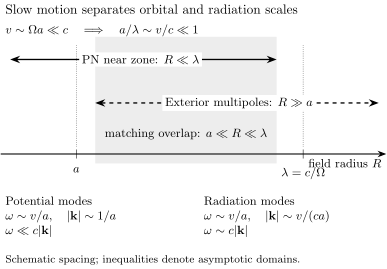
Slow motion separates the orbital source size from the reduced radiation wavelength , leaving a matching region for field radius . Here and the reduced wavelength omits the conventional factor . Potential modes vary slowly in time compared with their spatial scale, whereas radiation modes satisfy . The scale hierarchy is schematic and not to scale; the labeled zones have no sharp physical boundaries.
Expanding retardation without losing boundary data
Section titled “Expanding retardation without losing boundary data”In the near zone, a smooth source evaluated at retarded time admits the formal expansion
Equivalently, with , a time-symmetric inverse has the schematic series
Each pair of time derivatives costs , while each inverse Laplacian supplies ; their ratio is . This directly recovers PN counting. The symmetric propagator retains the conservative instantaneous sector. The retarded-minus-advanced part carries time-odd radiation reaction, while matching also generates time-symmetric hereditary terms. At 4PN the conservative dynamics contains a nonlocal tail produced by radiation scattered from the system’s monopolar curvature. It would be missed by treating every conservative term as an instantaneous Poisson potential.
The expansion also explains why infrared divergences can appear in individual near-zone Poisson integrals: gravity itself extends to infinity, while the expanded integrand is being used outside its region of uniform validity. Analytic finite parts and near/far matching remove the artificial overlap dependence in physical results. Ultraviolet singularities at particle locations are a different issue, treated on Regularization of Point-Particle Singularities.
PN order is not weak-field order
Section titled “PN order is not weak-field order”PN and post-Minkowskian (PM) expansions answer different questions. PN expands in and, for bound motion, simultaneously in . PM expands in at unrestricted velocity. A term such as has a definite power in each organization, but the two series group infinitely many terms differently. The PM expansion is therefore especially natural for relativistic scattering, while PN is efficient for slowly moving bound systems. Neither label alone specifies mass ratio, spin counting, eccentricity, or finite-size order.
Weak interbody gravity likewise does not require weak internal gravity. Black holes can be represented by worldlines because their radii are much smaller than , not because the field at each horizon is perturbatively small. What must remain small for the orbital PN expansion is the interbody scale , together with velocities and multipolar size ratios appropriate to the claimed truncation.
Checks and breakdown criteria
Section titled “Checks and breakdown criteria”Three checks should accompany any power count. First, dimensions must be restored consistently: every logarithm has a dimensionless argument, and each term in an acceleration has units of length per time squared. Second, the test-mass limit must agree with the expansion of geodesic invariants in Schwarzschild or Kerr spacetime. Third, gauge scales and regularization scales must cancel from an invariant such as , periastron advance, redshift, or scattering angle.
The approximation deteriorates when ceases to be small, but there is no universal numerical cutoff. Eccentric motion can have small orbit-averaged and relativistic pericenter speed; large aligned or antialigned spins introduce additional scales; resonances and hereditary integrals can spoil a naive local estimate; and a finite-order series can show accidental cancellation. Near merger, numerical relativity or a cross-regime model is needed. The PN series remains valuable there as input and as a weak-field constraint, not as a stand-alone error certificate. The practical reliability question is developed on PN Convergence, Resummation, and Error Estimates.
Exercise
Section titled “Exercise”For a circular binary, use Newtonian balance to determine the PN size of the first retardation correction relative to the instantaneous potential. Then explain why this does not make the leading radiation-reaction force a 1PN effect.
Solution
On a source varying over , the correction-to-leading ratio is
so the first even, time-symmetric retardation correction is 1PN. Radiation reaction depends instead on the time-antisymmetric part of the retarded solution and on the first radiative multipole allowed by conservation laws. For gravity that is the mass quadrupole. Its flux scales as , and energy balance gives a reaction acceleration smaller than by , namely 2.5PN. The power count of an individual symmetric propagator correction does not determine the order at which an outgoing flux can carry conserved energy away.
References
Section titled “References”- Blanchet, Luc. 2024. “Post-Newtonian Theory for Gravitational Waves.” Living Reviews in Relativity 27, 4. DOI.
- Futamase, Toshifumi, and Yousuke Itoh. 2007. “The Post-Newtonian Approximation for Relativistic Compact Binaries.” Living Reviews in Relativity 10, 2. DOI.
- Goldberger, Walter D., and Ira Z. Rothstein. 2006. “An Effective Field Theory of Gravity for Extended Objects.” Physical Review D 73, 104029. DOI.