Transient Orbital Resonances
Scrollable formula. Use Left and Right arrow keys to reveal hidden content.
Scrollable table. Use Left and Right arrow keys to reveal additional columns.
Scrollable figure. Use Left and Right arrow keys to inspect hidden content.
Ordinary adiabatic evolution averages the self-force over independent radial and polar phases. That average fails at an isolated commensurability because one Fourier phase stops oscillating and acts coherently over many orbital cycles. The resulting transient resonance gives a phase-dependent jump in the slow orbital actions and can alter the later waveform even though the resonance interval is short compared with the full inspiral.
Helpful background. The Einstein Equation fixes the background, Weak Metric Perturbations and Gauge Freedom supplies gauge control, and Presymplectic Potentials and Currents clarifies conserved actions. Black-Hole Perturbation Theory supplies self-force modes, Relativistic Two-Body Dynamics supplies multiscale logic, and Gravitational Radiation and Waveforms supplies phase and validation conventions.
The harmonic that averaging misses
Section titled “The harmonic that averaging misses”Let the slow actions obey
where the Kerr black hole has physical mass , the secondary has mass , and . Normalize the specific actions by so that is dimensionless; the coefficients then have dimension inverse time and scale as . The phases and frequencies use asymptotically normalized coordinate time. Away from resonance, each retained nonzero harmonic with oscillates rapidly and contributes only a bounded correction; the torus average retains .
At time suppose
for relatively prime integers . Define the resonant phase
Near the crossing,
Since the actions drift at , in dimensional units. The resonant phase changes by order unity over
intermediate between the orbital and radiation-reaction times.
Stationary-phase jump
Section titled “Stationary-phase jump”Define the jump relative to the smooth adiabatic drift: the ordinary evolution continues through the resonance and is subtracted before comparing the two outer solutions. Keep a nonzero resonant harmonic and freeze its amplitude across the narrow layer. To first order in the resonant Fourier amplitudes, evaluate the phase on the adiabatic crossing. Integrating from before to after the resonance gives
Stationary phase yields
The physical jump is real: real forcing obeys , so add the and terms, or twice the real part of each positive- term. Because , the jump scales as
relative to dimensionless orbital actions. It depends on the radial–polar phase at entry. A phase-averaged flux table cannot recover that dependence after the fact.
The asymptotic mechanism and its phase scaling are derived in Flanagan and Hinderer 2012, p. 4, “Analytic Derivation” and the jump formula following eq. (4). The formula assumes a simple crossing with , slowly varying mode amplitudes, and sufficient separation from another resonance or the plunge transition. Its Fresnel coefficient additionally neglects feedback of the resonant action change on the detuning. That feedback can enter the leading inner problem if the resonant harmonics are not weak; small mass ratio alone does not justify linearizing in their amplitudes.
For a single real harmonic with , write , where excludes the smooth drift and . With , the entire smooth crossing is
Its final value is . Entry phases and therefore give equal and opposite changes, while the underlying worldline remains continuous. A generic frequency shift of order acting for the remaining inspiral can accumulate radians; the coefficient and remaining duration determine the actual dephasing.
In the figure, compare the continuous accumulated corrections for the two entry phases. The detuning passes through zero in the same way, but the force reverses sign and produces the opposite lasting change.
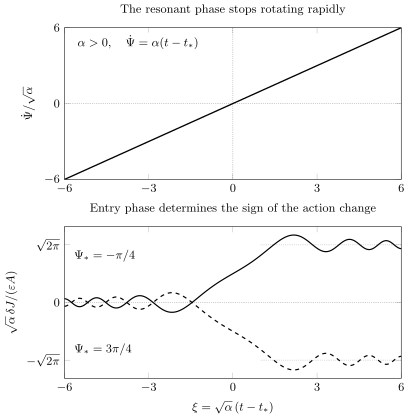
A single-harmonic resonance crossing with and . The lower panel shows after the smooth averaged drift has been removed. Entry phases and approach and , respectively. These curves solve the linearized normal form above; they are not Kerr self-force data or a self-consistent resonance calculation.
Competing modeling positions as of 2026-08-12
Section titled “Competing modeling positions as of 2026-08-12”Evidence and literature on this page are checked through 2026-08-12. Three defensible positions remain:
- Leading jump corrections are an adequate targeted extension. Compute the resonant Fourier coefficients, propagate an adiabatic inspiral to the crossing, apply the stationary-phase jump, and restart the adiabatic evolution. This retains the leading action change at modest cost.
- First-post-adiabatic phase-sensitive evolution is required. The entry phase itself receives conservative, oscillatory, and higher-order corrections. If the target is an accurate waveform rather than population statistics, a leading jump on an otherwise adiabatic trajectory can carry an uncontrolled phase error.
- Self-consistent or uniformly matched resonance evolution is needed for validation. Integrating the local force through the layer avoids an instantaneous jump idealization and is the appropriate benchmark, especially for overlapping strong-field effects.
These are not mutually exclusive numerical algorithms; they assert different accuracy requirements. Studies of representative populations have also found that resonance-induced loss of matched-filter signal can be small for many low-eccentricity systems even when the dynamical jump exists Berry et al. 2016, §§III–V. That empirical conclusion does not remove the effect from high-accuracy parameter inference or from more eccentric and inclined configurations.
What is established and what remains uncertain
Section titled “What is established and what remains uncertain”Established features include the commensurability condition, the failure of nonresonant torus averaging, the leading jump scaling for a simple crossing, and dependence on the resonant entry phase. Quantitative uncertainties include:
- generic-Kerr self-force Fourier coefficients in consistent gauges;
- the entry phase after first-post-adiabatic evolution;
- second-order and spin effects within the resonance layer;
- interference with the separatrix or another low-order resonance;
- waveform and parameter biases across mission-relevant source populations.
A model should recover ordinary adiabatic scaling when . It should also agree with a direct phase-sensitive integration through a test resonance and converge as the matching interval is varied.
This assessment should be revisited when a second-order or self-consistent generic-Kerr resonance waveform demonstrates a controlled phase error and is independently reproduced, or when a blind cross-model study changes the inferred accuracy requirement. Results published after the cutoff are outside this page’s evidence window.
The strongest practical test uses identical orbital data and force modes in two implementations: one integrates the phase-sensitive equations continuously and the other applies a matched jump. Agreement must cover the post-resonance actions and accumulated phase, not merely the resonance location. Varying the matching-window width should expose the next neglected asymptotic order rather than move the physical prediction arbitrarily.
Exercises
Section titled “Exercises”Evaluate the stationary-phase integral and recover the resonance-width and action-jump scalings.
Solution
For real nonzero ,
The phase changes by order unity when , so
Multiplying the integral by the force gives .
Why does averaging uniformly over the entry phase erase the mean leading jump without proving that the resonance is negligible?
Solution
Each resonant contribution contains , whose uniform phase average vanishes for . Individual systems nevertheless have definite entry phases and nonzero jumps, with a nonzero variance. The later waveform depends on that realized jump, so a vanishing ensemble mean is not an error bound for one source.
References
Section titled “References”- Berry, Christopher P. L., Robert H. Cole, Priscilla Cañizares, and Jonathan R. Gair. “Importance of Transient Resonances in Extreme-Mass-Ratio Inspirals.” Physical Review D 94 (2016): 124042. DOI.
- Flanagan, Éanna É., and Tanja Hinderer. “Transient Resonances in the Inspirals of Point Particles into Black Holes.” Physical Review Letters 109 (2012): 071102. DOI.