Black Holes Beyond Asymptotic Flatness
Scrollable formula. Use Left and Right arrow keys to reveal hidden content.
Scrollable table. Use Left and Right arrow keys to reveal additional columns.
Scrollable figure. Use Left and Right arrow keys to inspect hidden content.
Future null infinity is the natural receiver for outgoing signals in an asymptotically flat spacetime, but it is not available in every geometry. The right generalization is therefore not a new universal surface called “the” infinity. One must specify a future receiver set appropriate to the asymptotics—spacelike conformal infinity in a cosmology, the timelike boundary of anti-de Sitter spacetime, or a future-complete worldtube—and define the inaccessible region relative to that set. This receiver-relative formulation separates genuine black-hole boundaries from observer horizons and finite-time causal shadows.
Helpful background. Exact Solutions of Einstein’s Equations supplies the named de Sitter and anti-de Sitter examples; Causality and Global Structure supplies conformal completions and causal pasts; The Einstein Equation fixes the classical spacetime dynamics; Hypersurface Normals and Tangential Projectors supplies the geometry of null and timelike boundaries.
A black-hole region relative to a receiver
Section titled “A black-hole region relative to a receiver”Let the physical spacetime admit a suitable conformal completion, and let be a specified set of ideal or physical receivers to the future. A future-directed causal signal “escapes” when its curve has an endpoint on . The receiver-relative inaccessible region and its boundary are
The boundary is taken in the physical spacetime. This formula is useful only after three choices are made explicit: which connected asymptotic end is being used, how far into the future the receiver persists, and which causal completion makes endpoints meaningful. In the asymptotically flat case, recovers the standard black-hole region. Booth formulates this event-horizon construction and contrasts it with locally defined boundaries in Booth 2005, §2.1, pp. 1075–1079.
Receiver dependence is physical, not a defect. A two-ended eternal black-hole geometry may allow a signal to reach one exterior but not another. Likewise, an accelerated observer can fail to receive signals that another observer does receive. The notation prevents those distinct questions from being silently identified.
The two exact reference backgrounds below make the receiver choice visible. Inspect the spacelike future boundary and internal observer horizons in the de Sitter panel, then compare them with the single timelike boundary of the universal-cover anti-de Sitter panel. These are pure constant-curvature backgrounds, not diagrams of Schwarzschild–de Sitter or Schwarzschild–anti-de Sitter black holes.
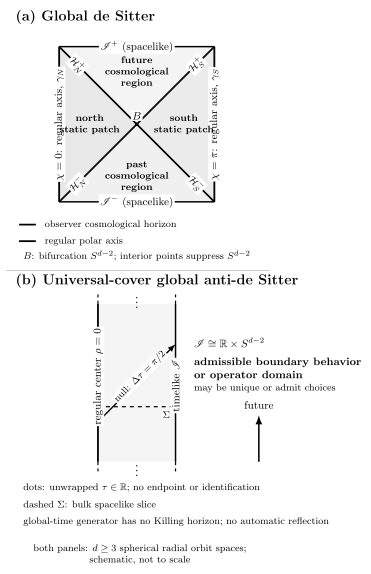
The causal receiver is part of the definition. In exact global de Sitter, is spacelike and an observer’s null cosmological horizon lies inside the spacetime. In universal-cover global anti-de Sitter, is timelike, so it can receive signals but a global field evolution also needs an admissible operator domain or boundary behavior. Changing that field choice on the fixed AdS metric does not change its null cones. Future points upward; both spherical radial diagrams are schematic and not to scale, and neither panel contains a black hole.
Spacelike infinity in de Sitter settings
Section titled “Spacelike infinity in de Sitter settings”In an asymptotically de Sitter spacetime, future conformal infinity is spacelike rather than null. One can nevertheless set , or choose one of its relevant components when the global completion has several asymptotic regions. Then contains events from which no future-directed causal curve reaches that future boundary.
Pure de Sitter spacetime is an essential check. Every physical event can send some future-directed causal curve to the complete spacelike future boundary, so the black-hole region relative to all of is empty. A geodesic observer still has a cosmological horizon: it is the boundary of the causal past of that observer’s future endpoint, not the boundary of the past of all future infinity. Thus “has an observer horizon” does not imply “has a global black-hole region.”
Schwarzschild–de Sitter supplies the discriminating case. Events beyond the black-hole horizon end at the black-hole singularity rather than at the chosen asymptotic component, while the cosmological horizon limits what a particular static observer can exchange with the rest of the exterior. The two null hypersurfaces can both appear in one static chart, but they answer different receiver questions. Their coincidence in a degenerate parameter limit does not erase that distinction.
The timelike boundary of anti-de Sitter spacetime
Section titled “The timelike boundary of anti-de Sitter spacetime”Anti-de Sitter asymptotics replace future null infinity by a timelike conformal boundary . The geometric black-hole region is commonly defined by
where reaching means reaching the selected asymptotic boundary in the future direction. Pure anti-de Sitter spacetime again gives an empty black-hole region: light can reach the boundary in finite conformal time. Schwarzschild–AdS instead has an interior from which no causal curve reaches that boundary.
The timelike character of adds a second issue that must not be folded into the causal definition. Anti-de Sitter spacetime is not globally hyperbolic, so initial data on a spacelike slice do not by themselves specify unique field evolution. Boundary conditions determine how field data behave at and whether flux is reflected, transmitted in an enlarged system, or otherwise controlled. Ishibashi and Wald develop the admissible dynamics through positive self-adjoint extensions in Ishibashi and Wald 2004, arXiv v4, §1, pp. 2–3, and §3, pp. 24–38.
This dynamical choice does not rewrite which curves are causal for a fixed metric. It completes the physical initial–boundary-value problem. Any claim about signals returning from the AdS boundary must therefore state the field boundary condition, whereas the set is determined by the spacetime causal structure and the chosen boundary component.
Finite boundaries and causal shadows
Section titled “Finite boundaries and causal shadows”A laboratory, numerical outer boundary, or timelike screen can also serve as a receiver. If the relevant portion persists through the entire future under consideration, then is a meaningful receiver-relative inaccessible region. It need not coincide with an event horizon defined by an asymptotic end.
The duration matters. Suppose a detector on is switched off at time . Events whose first signal arrives after lie outside , even in Minkowski spacetime. The boundary of that set is a finite-time causal shadow, not evidence for a black hole. Calling it a horizon is justified only with a stated receiver and time domain; calling it an event horizon requires the appropriate future-complete asymptotic construction.
The comparison can be summarized without treating the receiver as arbitrary:
| Setting | Receiver set | Result tested | Essential caution |
|---|---|---|---|
| Asymptotically flat | Future null infinity | Standard event horizon | Choose the asymptotic end |
| Asymptotically de Sitter | Spacelike future infinity | Global black-hole region | Distinguish observer cosmological horizons |
| Asymptotically AdS | Timelike conformal boundary | Boundary-relative black-hole region | State field boundary conditions separately |
| Finite enclosure | Future portion of a worldtube | Operational inaccessible region | A finite-time shadow is not an event horizon |
Check four limiting cases
Section titled “Check four limiting cases”For each spacetime, decide whether the indicated region is empty and explain which receiver is being used: pure de Sitter relative to all of ; pure de Sitter relative to one inertial observer’s future endpoint; pure AdS relative to its timelike boundary; and Schwarzschild–AdS relative to the same boundary.
Solution
Pure de Sitter has no black-hole region relative to the complete spacelike , because each event has a future-directed causal route to some point of that boundary. Relative to one observer’s future endpoint, however, the complement of the endpoint’s causal past is nonempty and is bounded by the observer’s cosmological horizon. Pure AdS has no black-hole region relative to its full timelike boundary because causal signals can reach it. Schwarzschild–AdS has a nonempty interior that cannot communicate with that boundary. The four answers differ because both the geometry and the receiver set differ; none can be inferred merely from the word “horizon.”
Horizons, Trapped Surfaces, and Singularities next separates several geometric and causal notions that are also often conflated.