Horizons, Trapped Surfaces, and Singularities
Scrollable formula. Use Left and Right arrow keys to reveal hidden content.
Scrollable table. Use Left and Right arrow keys to reveal additional columns.
Scrollable figure. Use Left and Right arrow keys to inspect hidden content.
An event horizon, a trapped surface, geodesic incompleteness, and curvature blow-up are four different statements. They often occur together in exact black-hole solutions, which makes their logical separation easy to miss. The Penrose theorem supplies one precise implication—from a closed trapped surface, with global and energy hypotheses, to future null geodesic incompleteness—but neither an event horizon nor divergent curvature is its conclusion. Keeping the definitions separate prevents an exact-solution picture from being mistaken for a general theorem.
Helpful background. Exact Solutions of Einstein’s Equations supplies examples that test failed converses; Causality and Global Structure supplies completeness and achronal boundaries; The Einstein Equation relates energy to null convergence; Hypersurface Normals and Tangential Projectors supplies the two null normals of a spacelike two-surface.
Four geometrically distinct statements
Section titled “Four geometrically distinct statements”In an asymptotically flat spacetime, the black-hole region is and its event horizon is . These are global causal sets. Their definition asks whether signals can escape through the entire future, not how large curvature is or how a chosen two-surface initially changes area.
Let instead be a compact spacelike codimension-two surface, with future outgoing and ingoing null normals and . For induced metric , define
A future trapped surface has both expansions strictly negative everywhere. A marginally outer trapped surface has ; a black-hole interpretation usually also assumes and specifies what “outward” means. These are properties of and its normal geometry. Under a positive boost , , expansion values rescale but their signs and zeros do not. A comparative account of trapped, marginal, and horizon boundaries is given in Booth 2005, §2.2, pp. 1078–1081.
The comparison below fixes a convenient normalization in its flat-space benchmark: identify with and with . The exact values and then apply only to a round sphere in Minkowski spacetime. Their opposite signs are the ordinary pattern; the lower panel changes the geometry so that both future expansions are negative.
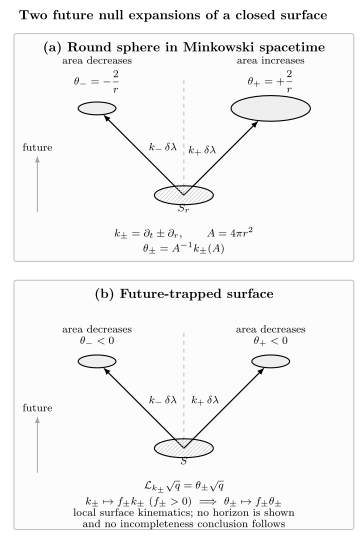
Two future null deformations need not change area in opposite ways. For a round Minkowski sphere with , the exact expansions are and . A future trapped surface has both expansions negative. Positive future-preserving rescalings change their magnitudes but not these signs. The lower panel states local kinematics only: it neither identifies an event horizon nor proves geodesic incompleteness. Normal-plane projection; surface sizes are schematic and not to scale.
A spacetime is null geodesically incomplete when at least one inextendible null geodesic has only a finite affine-parameter range. This definition does not insert a missing endpoint into the manifold or state what happens there. Finally, a curvature singularity is informal until one names an invariant and a limiting process—for example, divergence of along an incomplete curve. Curvature blow-up can establish an obstruction to a sufficiently regular extension, but incompleteness alone does not imply it: removing an ordinary point from Minkowski spacetime creates incomplete geodesics while curvature remains zero.
The precise trapped-surface implication
Section titled “The precise trapped-surface implication”A useful smooth form of the Penrose theorem assumes a connected, time-oriented spacetime of dimension at least three, without boundary, with a noncompact Cauchy hypersurface. It also assumes the null convergence condition
for every null vector , and a closed, achronal, future trapped surface. The conclusion is that the spacetime is future null geodesically incomplete. The original compactness argument is in Penrose 1965, pp. 57–59; a modern statement with the regularity and dimensional hypotheses made explicit appears in Steinbauer 2023, §2.1, p. 75, and §3.5, Theorem 3.9 and proof, p. 88.
The proof has three parts. First, Raychaudhuri’s equation and null convergence force each initially converging orthogonal null congruence to acquire a focal point within a uniform finite affine interval. Compactness of the trapped surface makes the bound uniform. Second, if all future null generators were complete, only the compact initial portions before those focal points could generate the future achronal boundary of the surface. That boundary would be compact. Third, global hyperbolicity lets one project this compact achronal boundary along a timelike flow onto a Cauchy hypersurface. The image is both open and closed and hence covers the connected Cauchy surface, contradicting its noncompactness. Thus some future null generator is incomplete.
The full theorem and proof architecture belong to Global Structure. What matters here is the exact endpoint of the argument. It proves the existence of an incomplete null geodesic. It does not prove that every causal geodesic is incomplete, that a scalar diverges, that the spacetime is inextendible in a named regularity class, or that the incompleteness is hidden behind an event horizon.
Why the familiar converses fail
Section titled “Why the familiar converses fail”The safest way to remember the logical structure is to test geometries in which the notions separate.
| Given feature | What follows without added hypotheses? | Separating example or reason |
|---|---|---|
| Event horizon | Neither trapped surface nor curvature blow-up by definition | The horizon can pass through a locally flat region before a collapsing shell arrives |
| Closed trapped surface | A focusing tendency, not incompleteness by itself | Global de Sitter has compact Cauchy slices, so the noncompactness contradiction is unavailable |
| Null incompleteness | Neither divergent curvature nor a black-hole region | Minkowski spacetime with one regular point excised has zero curvature |
| Curvature blow-up | No guarantee of an event horizon | A naked singular solution can expose large curvature to the asymptotic region |
The de Sitter check shows why theorem hypotheses are operative rather than decorative. In a contracting portion of global de Sitter spacetime, suitable compact spheres can be future trapped and null convergence is saturated, yet the spacetime is null complete. Its Cauchy surfaces are compact, so the final topological contradiction in Penrose’s proof does not occur.
The collapse check separates event horizons from trapped surfaces in the other direction. A globally selected event horizon can begin in a regular, locally flat portion before any trapped round sphere forms. Later, trapped surfaces may appear inside it. The horizon is located by future escape; the surface is classified by two local expansion signs.
What exact black-hole solutions add
Section titled “What exact black-hole solutions add”In Schwarzschild spacetime, round spheres inside are future trapped, the vacuum equation saturates null convergence, incomplete causal geodesics occur, and the Kretschmann scalar diverges as . The exact metric also shows that the future incomplete region is hidden behind the event horizon. Those facts jointly support the standard diagram, but they come from a theorem plus additional solution-specific calculations.
The same distinction governs dynamical work. A numerical slice can locate a marginally outer trapped surface without knowing the full future required for an event horizon. A singularity theorem can then diagnose incompleteness only if its causal, energy, compactness, and trappedness assumptions are justified. Cosmic censorship would add a statement about visibility, but it is a separate conjectural layer, not an unspoken clause of the Penrose theorem.
For exact definitions and sign checks, see Trapped and Marginal Surfaces. That page also explains why an apparent horizon is foliation-dependent while the trappedness of a specified geometric surface is not.
Diagnose the invalid inference
Section titled “Diagnose the invalid inference”A simulation finds a closed surface with both future null expansions negative on one time slice. A report concludes: “A curvature singularity has already formed, and an event horizon encloses it.” Identify what is established and what additional reasoning each conclusion requires.
Solution
The calculation establishes that the specified surface is future trapped, provided it is compact without boundary, the null normals are consistently future directed, and the inequalities hold everywhere. With a noncompact Cauchy surface, global hyperbolicity, null convergence, and the other smooth Penrose hypotheses, it implies future null geodesic incompleteness. Curvature blow-up requires a separate invariant estimate or an inextendibility theorem; geodesic incompleteness alone is insufficient. An event horizon requires the global causal past of the chosen future asymptotic receiver, and its enclosure or visibility properties require control of the full future development. Neither follows from data on the one slice alone.
Choosing a Black-Hole Definition now turns these distinctions into a practical selection procedure.
References
Section titled “References”- Booth, Ivan. “Black-Hole Boundaries.” Canadian Journal of Physics 83 (2005): 1073–1099. DOI.
- Penrose, Roger. “Gravitational Collapse and Space-Time Singularities.” Physical Review Letters 14 (1965): 57–59. DOI.
- Steinbauer, Roland. “The Singularity Theorems of General Relativity and Their Low Regularity Extensions.” Jahresbericht der Deutschen Mathematiker-Vereinigung 125 (2023): 73–119. DOI.