Why Event Horizons Are Global
Scrollable formula. Use Left and Right arrow keys to reveal hidden content.
Scrollable table. Use Left and Right arrow keys to reveal additional columns.
Scrollable figure. Use Left and Right arrow keys to inspect hidden content.
An event horizon is global because deciding whether an event lies on it requires knowing which future-directed causal curves ultimately reach the chosen future boundary. No finite time interval, local curvature measurement, or single Cauchy slice generally settles that question. This dependence is not an acausal force acting backward in time; it is a feature of how a boundary is selected from the completed spacetime. Once selected, the horizon is an ordinary null hypersurface with local geometry.
Helpful background. Exact Solutions of Einstein’s Equations supplies the eternal and collapse examples; Causality and Global Structure supplies achronal boundaries; The Einstein Equation supplies the dynamics used in focusing statements; Hypersurface Normals and Tangential Projectors supplies the comparison with slice-based horizons.
A quantifier over the complete future
Section titled “A quantifier over the complete future”For a chosen asymptotically flat end,
The causal past contains a point if there exists at least one future-directed causal curve from that reaches . The word “reaches” quantifies over the curve’s entire future. A null ray may initially move outward and still fail to escape because later geometry turns or traps it. Conversely, a ray that looks temporarily confined may reach the boundary after the exterior changes. The horizon separates these two global outcomes.
This explains why snapshots are insufficient. Initial data on a complete Cauchy surface determine a maximal development when the field equations are well posed, but the event horizon is identified only after that development is known. A numerical code can evolve marginal surfaces during a simulation; locating the event horizon is normally a post-processing problem in which candidate null generators are integrated backward from the late-time exterior. Booth makes this global-versus-quasi-local distinction explicit in Booth 2005, §2.1 and §3, pp. 1075–1085.
Collapse selects the boundary backward
Section titled “Collapse selects the boundary backward”Consider an ideal spherical null shell at advanced time . A compact way to write its flat interior and Schwarzschild exterior is
The jump idealizes the shell’s distributional stress tensor. Away from it, outgoing radial null curves obey
After the shell, the critical outgoing curve is the Schwarzschild horizon . Continuity of the areal radius makes it meet the shell at . Before the shell, , so tracing this same generator backward gives
and hence a regular-center vertex at . Equivalently, with and ,
This matching and vertex time agree with the independent null-shell construction in Siahmazgi et al. 2021, §2 and with the exact causal treatment on Event Horizons as Global Boundaries.
The figure shows what the matching constant means. Inspect the heavy critical ray in the flat region and compare it with the neighboring outgoing rays that meet the shell just outside or just inside .
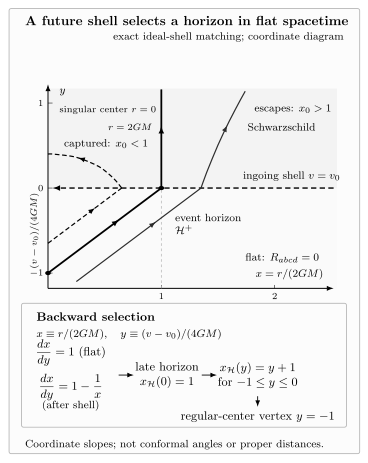
An ideal ingoing null shell at separates a flat region from a Schwarzschild region of mass . Backward matching the late horizon selects in the flat region, so the horizon begins at even though there. Outgoing rays meeting the shell at escape, whereas those meeting it at are captured. The neighboring curves are sampled from the exact radial null equations of this step-shell model; their Euclidean angles and separations are advanced-coordinate features, not conformal angles or proper distances.
Thus a portion of the event horizon lies in a region with zero Riemann tensor. Nothing local in that region announces “horizon.” The future collapse selects one otherwise ordinary outgoing Minkowski ray as the boundary between escape and capture. The construction is often called teleological because the final escape condition selects the earlier boundary. More precisely, the event horizon is a final-boundary-defined geometric object, not a surface driven backward by a local influence.
If the shell reverses course before forming a black hole, the same early flat region contains no event horizon. The local metric can therefore agree in two spacetimes while horizon membership differs. The next page turns this observation into a systematic test of local detectability.
Local geometry after global selection
Section titled “Local geometry after global selection”Global definition does not mean that every property of the horizon is nonlocal. Once has been identified, one can compute its induced degenerate metric, null generator field, expansion, shear, and connection from local spacetime geometry. Where the boundary is smooth it is generated by null geodesics. These generators can enter the horizon at past endpoints or crease sets, but under the usual regularity assumptions they do not leave it toward the future through an ordinary point: leaving would contradict the achronal boundary between escaping and nonescaping events.
The distinction is methodological:
- deciding which null hypersurface is the event horizon is global;
- evaluating geometric fields on that chosen hypersurface is local;
- proving monotonicity or completeness combines the local Raychaudhuri equation with global and energy hypotheses.
Conflating these steps makes local differential identities look as though they could locate the event horizon. They cannot do so without boundary data.
Why the horizon can anticipate infall
Section titled “Why the horizon can anticipate infall”Suppose additional positive energy falls into an already stationary black hole. The final horizon has a larger area. Tracing its generators backward shows that the event horizon begins expanding before the stress-energy crosses it. This statement does not allow an observer to receive information from the future. The observer cannot identify the event horizon locally and use its expansion as a signal; identifying that surface already presupposes knowledge of the future solution.
The familiar event-horizon area theorem is compatible with this behavior. It is a global theorem about the correctly selected causal boundary under null convergence and predictability assumptions. Quasi-local horizons instead admit flux laws tied more directly to matter and gravitational radiation at the surface. Ashtekar and Krishnan compare these uses in Ashtekar and Krishnan 2025, §§1–2. Neither framework is a universal replacement for the other: event horizons organize causal escape, while quasi-local horizons organize finite-time geometry and dynamics.
Consequences for calculation and interpretation
Section titled “Consequences for calculation and interpretation”Three practical rules follow.
First, an event horizon shown in a completed analytic spacetime is an exact object, but in a finite-duration numerical evolution its location may carry a future-boundary uncertainty. One must state how the late-time surface was chosen and how far backward the generator integration is reliable.
Second, a locally found marginal surface should not be relabeled an event horizon merely because the two coincide in stationary Schwarzschild. During accretion or merger they can be separated, and marginal surfaces can depend on the slicing.
Third, causal language should be relative to an asymptotic region. In a multi-ended spacetime, a point may escape to one infinity and fail to escape to another. In anti-de Sitter, the selected timelike-boundary component is part of the geometric causal question; boundary conditions for matter fields are additional data for deciding what happens after a field reaches that boundary. Global does not mean context free.
Check the two-stage reasoning
Section titled “Check the two-stage reasoning”A simulation supplies the metric and stress-energy accurately up to time , and no marginally trapped surface has appeared by then. Can one conclude that the region evolved before contains no event horizon?
Solution
No. A later collapse can select an event horizon whose generators extend into the already evolved region, just as in the null-shell example. The absence of a marginal surface by is valuable quasi-local information, but it does not answer the future escape question. A conclusion about the event horizon requires either the complete future development or additional hypotheses that control it. Conversely, the later appearance of an event horizon does not retroactively produce a locally detectable field in the earlier region.
Teleology and Local Undetectability next constructs locally identical neighborhoods with different global horizon membership and separates invariants from boundary-dependent labels.
References
Section titled “References”- Ashtekar, Abhay, and Badri Krishnan. “Quasi-Local Black Hole Horizons: Recent Advances.” Living Reviews in Relativity 28 (2025): article 8. DOI.
- Booth, Ivan. “Black-Hole Boundaries.” Canadian Journal of Physics 83 (2005): 1073–1099. DOI.
- Siahmazgi, Shohreh Gholizadeh, Paul R. Anderson, Raymond D. Clark, and Alessandro Fabbri. “Stress-Energy Tensor for a Quantized Scalar Field in a Four-Dimensional Black Hole Spacetime That Forms from the Collapse of a Null Shell.” arXiv:2111.14764 [gr-qc] (2021). arXiv.