Light Deflection and Shapiro Delay
Scrollable formula. Use Left and Right arrow keys to reveal hidden content.
Scrollable table. Use Left and Right arrow keys to reveal additional columns.
Scrollable figure. Use Left and Right arrow keys to inspect hidden content.
Light deflection and Shapiro delay are two consequences of the same weak, static null geometry. The time-time perturbation changes coordinate propagation, while the spatial perturbation changes the relation between local and asymptotic straight lines. Keeping both contributions gives the general-relativistic bending and a positive logarithmic propagation delay; retaining only Newtonian time dilation gives exactly half the bending.
Required background. We use The Einstein Equation to fix the weak exterior metric, Events, Intervals, and Minkowski Geometry for the undeflected null path and asymptotic angle, and The Newtonian Gravitational Field and Potential for the monopole potential.
Helpful background. Tensor Fields and Natural Operations clarifies coordinate versus measured quantities, Affine and Variational Geodesics supplies null geodesics and the impact parameter, and The Wave Equation and Characteristics supplies the geometric-optics regime.
The weak static optical metric
Section titled “The weak static optical metric”Write outside a spherical source. In isotropic weak-field coordinates, a useful one-parameter metric is
The parameter labels the leading spatial-curvature contribution; general relativity has . Here it is not a Lorentz factor. The calculation assumes a static monopole, endpoints in the weak exterior, geometric optics, and an unperturbed impact parameter satisfying
Source motion and multipoles, plasma dispersion, finite wavelength, strong lensing, and terms of order are excluded. For a null path with Euclidean line element , the metric gives
Thus the effective refractive index is . The coefficient separates cleanly into a temporal part and a spatial-curvature part .
The two panels below separate the geometries used in the next calculations. In the upper panel compare ray directions; in the lower panel follow the fixed straight segment on which the first-order time correction is evaluated.
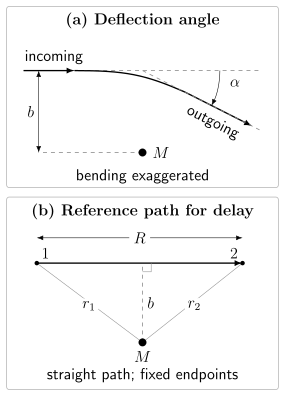
Bending compares incoming and outgoing directions at infinity; is measured from the mass to the undeflected incoming line. The leading one-way Shapiro delay instead integrates along the straight reference segment between fixed endpoints, whose source radii are and and separation is . The lower panel places closest approach within that segment. Weak static exterior geometry; schematic and not to scale, with bending exaggerated.
Deflection at fixed impact parameter
Section titled “Deflection at fixed impact parameter”Choose the zeroth-order ray along the direction with closest approach in the transverse plane, so . To first order, Fermat’s principle or the transverse null-geodesic equation gives the change of direction toward the source,
Its magnitude is
Therefore general relativity predicts
The direction is transverse and inward, toward the projected source position. If the spatial perturbation is discarded by setting while retaining , the result is . Will explains this temporal-plus-spatial split in Will 2014, § 4.1.1, printed pp. 40–42, Eqs. (59)–(61), PDF. The Schwarzschild null-geodesic impact parameter and the general-relativistic weak-bending result appear in Reall 2013, § 12.3, printed pp. 135–137, Eq. (12.14), PDF.
The integral gives both a factor and a sign check: its elementary value is , so no additional factor of two may be inserted by analogy. Reversing which side of the source the ray passes reverses the deflection vector but not its magnitude.
The logarithmic Shapiro delay
Section titled “The logarithmic Shapiro delay”The same null condition gives the one-way excess coordinate time over the flat path. At first order it is sufficient to integrate along the undeflected straight segment between fixed endpoints: the Euclidean length is stationary on that segment, so its path displacement contributes only at the next order. This is a perturbation at fixed endpoint geometry. If a near alignment makes the bent path differ appreciably from the reference segment, small alone is insufficient for this approximation; the null boundary-value problem must instead be solved for the actual paths.
To evaluate the integral, write the reference line as , with endpoints . Then
Using rewrites the ratio in terms of the endpoint distances and separation . Thus
For endpoints far from closest approach and nearly opposite as seen from the source,
In GR the coefficient is for one-way propagation; an echo along the same geometry doubles the leading delay. The logarithm has a dimensionless argument, and for it is positive. This checks that the effect is a delay rather than an advance within the stated convention. Reall gives the corresponding Schwarzschild round-trip proper-time expression in Reall 2013, § 12.3, printed pp. 137–138, Eq. (12.15), PDF, while the dependence is explicit in Will 2014, § 4.1.2, printed pp. 43–44, Eqs. (62)–(63), PDF.
Coordinate delay by itself is not a complete experimental observable. A clock records proper time at an endpoint, and an actual comparison also requires endpoint motion, a reference ephemeris, signal transponding, and nongravitational propagation effects. Those details do not change the durable leading coefficient in its controlled static domain, but they prevent a coordinate-time formula from being presented as raw instrument output.
Restoring provides a useful units check: is an angle in radians, while the coefficient of the one-way logarithmic delay is , a time. The asymptotic bending formula and the finite-endpoint delay describe different measurements even though the same optical metric determines both.
Worked check
Section titled “Worked check”Evaluate the transverse integral and state separately the temporal and spatial contributions to the bending for general .
Solution
Set . Then and , so
Consequently . The contribution is and the spatial contribution is . In GR, , so the two equal halves sum to .