Radar Distance and Observer-Adapted Coordinates
Scrollable formula. Use Left and Right arrow keys to reveal hidden content.
Scrollable table. Use Left and Right arrow keys to reveal additional columns.
Scrollable figure. Use Left and Right arrow keys to inspect hidden content.
One observer can assign a time and a distance to a nearby event by emitting a light signal, having it reflected, and recording its return. The resulting radar quantities are operational but only where the two required null connections exist uniquely. Fermi coordinates use spacelike geodesics instead; they are geometrically convenient, not the outcome of the same measurement procedure.
Required background. Observers, Rest Spaces, and Measured Components provides observer projectors and measured decompositions; Pseudo-Riemannian Metrics and Signature provides Lorentzian norms and causal classification; Frames, Coframes, and Anholonomy provides dual frames and local Lorentz freedom.
Helpful background. Events, Intervals, and Minkowski Geometry supplies the flat-spacetime limit; Tensor Fields and Natural Operations clarifies tensors versus their components; Proper Acceleration and Accelerometer Readings gives operational intuition for carried instruments.
Two-way light assignment
Section titled “Two-way light assignment”Let be an ideal observer clock parametrized by proper time. Suppose an event is joined to the worldline by exactly two relevant null geodesic segments: an outgoing signal leaves at , is reflected at , and returns at . Define
With , has units of time and length. Restoring gives . The midpoint convention assigns simultaneity by the observer’s own clock, while the half-round-trip time defines distance. Both are scalars once the worldline, clock parametrization, reflected ray pair, and reflection event are fixed.
Angles supplied by a carried tetrad can supplement to form radar coordinates. Spherical angular coordinates are singular on the worldline, just as ordinary polar coordinates are singular at their origin; locally one may instead use . The definitions and their direct operational interpretation are given in Perlick 2008, §§ 1–2, pp. 1–5, preprint PDF.
Radar distance is not the length of a spacelike curve chosen “at the same time.” It is a two-way signaling observable. The construction also idealizes the reflection as localized and instantaneous; a transponder delay must be calibrated and removed before the mathematical is inferred.
The diagram makes the midpoint construction explicit for an inertial clock in Minkowski spacetime. Follow the two future-directed light arrows and compare the reflection time with the two readings on the clock’s worldline.
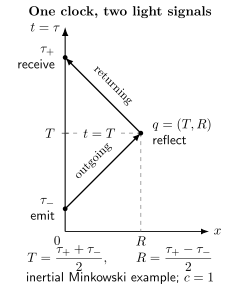
Radar assignment in an inertial Minkowski frame: the reflection event lies on light rays sent at and received at . Their midpoint gives and their half-separation gives . The dashed horizontal line is the resulting simultaneity assignment, not a signal. Equal spacetime-axis scales; . Curved and accelerated cases need the two null connections separately.
Local existence and global failure
Section titled “Local existence and global failure”Near any event on a smooth timelike worldline, a sufficiently small convex normal neighborhood supplies unique connecting geodesics. A still smaller tubular region therefore admits one past-directed and one future-directed null connection to the worldline. In that local radar neighborhood, and are smooth away from the polar degeneracy at , and the surfaces meet the worldline orthogonally.
Global extension is not guaranteed. Radar assignment fails if either signal is absent, as can happen behind an obstacle or beyond an observer horizon. It also becomes multivalued when lensing, caustics, or self-intersections provide more than one outgoing or returning null ray. Even within a region where the ray pair remains unique, a radar-time surface that is spacelike near need not remain spacelike everywhere. Perlick’s precise local proposition and these distinct nonexistence and nonuniqueness failures appear in Perlick 2008, § 2, pp. 3–5, preprint PDF.
The phrase “the radar distance” must therefore name the selected observer and ray pair. Choosing the earliest return, brightest image, or another branch after multiple imaging is an additional convention, not a recovery of the original unique construction.
Fermi coordinates use spacelike geodesics
Section titled “Fermi coordinates use spacelike geodesics”Choose a nonrotating spatial triad along . For sufficiently close to the worldline, Fermi coordinates seek a unique proper time and a unique spacelike vector such that
The connecting spacelike geodesic leaves orthogonally, and its initial length is . Unlike , neither nor is obtained by a two-way light exchange. For a geodesic reference worldline and a parallel-transported tetrad, this is the Fermi normal construction analyzed in Manasse and Misner 1963, pp. 735–743. The local exponential-map basis of the construction is reviewed in Reall 2013, § 4.4, pp. 47–48, PDF.
The Fermi chart ends when the normal exponential map ceases to be one-to-one: spacelike normal geodesics may form caustics or self-intersections, or orthogonal hypersurfaces based at different values of may intersect. Radar coordinates instead depend on uniqueness of both null legs. There is no general reason for the two domains to end at the same boundary. Close to the worldline they share the same local rest-space geometry to first order, but acceleration and curvature produce different higher-order extensions.
Inertial and dimensional checks
Section titled “Inertial and dimensional checks”For an inertial observer at the spatial origin of Minkowski coordinates, , an event with has emission and reception times and . Hence and . The Fermi construction gives the same coordinates because the orthogonal spacelike geodesics are straight lines in constant- hyperplanes.
This check fixes the factor of one half and confirms that has the dimensions of length in units with . It does not establish equality for accelerated motion or curved spacetime. There, the radar values depend on null propagation in both time directions, whereas the Fermi values depend on a spacelike normal exponential map.
Exercises
Section titled “Exercises”In dimensional Minkowski spacetime, let an inertial observer follow . A reflection event has coordinates with . Derive its radar coordinates and explain what would go wrong if two different returning null rays reached the observer.
Solution
The outgoing ray satisfies and reaches , so . The returning ray satisfies and reaches at . Therefore
If two returning null rays arrived at distinct proper times, the same event and outgoing signal would produce two values of and hence two pairs . A branch-selection rule could label them, but the radar assignment would no longer be a single coordinate map.
Now consider an accelerated observer at in the flat Rindler metric
Its proper time is . A reflector remains at . Find the radar distance to a reflection event and compare it with the Fermi distance on a constant- slice.
Solution
For each radial null leg, . Stationarity makes the outward and return coordinate durations equal:
If reflection occurs at , emission and reception occur at . Hence the radar time is , but
The constant- normal geodesic has length , so the two distances agree to first order near the observer and differ at the next order even though curvature is zero. Taking recovers . This makes concrete why a two-way light distance and a spacelike proper length are different constructions.
References
Section titled “References”- Manasse, F. K., and C. W. Misner. “Fermi Normal Coordinates and Some Basic Concepts in Differential Geometry”, Journal of Mathematical Physics 4, no. 6 (1963): 735–745.
- Perlick, Volker. “On the Radar Method in General-Relativistic Spacetimes”, in Lasers, Clocks and Drag-Free Control, Astrophysics and Space Science Library, Springer, 2008, pp. 131–152; Open PDF.
- Reall, Harvey S. General Relativity, PDF, Part III lecture notes, University of Cambridge, 2013, § 4.4, pp. 47–48.