Observers, Rest Spaces, and Measured Components
Scrollable formula. Use Left and Right arrow keys to reveal hidden content.
Scrollable table. Use Left and Right arrow keys to reveal additional columns.
Scrollable figure. Use Left and Right arrow keys to inspect hidden content.
An observer is not merely a coordinate system. At one event, an ideal observer is represented by a future-directed unit timelike vector . That vector fixes a time direction and a three-dimensional rest space, so the energy, momentum, density, flux, and stress measured there can be defined by contractions and projections rather than by a preferred chart.
Required background. Events, Intervals, and Minkowski Geometry begins the Special Relativity sequence and supplies causal geometry and four-vectors; Relativistic Energy, Momentum, and Mass Shells supplies the particle mass shell used below. Helpful background. Calculus and Linear Algebra supplies contractions, projectors, orthonormal bases, and tensor components; Classical and Variational Mechanics supplies the familiar velocity, momentum, and rest-frame language used in examples.
The rest-space projector
Section titled “The rest-space projector”Throughout this page,
The construction is local and carries directly to curved spacetime by replacing with the metric at the event.
Define
It satisfies
Thus projects into the hyperplane orthogonal to . The induced quadratic form is positive definite there: if and , then .
This positivity is easiest to see without coordinates doing any physical work. One may choose an inertial frame in which at the event. Orthogonality then forces , and therefore for every nonzero in the rest space. Because the statement is invariant, it holds in every frame.
Any vector decomposes uniquely as
The minus sign in follows from . Contracting the decomposition with is a quick sign check.
The figure shows the same construction in a 1+1-dimensional tangent-space section. The line drawn as represents one spatial direction in the observer’s actual three-dimensional rest space; its screen angle is not a Euclidean measure of Minkowski orthogonality.
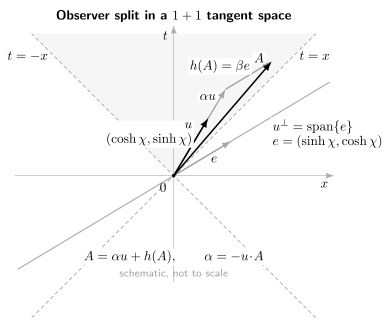
A unit timelike direction selects the rest space and decomposes uniquely into and . This is a 1+1-dimensional tangent-space schematic, not a Euclidean construction and not to scale.
The algebra is pointwise: it does not require to extend to a hypersurface-orthogonal observer field. The corresponding projector identities are given in Gourgoulhon 2007, §2.4.1, printed pp. 29–30, Eqs. (2.61)–(2.71); that source specializes its field to hypersurface-normal observers, while only the local linear algebra is used here.
Measured particle energy and momentum
Section titled “Measured particle energy and momentum”For a future-directed particle four-momentum , the observer measures
so
Using gives the observer’s mass-shell relation
The measured energy is a scalar once both and are specified. Saying “energy is frame dependent” means that a different observer vector produces a different scalar; it does not make the measurement coordinate dependent.
Orthonormal tetrads and components
Section titled “Orthonormal tetrads and components”Choose a mutually orthonormal spatial triad spanning the rest space and set . The resulting tetrad obeys
Let be its dual coframe, defined by
In particular . The measured components of a vector are therefore
The time leg is fixed by the observer velocity, but the spatial triad can be rotated. A scalar energy is independent of that rotation; three listed momentum components are not. Transporting the triad between events introduces a further physical choice, developed in Fermi–Walker Transport and Nonrotating Frames.
Measuring a rank-two tensor
Section titled “Measuring a rank-two tensor”An observer decomposes a symmetric tensor into density, spatial flux, and spatial stress:
These obey and , and reconstruct
For stress–energy, is the local energy density, the energy flux or momentum density in the rest space, and the spatial stress. Whether vanishes depends on the observer and matter model.
In the instantaneous rest frame, these definitions reduce to , , and . This component check fixes the signs in the reconstruction. The same split, again for a hypersurface-normal observer field, appears in Gourgoulhon 2007, §4.1.2, printed pp. 52–53, Eqs. (4.3)–(4.10).
Worked check: a moving particle
Section titled “Worked check: a moving particle”In inertial coordinates let the observer be at rest, , and let
Then
and . In the particle’s own rest frame the observer vector equals , so and the spatial momentum vanishes. Both descriptions follow from the same contraction.
Limits and common mistakes
Section titled “Limits and common mistakes”- A single defines a rest space only at one event. Comparing spatial vectors at separated events needs a transport rule or a congruence.
- A coordinate basis need not be orthonormal. Coordinate components are not automatically readings on rods and clocks.
- Simultaneity away from the event is not determined by the local orthogonal plane alone; extending it is a synchronization choice and may fail globally.
- The projector has a plus sign, , for the site’s timelike norm .
- An extended detector has acceleration, rotation, finite response time, and calibration. The ideal observer is its local pointlike limit.
Exercises
Section titled “Exercises”Projector checks
Section titled “Projector checks”Starting from and , verify that , , and .
Solution
Direct contraction gives
For idempotence,
Finally, in four spacetime dimensions,
Two observers, one particle
Section titled “Two observers, one particle”In one spatial dimension, let and . Compute the energy measured by and check the coincident-observer and particle-rest limits.
Solution
The contraction gives
If the observer follows the particle, , so . If the particle is at rest in the original coordinates, , then : the moving observer assigns the rest particle the expected boosted energy.
Continue to Four-Velocity, Four-Acceleration, and Relativistic Force to follow these local measurements along a particle worldline.
References
Section titled “References”- Gourgoulhon, Éric. 3+1 Formalism and Bases of Numerical Relativity. arXiv:gr-qc/0703035v1 (6 March 2007). Versioned arXiv record.
Further reading
Section titled “Further reading”- Miller, D., D. R. Tovey, and J. D. Jackson, “Kinematics,” in S. Navas et al. (Particle Data Group), Review of Particle Physics, Physical Review D 110, 030001 (2024), 2025 update. Official PDF, §§49.1–49.2, printed pp. 1–2; mass-shell signs translated from the source’s signature.
- David Tong, Lectures on General Relativity, §1.2.1 “A Particle in Minkowski Spacetime,” University of Cambridge, 2019.