The Bondi-Metzner-Sachs Group
Scrollable formula. Use Left and Right arrow keys to reveal hidden content.
Scrollable table. Use Left and Right arrow keys to reveal additional columns.
Scrollable figure. Use Left and Right arrow keys to inspect hidden content.
The Bondi–Metzner–Sachs group is the asymptotic symmetry group of the standard four-dimensional asymptotically flat null phase space. It contains the Lorentz group but enlarges ordinary translations to angle-dependent translations along null infinity. This enlargement follows from preserving the universal null structure and Bondi falloffs; it is not an arbitrary addition to Poincaré symmetry.
Required background. Variational and Symplectic Geometry supplies boundary symmetries and charges. Helpful background. Lorentzian Metrics and Causal Cones and Geodesics and Jacobi Fields supply null geometry; Causality and Global Structure supplies ; Formulations of General Relativity develops general charge construction; Waves, Green Functions, and Geometric Optics supplies radiative fields.
Bondi gauge and asymptotic data
Section titled “Bondi gauge and asymptotic data”Near future null infinity choose retarded Bondi coordinates , where labels outgoing null hypersurfaces, is an areal coordinate, and label the sphere. In one standard convention the asymptotic metric begins
with additional and coefficients containing the Bondi mass and angular-momentum aspects. Bondi gauge imposes
so . The round unit-sphere metric chooses a conformal frame; denotes its covariant derivative. The news is in this convention.
A different conformal frame or radial convention rearranges subleading coefficients without changing the underlying universal structure. Every transformation formula must be translated together with those choices. Compère and Fiorucci derive the residual vector fields from the full Bondi expansion in Compère and Fiorucci 2019, §§3.1–3.2, pp. 69–78.
Residual diffeomorphisms
Section titled “Residual diffeomorphisms”Solve subject to preservation of Bondi gauge and falloffs. The leading residual vector field is determined by a sphere vector and a function :
Preserving the leading round-sphere metric requires to be a conformal Killing vector,
and determines the retarded-time dependence
The six globally smooth conformal Killing fields on generate rotations and boosts, hence the connected Lorentz group. The unrestricted smooth function generates a supertranslation. Its spherical harmonics with reproduce the four ordinary translations; modes with are genuine angle-dependent translations.
A cut is one event on each generator, written . A supertranslation moves those events along the generators while leaving the angular labels fixed. A constant shifts every generator equally and is a time translation. Ordinary spatial translations already have angle dependence, up to the active/passive sign convention. What distinguishes a pure supertranslation in this Bondi frame is its content, not angle dependence alone.
The figure follows the image of a cut under the point map . Inspect the unchanged vertical generators and the different heights of the shifted cut. For comparison, a passive coordinate change makes the new zero-coordinate cut the old cut . Moving a cut and selecting a new coordinate-zero cut are different operations; this is why their signs must not be interchanged.
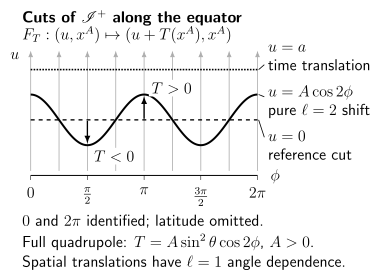
A supertranslation changes the cut along fixed null generators. The schematic shows an equatorial slice of , with and identified and the latitude omitted. The dashed cut maps to the dotted cut for a time translation, or to the solid cut for , a real harmonic with . Arrows on that cut show signed shifts, not radiation propagation. Ordinary spatial translations have angle dependence. No metric scale or radiative evolution is represented.
The residual vector field grows in the radial component for boosts, but it preserves the asymptotic phase space. Conversely, a vector field that decays in coordinates can still carry a boundary charge. The allowed/proper quotient, not component size, decides physical symmetry.
Semidirect-product algebra
Section titled “Semidirect-product algebra”Supertranslations form an Abelian normal subgroup . Lorentz transformations act on them with the conformal weight induced by . For field-independent leading parameters, the algebra can be written schematically as
The semidirect product can be checked rather than memorized. Write a generator as and set . The bracket of two leading generators has parameters
Setting gives zero, so supertranslations commute. With only nonzero, the second line gives the Lorentz action on a function with the required conformal weight Compère and Fiorucci 2019, §3.2, Eq. (3.21), p. 76.
The ordinary Poincaré algebra is a subalgebra obtained from the Lorentz fields and the supertranslations. The four-dimensional translation subspace is distinguished and Lorentz invariant, but a preferred Lorentz subgroup is not canonically selected once the vacuum shear is allowed to change: different supertranslation frames select different translation-compatible Lorentz subgroups. The complementary designation “pure ” uses the chosen sphere frame; that complement need not be invariant under boosts.
Subleading, field-dependent pieces require a modified bracket that subtracts variations of the vector fields caused by variations of the metric. Using the ordinary Lie bracket without this correction can appear to spoil closure. The resulting asymptotic algebra is represented by charges only after finiteness, integrability, and flux terms have been handled.
Several larger groups are called “extended BMS” in the literature. Allowing local meromorphic conformal maps of the sphere introduces singular superrotations; allowing smooth transformations changes the boundary metric data and phase space. These proposals have distinct regularity, charge, and flux questions. The standard BMS group on this page uses globally smooth conformal Killing and smooth .
Action on shear and vacua
Section titled “Action on shear and vacua”For a pure supertranslation in the stated convention, the asymptotic shear transforms as
The last two terms are trace free. The harmonics have vanishing trace-free Hessian, so ordinary translations do not shift a stationary vacuum shear. Higher harmonics do. Thus metrics with zero news can occupy a family of supertranslation-related vacuum frames with different .
Differentiating in removes the inhomogeneous shift for time-independent :
This is why the news is radiative while the shear contains both radiative history and vacuum-frame information. A permanent change between nonradiative eras is the geometric seed of displacement memory, but the observable detector response belongs to the radiation treatment.
The inhomogeneous transformation also explains the angular-momentum ambiguity. A charge associated with a Lorentz generator changes under a supertranslation because the cut and vacuum frame change. Energy–momentum and angular momentum cannot be organized exactly as in Poincaré theory until a preferred cut or supertranslation frame is supplied.
Future and past null infinity
Section titled “Future and past null infinity”The same construction applies at using advanced coordinates, with orientation and sign changes. A scattering problem relates incoming data on to outgoing data on . Identifying their BMS groups requires a matching rule through spatial infinity, commonly an antipodal relation under specified regularity. It does not follow simply because the two null boundaries meet at the point drawn as .
This matching underlies diagonal BMS conservation laws across scattering. Its hypotheses include asymptotic falloffs near spatial infinity and control of massive or long-range fields. When those conditions fail, independent past and future groups may remain the correct description.
The result is structural: null infinity admits infinitely many translations because its degenerate conformal geometry contains no preferred origin along each generator. Charges, Bondi constraints, and flux will decide how these symmetries act on physical data.
Exercise
Section titled “Exercise”Show that the trace-free Hessian shift of vanishes for the and supertranslations on the unit sphere.
Solution
For a constant (), , so the shift vanishes. For an harmonic, the unit-sphere identity is
Therefore
For , the trace-free Hessian is generally nonzero, so those supertranslations shift the vacuum shear. This separates ordinary translations from the pure supertranslation modes geometrically.
Bondi Mass Aspect and the Asymptotic Constraint next uses the field equations to propagate the energy aspect between cuts.
References
Section titled “References”- Compère, Geoffrey, and Adrien Fiorucci, Advanced Lectures on General Relativity, §§3.1–3.3, pp. 69–84, Springer, 2019.
- Frauendiener, Jörg, “Conformal Infinity”, Living Reviews in Relativity 7, article 1, §§1–2, 2004.