Plus and Cross Polarizations
Scrollable formula. Use Left and Right arrow keys to reveal hidden content.
Scrollable table. Use Left and Right arrow keys to reveal additional columns.
Scrollable figure. Use Left and Right arrow keys to inspect hidden content.
Plus and cross are the two tensor components of a general-relativistic plane wave in an oriented transverse screen. They are not individually basis invariant: rotating the screen mixes them through twice the rotation angle. The complex combination packages this spin-two transformation and supplies the convention used for every harmonic and asymptotic waveform in the volume. This kinematic baseline does not include empirical limits on additional polarizations.
Helpful background. Einstein Equations supplies the field equations that reduce the vacuum spectrum to two tensors. Waves, Green Functions, and Geometric Optics supplies null propagation and the transverse screen. Gravitational Radiation and Waveforms supplies TT strain and tidal response. Tests of Gravity supplies the later theory/observation setting in which this GR baseline is compared with alternatives.
An oriented screen
Section titled “An oriented screen”Let the wave propagate toward the observer along a declared unit spatial vector . Choose orthonormal vectors perpendicular to , with . Define
They are symmetric, transverse, and traceless:
The TT strain is
For propagation along with and ,
The two amplitudes are independent functions of retarded time. They are components of one tensor field, not two coordinate-invariant scalar fields.
The TT construction and its observable tidal interpretation are derived in Flanagan and Hughes 2005, §2.1, pp. 7–8, and §3, pp. 13–17, PDF.
Complex strain and spin weight
Section titled “Complex strain and spin weight”Introduce the unit complex dyad
Contracting with two conjugate dyads gives
Now rotate the dyad phase,
For the real screen vectors this means
This explicit basis change fixes the sign of ; the opposite geometric rotation uses .
The tensor itself is unchanged, while its complex component transforms as
Thus has spin weight . Expanding the phase gives the real component transformation
If a source uses the opposite dyad rotation or defines , both signs change together. The physical tensor and curvature do not.
Linear, circular, and elliptical polarization
Section titled “Linear, circular, and elliptical polarization”For a monochromatic component with site time dependence , let and be complex amplitudes. Their relative magnitude and phase determine the polarization ellipse:
- equal phases give linear polarization after a suitable screen rotation;
- equal magnitudes with relative phase give circular polarization;
- the generic case is elliptical.
Handedness requires an orientation and viewing direction. Looking along versus back toward the source reverses the visual sense of rotation. A sign attached to “right-handed” without that statement is incomplete.
A real waveform contains conjugate positive- and negative-frequency content. Helicity language is most transparent for one frequency sign; the real time series should not be mistaken for a single unconjugated complex metric.
Tidal patterns
Section titled “Tidal patterns”The local electric curvature is
For initial transverse separation , the long-wavelength response is
Plus stretches one screen axis while compressing the other. Cross has the same pattern rotated by . Since a screen rotation mixes the component names, the invariant statement is that the tidal matrix is transverse and trace free with two eigen-directions.
The figure applies these displacement equations to an initially circular ring. Compare the principal axes of the plus and cross patterns, then compare opposite signs of the same amplitude.
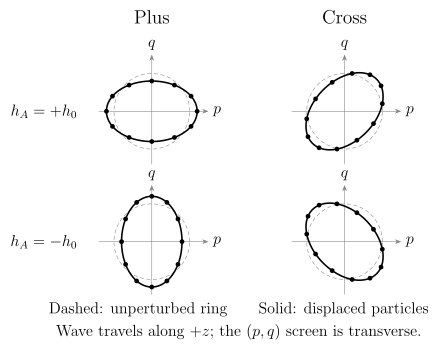
The two tensor patterns for a wave along , with . Each ring follows ; the dashed circle is undeformed. The amplitudes use only to exaggerate the linear response. Area is preserved to first order, not exactly at this illustrative amplitude. These are phase snapshots, not additional independent polarizations.
Field, frame, and detector are different objects
Section titled “Field, frame, and detector are different objects”A detector channel is a contraction of the spacetime field with a response tensor and, at finite frequency, a transfer function. In the long-wavelength idealization,
The antenna factors depend on detector geometry and sky convention. They are not new spacetime polarizations. In column-vector notation, the amplitudes and antenna factors both transform with the same orthogonal doubled-angle matrix : and . Thus is unchanged because .
Detector calibration, networks, likelihoods, and empirical polarization bounds belong to Gravitational-Wave Astronomy and Tests of Gravity. This page defines the field-side basis.
Common pitfalls
Section titled “Common pitfalls”Calling plus and cross invariant observables. Their two-dimensional span is physical; their individual values depend on the oriented screen.
Forgetting the doubled angle. A rank-two trace-free tensor rotates with , which is why the complex field has spin weight .
Confusing cross with a non-GR mode. Cross is the second tensor polarization of GR. Vector and scalar modes have different tidal matrices, not merely different screen angles.
Exercises
Section titled “Exercises”1. Forty-five-degree rotation. Set in the component transformation. What happens to a pure plus wave?
Solution
Since and ,
Thus a pure plus component becomes a pure cross component in the rotated screen convention. The tensor and its tidal eigenvalues are unchanged; only the component labels have rotated.
2. Basis-independent norm. Show that for real time-domain components.
Solution
Orthogonality of the polarization tensors gives
Meanwhile . The norm therefore has the stated form and is unchanged by the phase .
This supplies an immediate normalization check when plus and cross modes are rotated between waveform frames.