Collision Kinematics and Center-of-Momentum Frames
Scrollable formula. Use Left and Right arrow keys to reveal hidden content.
Scrollable table. Use Left and Right arrow keys to reveal additional columns.
Scrollable figure. Use Left and Right arrow keys to inspect hidden content.
The center-of-momentum frame of an isolated system is determined by its total four-momentum, not by averaging particle velocities. When the total momentum is timelike, its invariant length is the system’s center-of-momentum energy and its unit direction is the frame’s four-velocity.
Required background. Events, Intervals, and Minkowski Geometry begins the Special Relativity sequence and supplies causal geometry; Relativistic Energy, Momentum, and Mass Shells supplies four-momentum and . Helpful background. Calculus and Linear Algebra supplies vector sums and quadratic invariants; Classical and Variational Mechanics supplies momentum conservation and the Newtonian center-of-mass limit.
Invariant mass and the center-of-momentum observer
Section titled “Invariant mass and the center-of-momentum observer”For an asymptotically free incoming or outgoing particle state, with interactions negligible and every emitted particle or radiation quantum included, let
for all particles in that state. Four-momentum conservation states that an isolated process has the same in its asymptotic initial and final states.
At finite times an interaction or field can itself carry four-momentum, so the particle sum need not be complete. The full conserved translation charge must then include those degrees of freedom, as developed in Poincaré Symmetry and Relativistic Conservation Laws. This page stays with asymptotically free particle states.
With signature , define
If is future timelike, and the center-of-momentum four-velocity is
The energy measured by this observer is
while its projected total spatial momentum vanishes:
This proves that is the unique future unit timelike center-of-momentum four-velocity. An adapted coordinate frame still has conventional spatial axes and origin. The invariant mass includes internal kinetic and interaction energy; it is generally not the sum of constituent rest masses.
Two incoming particles
Section titled “Two incoming particles”For momenta and masses ,
If , particle 2 has a rest frame in which , and
This fixed-target identity is often more useful than explicitly boosting. It also displays a practical fact: much of a high-energy projectile’s laboratory energy goes into motion of the center of momentum rather than into invariant energy available for new rest mass.
For two beams of equal energy and opposite momentum, and . A collider uses energy more efficiently than a fixed target because the laboratory can already be the center-of-momentum frame.
Two-body final states
Section titled “Two-body final states”Consider a final state with masses . In the center-of-momentum frame,
Energy conservation and the two mass shells give
and
where
Reality of requires , but that algebraic inequality alone also admits the lower branch . Requiring both final momenta to be future-directed removes that branch: a physical two-body final state exists only for . With two positive masses, equality is an attained threshold and both particles are at rest in the center-of-momentum frame. If a daughter is massless, equality would assign it zero four-momentum, so the boundary may be only an infimum of physical final states rather than an attained state.
Worked example: equal masses with a fixed target
Section titled “Worked example: equal masses with a fixed target”A particle of mass and laboratory energy strikes an identical particle at rest. Then
If the projectile momentum magnitude is , its laboratory speed is , and the center-of-momentum frame moves with
Indeed, the total laboratory momentum and energy are , so a boost at that speed removes the spatial part. In the nonrelativistic limit with , , as expected for equal Newtonian masses.
In the ultrarelativistic fixed-target limit ,
which grows only as the square root of projectile energy. Two opposed beams with the same single-beam energy instead give .
The figure makes the four-momentum bookkeeping visible. Inspect the total spatial momentum: it survives in the fixed-target laboratory but cancels between opposed beams.
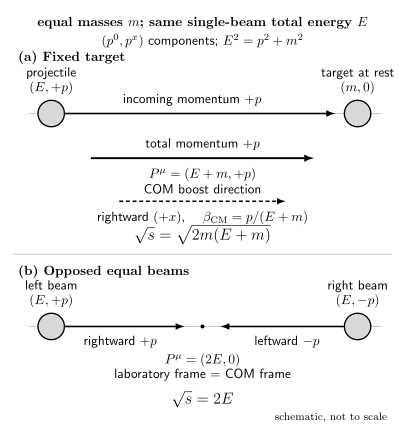
For equal masses and equal single-beam total energy , a fixed target has and , while opposed beams have and . The comparison is schematic and not to scale.
When a center-of-momentum frame fails to exist
Section titled “When a center-of-momentum frame fails to exist”For a finite collection of nonzero future-directed causal momenta, the sum is timelike unless every summand is null and all are proportional to the same future null direction. In that exact exceptional case every constituent is massless and all momenta point the same way. Then , no boost can make the spatial momentum vanish, and dividing by is impossible. Two photons that are not parallel in the same direction—including a head-on pair—have a timelike sum and do possess a center-of-momentum frame.
External fields or radiation crossing the system boundary complicate the accounting: particle momentum alone may not be conserved. The system must include the relevant field or environmental momentum flux.
Checks and common mistakes
Section titled “Checks and common mistakes”- With the site signature, ; references using write . The numerical invariant is the same.
- A frame transformation cannot change . If two frame calculations give different values, a sign, energy, or momentum component is wrong.
- The two-body formulas determine momentum magnitudes, not angular distributions. Scattering dynamics supplies the latter.
- “Center of mass” is potentially misleading for photons or interacting systems; center of momentum states the invariant condition.
- Adding rest masses gives the minimum possible invariant mass only when all constituents can be mutually at rest and binding energy is absent.
The center-of-momentum and fixed-target relations are reviewed in Miller, Tovey, and Jackson 2025, §49.2, printed p. 1, Eqs. (49.2)–(49.7), and the two-body energies and Källén formula in §49.4.2, printed p. 3, Eqs. (49.16)–(49.18). The source uses and ; both signs have been translated to the site convention.
Exercises
Section titled “Exercises”Two-photon invariant mass
Section titled “Two-photon invariant mass”Two photons have energies and propagation directions separated by an angle in one inertial frame. Show that
and interpret the parallel and head-on limits.
Solution
Write with . Since each photon is null,
and . For , : the total momentum is null and no center-of-momentum frame exists. For , ; equal energies give a laboratory center-of-momentum frame with .
Verify the center-of-momentum observer
Section titled “Verify the center-of-momentum observer”Assume is future timelike and set . Verify , , and .
Solution
Let . Then
Finally,
Continue to Decays, Thresholds, and Invariant Phase Space to turn these kinematic constraints into allowed final-state measures.
References
Section titled “References”- Miller, D., D. R. Tovey, and J. D. Jackson. “Kinematics.” In S. Navas et al. (Particle Data Group), Review of Particle Physics, Physical Review D 110, 030001 (2024), 2025 update. Official PDF.
Further reading
Section titled “Further reading”- Tong, David. Lectures on Dynamics and Relativity, §7.5, printed pp. 145–149, University of Cambridge, 2013.