Minkowski Conformal Diagram
Scrollable formula. Use Left and Right arrow keys to reveal hidden content.
Scrollable table. Use Left and Right arrow keys to reveal additional columns.
Scrollable figure. Use Left and Right arrow keys to inspect hidden content.
Four-dimensional Minkowski spacetime is the cleanest place to learn what a conformal diagram does. After spherical symmetry is reduced, the infinite radial orbit space fits inside a triangle: causal curves keep their light-cone relations, while timelike, null, and spatial infinity become distinct ideal endpoints. The triangle is not the full compactification of unconstrained Minkowski spacetime, and its vertical edge is a regular center rather than infinity.
Helpful background. Constructing Penrose Diagrams develops the compactification method and boundary tests. Minkowski Spacetime and Its Coordinate Atlas supplies the physical metric and chart domains used here.
Compactification and physical domain
Section titled “Compactification and physical domain”Start from spherical Minkowski coordinates with ,
and introduce physical null coordinates. Choose an arbitrary length before mapping those dimensional coordinates to bounded, dimensionless ones:
Set
Because , the physical radial domain is
The conformal factor and unphysical metric are
Changing changes only the compactified coordinate placement of finite physical events; it does not change the boundary types or causal incidence.
The angular coefficient is a useful check: vanishes smoothly at , where the symmetry two-spheres shrink to a regular center. It would be a category error to call this timelike edge a conformal boundary. Frauendiener’s physical-versus-unphysical metric framework and radial suppression rules make that distinction explicit in Frauendiener 2004, §§ 1.1–1.3.
The figure shows the resulting domain and representative curves. Inspect where each curve ends, and note that every ordinary interior point represents an entire symmetry two-sphere.
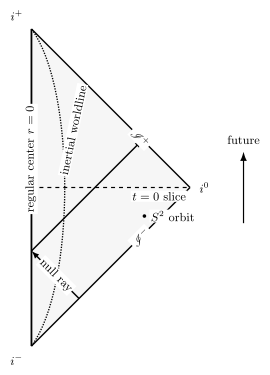
The radial compactification of four-dimensional Minkowski spacetime is a triangle: the vertical edge is the regular center, the open diagonal edges are and , and the vertices are , , and . Future points upward; the diagram is schematic and not to scale.
Boundary and curve key
Section titled “Boundary and curve key”Ideal boundaries and axis.
| Object | Compactified location | Meaning in the physical spacetime |
|---|---|---|
| Regular center | , with | Smooth fixed set of the rotation action; the symmetry two-sphere has zero area here |
| , excluding its endpoints | Future null infinity; future-directed outgoing null curves approach this open segment | |
| , excluding its endpoints | Past null infinity; incoming null curves approach from this open segment | |
| , | Ideal future endpoint of complete timelike geodesics (inertial worldlines) | |
| , | Corresponding ideal past endpoint of complete timelike geodesics | |
| , | Spatial infinity; the slice and other asymptotically spacelike slices approach it |
Representative curves and markers.
| Object | Compactified location | Meaning in the physical spacetime |
|---|---|---|
| Radial null ray | Two 45-degree segments meeting at | One smooth four-dimensional null geodesic passes through the regular center; the radial coordinate reverses direction there |
| Inertial worldline | Dotted interior curve from to | The drawn complete constant-position geodesic remains timelike and has both null coordinates divergent with the same time orientation |
| slice | Dashed line from the center to | A constant-time spacelike half-slice approaches spatial infinity |
| orbit | Any marked ordinary interior point | One point of the radial quotient represents an entire symmetry two-sphere in four dimensions |
| Future arrow | Upward | Fixes the time orientation used by every causal label and directed null ray |
Bičák summarizes the three inequivalent approaches to infinity—timelike geodesics to , null geodesics to , and spacelike geodesics to —in Bičák 2000, § 1.3, printed pp. 8–10, PDF.
Why the radial picture is a triangle
Section titled “Why the radial picture is a triangle”For unconstrained Cartesian Minkowski spacetime, the spatial coordinate can run in both directions, so the compactification is a diamond with left and right null boundaries. Here is an areal radius and satisfies . Quotienting by rotations removes the angular directions, retains only , and turns the would-be left edge into the regular axis where the orbits collapse. The triangle therefore represents four-dimensional spherical Minkowski spacetime, not an assertion that the original spacetime has only two dimensions.
Endpoint type follows the curve, not merely its timelike, null, or spacelike classification at finite points. Complete timelike geodesics, including the drawn inertial worldline, approach ; a radial null geodesic approaches ; and a constant- spacelike slice approaches . Timelikeness alone is not enough: the complete uniformly accelerated hyperbola with has and toward the future, so it approaches an open point of rather than . None of these ideal points or open boundary segments is an ordinary event of the physical spacetime. Future and Past Null Infinity gives the corresponding invariant boundary conditions.
What the diagram does not measure
Section titled “What the diagram does not measure”The conformal rescaling preserves causal type and incidence before the spherical-symmetry quotient. The radial orbit-space diagram preserves radial causal order and ideal endpoints, but it suppresses angular separation: causal relations between specified angularly separated events require restoring the data. It does not preserve physical lengths, elapsed proper times, affine parameters, sphere areas, or curvature scales. Minkowski curvature is zero everywhere in the physical spacetime; the finite triangular size is entirely a conformal representation. Any quantitative calculation must return to the physical metric .
References
Section titled “References”- Bičák, Jiří. “The Role of Exact Solutions of Einstein’s Equations in the Developments of General Relativity and Astrophysics: Selected Themes.” In Einstein’s Field Equations and Their Physical Implications, edited by Bernd G. Schmidt, 1–126. Lecture Notes in Physics 540. Springer (2000), § 1.3, printed pp. 8–10. Open PDF.
- Frauendiener, Jörg. “Conformal Infinity.” Living Reviews in Relativity 7, article 1 (2004). DOI: 10.12942/lrr-2004-1.