de Sitter and Anti-de Sitter Conformal Diagrams
Scrollable formula. Use Left and Right arrow keys to reveal hidden content.
Scrollable table. Use Left and Right arrow keys to reveal additional columns.
Scrollable figure. Use Left and Right arrow keys to inspect hidden content.
Changing the sign of the cosmological constant changes the causal character of infinity. Exact global de Sitter spacetime has disconnected spacelike past and future conformal boundaries, with observer-dependent cosmological horizons inside the spacetime. The universal cover of global anti-de Sitter spacetime instead has a timelike conformal boundary extending for all global time. A global field theory must therefore specify its admissible boundary behavior or operator domain; depending on the field and sector, that specification may be unique or may admit choices.
Helpful background. de Sitter Spacetime and Anti-de Sitter Spacetime give the exact metrics and embeddings. Conformal Completion, Causal Boundaries, and Penrose Diagrams explains what the compactification preserves. This page compares the exact global backgrounds in spacetime dimension ; it is not a diagram of a Poincaré patch, an asymptotically locally AdS solution, or a cosmological perturbation.
Constant curvature fixes the boundary sign
Section titled “Constant curvature fixes the boundary sign”Let and be the independent curvature radii of the two backgrounds. For the physical metric, the site’s curvature convention gives
The exact global de Sitter metric in conformal time is
Each constant- slice is . After suppressing the orbits, the diagram is therefore a rectangle: and are regular polar axes where the orbit shrinks smoothly, not conformal boundaries. The horizontal ends are the disconnected components . Anninos gives the global and static charts and their horizon coverage in Anninos 2012, § 1.1, pp. 4–6; the exact completion and its two spherical ends are checked in Ashtekar, Bonga, and Kesavan 2015, § III.A, pp. 10–11.
For the universal cover of global anti-de Sitter spacetime,
Unwrapping removes the closed timelike curves of the embedded hyperboloid. A spherical radial diagram is a half-strip: is one regular center, while is one timelike conformal boundary with topology . There are no upper or lower time edges and no periodic identification. The hyperboloid, universal cover, global conformal metric, and boundary appear in Aharony et al. 2000, § 2.2.1, pp. 40–43.
Choose defining functions and unphysical metrics by
At the respective boundaries,
Thus de Sitter infinity has a timelike normal and is spacelike; anti-de Sitter infinity has a spacelike normal and is timelike. The four-dimensional asymptotically de Sitter normal calculation, including its smoothness and matter-decay hypotheses, is derived in Ashtekar, Bonga, and Kesavan 2015, § II.A–B, pp. 5–9, especially Eq. (2.2). The equations above establish the general- signs only for the exact constant-curvature backgrounds shown here.
Read the two radial diagrams
Section titled “Read the two radial diagrams”In the upper panel, inspect the difference between the horizontal conformal ends and the diagonal observer horizons. In the lower panel, inspect the unbounded time direction and the single timelike boundary. Every ordinary interior point represents an orbit; future points upward and radial null directions lie at . The picture is a causal incidence map, not a metric-scale drawing, as emphasized in Frauendiener 2004, §§ 1–2.
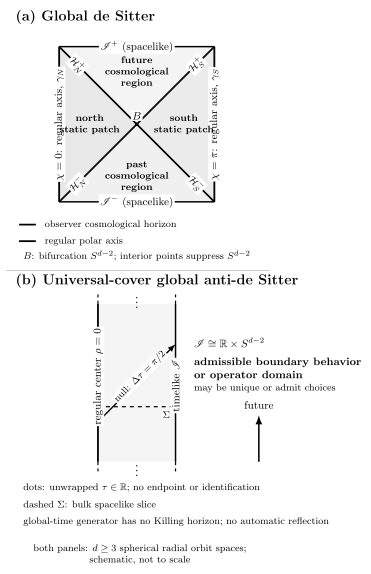
The positive and negative signs of the cosmological constant produce different global conformal boundaries. Global de Sitter has spacelike and observer-dependent null cosmological horizons inside a finite rectangle; the universal cover of global anti-de Sitter is an infinite-time radial half-strip with timelike , so a global field theory must specify admissible boundary behavior or an operator domain, which may be unique or may admit choices depending on the field and sector. Future points upward; both spherical radial diagrams are schematic and not to scale, and the anti-de Sitter continuation marks are not identifications.
| Diagram element | Exact meaning |
|---|---|
| de Sitter top and bottom edges | Spacelike and , each with topology |
| de Sitter vertical edges | Regular polar worldlines at and ; neither is infinity or singular |
| de Sitter diagonal branches | Observer-dependent cosmological Killing horizons inside the physical spacetime |
| Central crossing in de Sitter | A bifurcation at , not a point singularity |
| Anti-de Sitter left edge | Regular center where the orbit collapses |
| Anti-de Sitter right edge | Timelike conformal boundary |
| Anti-de Sitter continuation marks | Unwrapped ; they are neither endpoints nor identifications |
de Sitter horizons are internal and observer-dependent
Section titled “de Sitter horizons are internal and observer-dependent”For the geodesic observer on the axis, the static patch is
Its past and future null boundaries are
They meet at . In the full spacetime this orbit is a bifurcation of areal radius . The antipodal observer at has the reflected triangular static patch. In static coordinates,
so the static Killing field becomes null at . The metric and curvature are regular there in horizon-crossing coordinates. The future branch is the boundary of the causal past of the observer’s future endpoint on ; the past branch is analogously the boundary of the causal future of its past endpoint on . These null surfaces delimit what the chosen observer can receive from or influence; they are not , singularities, or edges of global de Sitter. Observer Patches and Cosmological Horizons develops that distinction, while Spacelike Conformal Infinity in de Sitter Geometry derives the boundary character. Global de Sitter itself is globally hyperbolic: every constant- sphere is a Cauchy surface.
Anti-de Sitter evolution depends on boundary behavior
Section titled “Anti-de Sitter evolution depends on boundary behavior”Radial null curves in the global conformal coordinates obey
A ray emitted outward from reaches the conformal boundary after
from the center, . This is finite conformal and global coordinate time, but it is not finite physical affine parameter. If is affine for and is affine for along the same null ray, then with . Because , the physical affine integral diverges at the boundary.
The timelike boundary nevertheless destroys boundaryless global hyperbolicity. For center events and , points with lie in but have no convergent subsequence in the physical spacetime. The causal diamond is noncompact. Why AdS Is Not Globally Hyperbolic gives the full argument, and Timelike Conformal Infinity in AdS develops the completion and affine check.
Because AdS is not globally hyperbolic, a global field theory must state how its dynamics is completed at timelike infinity. For linear fields on this static spacetime, this can be encoded by admissible boundary behavior or, equivalently, the domain of the spatial operator that generates evolution. Some field, effective-mass, dimension, and mode sectors are essentially self-adjoint, so the admissible domain is unique; other sectors admit multiple positive self-adjoint extensions and hence genuine boundary-condition choices. There is no universal geometry-only choice of Dirichlet, Neumann, Robin, reflecting, transparent, or mixed behavior. Ishibashi and Wald make this dependence precise in Ishibashi and Wald 2004, abstract, § 1, pp. 1–4, and § 3.2, pp. 30–38. Boundary Conditions and AdS Evolution compares the available structures. A reflected return ray would take total center proper time , but only after a reflecting condition has been chosen; the figure deliberately draws no return segment.
In areal radius , the global static factor is , so the global-time generator has no Killing horizon. Other generators on restricted wedges can have one: the Poincaré horizon belongs to a partial chart and is neither the global conformal boundary nor a curvature singularity. Use the de Sitter and anti-de Sitter coordinate reference for that patch comparison.
The flat limit is local, not a diagram morph
Section titled “The flat limit is local, not a diagram morph”At fixed physical time and radius, the respective metrics approach Minkowski space as or , and their curvature tends to zero. Globally, each limit is nonuniform. The de Sitter static horizon recedes to ; the AdS center-to-boundary time diverges; and the boundary normal becomes null only at . Neither compact diagram should be deformed into the Minkowski triangle by simply setting a curvature radius to infinity at fixed conformal coordinates.
The diagrams establish no holographic dictionary, cosmological observation, stability theorem, thermodynamic result, or nonlinear evolution. Each of those questions requires additional equations, assumptions, and evidence.
References
Section titled “References”- Aharony, Ofer, Steven S. Gubser, Juan Maldacena, Hirosi Ooguri, and Yaron Oz. “Large N Field Theories, String Theory and Gravity.” Physics Reports 323 (2000), 183–386, § 2.2.1, pp. 40–43. DOI: 10.1016/S0370-1573(99)00083-6.
- Anninos, Dionysios. “De Sitter Musings.” International Journal of Modern Physics A 27 (2012), 1230013, § 1.1, pp. 4–6. DOI: 10.1142/S0217751X1230013X.
- Ashtekar, Abhay, Béatrice Bonga, and Aruna Kesavan. “Asymptotics with a Positive Cosmological Constant: I. Basic Framework.” Classical and Quantum Gravity 32 (2015), 025004, §§ II–III.A, pp. 5–11. DOI: 10.1088/0264-9381/32/2/025004.
- Frauendiener, Jörg. “Conformal Infinity.” Living Reviews in Relativity 7 (2004), article 1, §§ 1–2. DOI: 10.12942/lrr-2004-1.
- Ishibashi, Akihiro, and Robert M. Wald. “Dynamics in Non-Globally-Hyperbolic Static Spacetimes III: Anti-de Sitter Spacetime.” Classical and Quantum Gravity 21 (2004), 2981–3014, abstract, § 1, and § 3.2. DOI: 10.1088/0264-9381/21/12/012.