Black Hole Formed by Collapse
Scrollable formula. Use Left and Right arrow keys to reveal hidden content.
Scrollable table. Use Left and Right arrow keys to reveal additional columns.
Scrollable figure. Use Left and Right arrow keys to inspect hidden content.
A black hole formed from regular matter does not have the full past of the eternal Schwarzschild extension. This record fixes one exact model—four-dimensional Oppenheimer–Snyder collapse—so that the diagram’s matter region, horizon, singularity, and single asymptotic end have a definite meaning. It is a compact causal map of that model, not a universal picture of every collapse process.
Helpful background. Constructing Penrose Diagrams supplies the compactification and boundary tests. Trapped Surfaces and Horizon Formation separates global event horizons from quasi-local trapped and marginal surfaces.
Selected collapse model
Section titled “Selected collapse model”The Oppenheimer–Snyder solution uses a spherically symmetric, homogeneous pressureless-dust interior,
with a regular center throughout the pre-singular region. The timelike stellar surface is matched to an asymptotically flat Schwarzschild exterior of mass . Rotation, pressure support, outgoing radiation, and nonspherical structure are absent. These assumptions identify a solvable representative rather than a realistic late-stage stellar model; the original construction and exterior matching are given in Oppenheimer and Snyder 1939, printed pp. 455–459.
This record selects the original marginally bound scattering branch and its specified regular past completion: the stellar surface emanates from past timelike infinity , while its areal radius tends to infinity toward the past. Alford 2020, § 2 and § 3.1; Figs. 2–3 makes this past completion explicit and distinguishes it from models whose star remains at finite radius in the remote past. A future development posed only from data on a finite-radius initial Cauchy surface is a different domain; its causal diagram should display that initial surface instead of silently inheriting the and boundaries drawn here.
Relative to the one chosen asymptotic end, define
The event horizon is therefore global: deciding whether a point lies on requires knowing whether future-directed causal curves from that point ever reach . In this model, has its past endpoint at the regular center before the stellar surface crosses the Schwarzschild radius. The horizon then crosses that timelike surface; only its exterior segment is the stationary Schwarzschild surface . Reall’s collapse construction and its distinction from the maximal extension are explicit in Reall 2013, §§ 12.5–12.7, printed pp. 142–148, PDF.
The figure shows the complete radial causal relation. Inspect the horizon’s origin and matter crossing before comparing the upper exterior with the eternal solution.
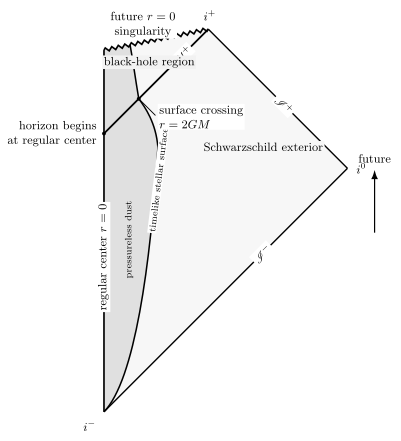
In the original marginally bound, one-ended Oppenheimer–Snyder branch, the stellar surface emanates from past timelike infinity, the event horizon begins at the regular center, crosses that surface where the exterior areal radius is , and bounds a future black-hole region ending at a spacelike singularity. Future points upward; the radial diagram is schematic and not to scale.
Region and boundary key
Section titled “Region and boundary key”| Object | Role in this diagram | Decisive qualification |
|---|---|---|
| Regular center | Timelike axis before singularity formation | Smooth fixed set of spherical symmetry, not a conformal boundary |
| Dust interior | Shaded region between the center and stellar surface | Homogeneous pressureless matter in the selected model, not Schwarzschild vacuum |
| Stellar surface | Timelike boundary of the dust | Crosses the event horizon where the exterior areal radius is |
| Null boundary of | Begins in the regular region; it is not located from local curvature or one time slice | |
| Exterior | Region outside the matter and to the causal past of | Schwarzschild by spherical vacuum matching, but only outside the star |
| Black-hole region | Points that cannot send a future causal signal to | Contains both matter and vacuum portions |
| Future | Jagged spacelike boundary | Curvature-singular future boundary in this exact dust solution |
| , , | One set of null and ideal asymptotic endpoints | One asymptotically flat end, not the two ends of maximal Schwarzschild |
As in every radial conformal diagram, each ordinary interior point suppresses a symmetry two-sphere. Open segments are null conformal boundaries, whereas and are limiting ideal points with different endpoint character. The physical/unphysical metric distinction and the absence of metric scale follow the framework in Frauendiener 2004, §§ 1.1–1.3.
In the conformal completion, the closures of and the spacelike singular boundary share the ideal endpoint . The physical horizon generators do not meet the curvature singularity.
Event horizon versus marginal surfaces
Section titled “Event horizon versus marginal surfaces”The horizon starts at the regular center because its definition uses the complete future, not because a local scalar first reaches a threshold there. A marginally outer trapped surface instead has vanishing outgoing null expansion on a selected spacelike slice. Its worldtube can be spacelike, null, or timelike and need not coincide with . The schematic deliberately does not draw a marginal tube, avoiding a false identification of the global event horizon with a slicing-dependent local boundary.
Apparent Horizons and Marginally Trapped Surfaces gives the definitions, while Emergence of Marginal Tubes in Collapse treats their formation and signature. Those local diagnostics do not replace the causal definition above.
Contrast with eternal Schwarzschild
Section titled “Contrast with eternal Schwarzschild”| Feature | Oppenheimer–Snyder collapse | Maximal eternal Schwarzschild |
|---|---|---|
| Asymptotic ends | One | Two |
| Past interior | Regular center and matter | White-hole region and past singularity |
| Bifurcation sphere | Absent | Present where four horizon branches meet |
| Matter | Dust interior bounded by a timelike surface | Vacuum everywhere away from |
| Future black-hole region | Present | Present |
| Future singularity | Spacelike in this exact solution | Spacelike in the maximal vacuum extension |
The late exterior can be isometric to a Schwarzschild exterior without making the complete spacetime the eternal vacuum solution. The Maximally Extended Schwarzschild Diagram displays the additional regions, and The Maximal Schwarzschild Extension derives them from the analytic vacuum continuation.
Scope and limitations
Section titled “Scope and limitations”This exact solution shows that regular spherical initial data can evolve into a one-ended black-hole spacetime under an idealized matter model. It does not prove that generic rotating or nonspherical matter forms a black hole, that every collapse singularity is spacelike, that the exterior always settles to Kerr, or that cosmic censorship holds. Pressure, radiation, angular momentum, shocks, matter equations of state, and quantum effects can change the dynamics. Any diagram for those regimes must name its assumptions rather than inherit this one silently.
References
Section titled “References”- Alford, Fred. “The Scattering Map on Oppenheimer–Snyder Space-Time.” Annales Henri Poincaré 21 (2020) 2031–2092. DOI: 10.1007/s00023-020-00905-5.
- Frauendiener, Jörg. “Conformal Infinity.” Living Reviews in Relativity 7, article 1 (2004). DOI: 10.12942/lrr-2004-1.
- Oppenheimer, J. Robert, and Hartland Snyder. “On Continued Gravitational Contraction.” Physical Review 56 (1939) 455–459. DOI: 10.1103/PhysRev.56.455.
- Reall, Harvey S. General Relativity. Cambridge Part III lecture notes (2013), §§ 12.5–12.7, printed pp. 142–148. PDF.