Hawking–Page and Cavity Phase Transitions
Scrollable formula. Use Left and Right arrow keys to reveal hidden content.
Scrollable table. Use Left and Right arrow keys to reveal additional columns.
Scrollable figure. Use Left and Right arrow keys to inspect hidden content.
A canonical gravitational ensemble can contain several smooth Euclidean saddles with the same boundary temperature. The dominant saddle is the one with the smallest renormalized on-shell action, while local stability is controlled by the second variation or response functions. Schwarzschild–AdS exhibits the Hawking–Page transition between thermal AdS and a large black hole. A finite reflecting cavity stabilizes a different canonical problem for asymptotically flat Schwarzschild. Their boundary data must not be mixed.
Required background. Gravitational Actions and Boundary Terms supplies regulated action differences; Variational and Symplectic Geometry supplies the charges conjugate to boundary sources.
Helpful background. Quantum Fields in Curved Spacetime supplies the canonical path integral; Einstein Equations supplies the saddle families; and Black-Hole Geometry and Mechanics supplies horizon temperature and entropy.
Four-dimensional Schwarzschild–AdS saddles
Section titled “Four-dimensional Schwarzschild–AdS saddles”Let the AdS radius be and use the horizon generator normalized by the standard conformal-boundary time. The Lorentzian black-hole family is
Euclidean regularity and the quarter-area entropy give
The temperature has a minimum at ,
Below there is no smooth black-hole saddle with the prescribed boundary circle. Above it there are two: the small branch has negative heat capacity, while the large branch has positive heat capacity. This is a local statement along the black-hole family, not yet a comparison with thermal AdS.
For example, direct differentiation gives
The response diverges at the turning point; it does not pass through zero. The energy is monotone in , so the sign of suffices to identify the two branches.
Action crossing and global dominance
Section titled “Action crossing and global dominance”Choose thermal AdS as the zero of free energy after matching the conformal boundary geometry. For the black hole,
The actions cross when , hence
For , the large black hole is locally stable but still has higher free energy than thermal AdS: it is metastable. For , it is both locally stable and globally dominant. In the reduced off-shell description at bath temperature , define . The first law implies . At a stationary point its curvature is , so the small branch is the maximum separating the thermal and large-hole branches in this reduced description. This explains its role as a thermal nucleation barrier without identifying the reduced radius variation with the full metric fluctuation problem. Hawking and Page compute this canonical AdS saddle competition in Hawking and Page 1983, pp. 577–588.
Compare the temperature minimum in the upper panel with the free-energy crossing in the lower panel. They occur at different radii: part of the positive-heat-capacity branch still has higher free energy than thermal AdS.
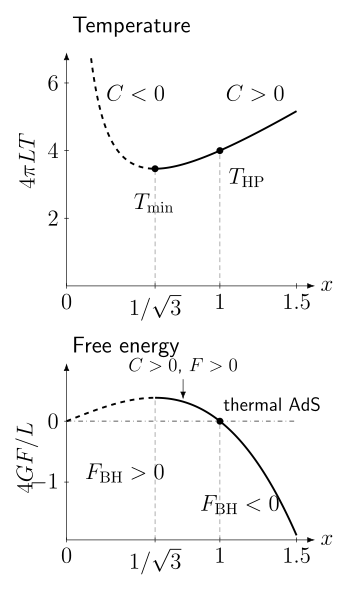
Local canonical stability and global preference differ. With , the temperature minimum is at and the Hawking–Page crossing is at . The interval between them has but relative to thermal AdS. These are quantitative leading Einstein-gravity curves for four-dimensional neutral Schwarzschild–AdS at fixed and standard boundary time. Each point is compared with thermal AdS at its own ; different radii need not have the same temperature. On the small branch, does not imply thermal AdS is the global winner: another, larger black-hole saddle may dominate at that temperature. The curves do not compute a negative-mode spectrum or establish real-time stability.
This example cleanly separates two questions:
| Test | Quantity | Conclusion |
|---|---|---|
| Local canonical stability | Heat capacity or action Hessian on one branch | Whether nearby fluctuations raise the action |
| Global dominance | Renormalized action difference between all saddles with identical sources | Which phase gives the leading partition function |
A positive heat capacity does not guarantee global dominance, and a lower free energy does not by itself prove real-time dynamical stability.
Finite-cavity stabilization
Section titled “Finite-cavity stabilization”Now set and place Schwarzschild inside a spherical reflecting wall of areal radius . The canonical source is the wall’s proper temperature, not the temperature normalized at infinity. With , Tolman redshift gives
This function has a minimum at ,
Above that temperature two black-hole branches fit the same wall data. The small- branch has negative canonical heat capacity, while the large- branch is locally stable because gravitational redshift at the wall reverses the response. York derives the fixed-wall-area variational problem, the two branches, and their action Hessian in York 1986, §§II–V.
Using Brown–York quasilocal energy relative to a flat reference,
the black-hole free energy relative to hot flat space is . Its nontrivial zero occurs at
To verify the crossing, set . Then . Setting it to zero gives : is the zero-mass endpoint, whereas gives the genuine black-hole crossing . As in AdS, the locally stable branch appears before it is globally preferred.
This cavity transition resembles the AdS competition structurally, but its control parameter and subtraction background are different. The cavity wall is physical boundary data; is an asymptotic curvature scale.
Confinement interpretation and limits
Section titled “Confinement interpretation and limits”In a holographic theory with an AdS gravity regime, thermal AdS and the large black hole have parametrically different large- free energies. The Hawking–Page transition can then map to a confinement/deconfinement transition of the boundary gauge theory, as developed in Witten 1998, §§2–3, PDF. That interpretation requires the holographic dictionary and a suitable large- boundary theory; it is not a statement about every AdS black hole.
All displayed results are leading classical saddle calculations. One-loop determinants shift free energies by subleading amounts, additional charged or rotating branches can alter the phase diagram, and nucleation rates require a negative mode and a real-time or contour prescription. Fixed-background thermal fields, self-consistent equilibrium saddles, and time-dependent formation are distinct approximations.
Exercise
Section titled “Exercise”Starting from the Schwarzschild–AdS expressions for , , and , verify the free energy above. Determine the temperature and latent heat at the Hawking–Page transition.
Solution
Multiplication gives
Subtracting from yields
Thus the nonzero crossing is , where . Thermal AdS has vanishing entropy at this classical order, while the black hole has . The latent heat is
The nonzero latent heat confirms a first-order transition at the leading saddle level.
References
Section titled “References”- Hawking, S. W., and D. N. Page (1983), “Thermodynamics of Black Holes in Anti-de Sitter Space,” Communications in Mathematical Physics 87, 577–588. DOI.
- Witten, E. (1998), “Anti-de Sitter Space, Thermal Phase Transition, and Confinement in Gauge Theories,” Advances in Theoretical and Mathematical Physics 2, 505–532. Open PDF.
- York, J. W., Jr. (1986), “Black-Hole Thermodynamics and the Euclidean Einstein Action,” Physical Review D 33, 2092–2099. DOI.