Trapped and Marginal Surfaces
Scrollable formula. Use Left and Right arrow keys to reveal hidden content.
Scrollable table. Use Left and Right arrow keys to reveal additional columns.
Scrollable figure. Use Left and Right arrow keys to inspect hidden content.
A trapped surface is a compact spacelike codimension-two surface whose two future null congruences initially decrease in area. A marginal surface has a vanishing null expansion, but “marginal” is incomplete unless one says which expansion vanishes and what the other does. Vanishing alone does not guarantee that the sign changes on neighboring surfaces. These are quasi-local properties of a specified surface. They neither define an event horizon nor imply a singularity without the hypotheses of a global theorem.
Required background. We use timelike congruences and spatial projection for optical expansion and hypersurface normals and tangential projectors for induced geometry and normal bundles.
Helpful background. Pseudo-Riemannian metrics and signature fix future null directions, affine and variational geodesics prepare focal points, Causality and Global Structure gives the global setting, and Exact Solutions of Einstein’s Equations supplies invariant test cases.
Two null expansions of a surface
Section titled “Two null expansions of a surface”Let be a connected, orientable, compact spacelike submanifold of codimension two in a time-oriented four-dimensional spacetime. “Compact” here means compact without boundary. Choose the two future-directed null normals and with cross-normalization
If an asymptotic exterior or a containing spacelike hypersurface has been specified, label outward and inward. Without that extra structure, “outer” is not intrinsic. The induced positive-definite metric is
and the future null expansions are
Equivalently, if the null normals generate smooth deformations of near the initial leaf,
Thus each expansion is a scalar field on : its value at gives the instantaneous fractional change of the local area density along the corresponding future null deformation. Classifying the whole surface as trapped or marginal requires the stated sign condition at every point of .
The normalization is not unique. For any positive function on ,
preserves and sends , . Numerical values depend on the boost gauge, but zero sets and signs do not. The null-normal construction and its relation to the mean-curvature vector are given in Senovilla 2011, §§2.1–2.2, pp. 3–6.
Trapped, marginal, outer, and anti-trapped
Section titled “Trapped, marginal, outer, and anti-trapped”With both normals future directed, the standard sign classes are:
- future trapped: and everywhere on ;
- future weakly trapped: both expansions are nonpositive everywhere;
- future marginally trapped: one expansion vanishes everywhere and the other is nonpositive, with the strict or weak version stated;
- outer trapped: after an exterior has been chosen, , regardless of the sign of ;
- marginally outer trapped surface (MOTS): , often supplemented by when a future black-hole interpretation is intended;
- past trapped or anti-trapped: both future expansions are positive, equivalently both past-directed null congruences initially converge.
Sign inequalities must hold at every point unless a weaker notion is explicitly introduced. A surface with one vanishing expansion and the other positive is a MOTS in the bare outward-expansion sense, but it is not future weakly trapped. This is why “marginal surface” or “apparent horizon” without qualifiers is unsafe terminology. Minguzzi states the compactness, differentiability, orientation, and sign conventions together in Minguzzi 2019, §6.3, Definition 6.14, pp. 168–170.
A marginally trapped tube is a hypersurface foliated by marginally trapped surfaces. Its signature can be spacelike, timelike, or null. A trapping horizon adds conditions on how the vanishing expansion changes in the other null direction. An apparent horizon is commonly the outer boundary, within a chosen spacelike slice, of a trapped or outer-trapped region. These added constructions depend on a foliation or stability conditions and are developed in Apparent Horizons and Marginally Trapped Surfaces, not silently folded into the surface definitions here.
Round spheres as sign checks
Section titled “Round spheres as sign checks”In Minkowski spacetime, take a round sphere of areal radius on a constant inertial-time slice and choose
They obey . Since the area is ,
The outgoing light front expands and the ingoing one contracts, so the sphere is untrapped. The ingoing rays nevertheless focus at the center. Focusing of one congruence is not sufficient for a trapped surface, and a focal point does not require curvature.
The figure compares this ordinary sign pattern with the two negative expansions of a future-trapped surface. Both arrows in each panel point to the future; “ingoing” and “outgoing” label the two null normals, not opposite time directions.
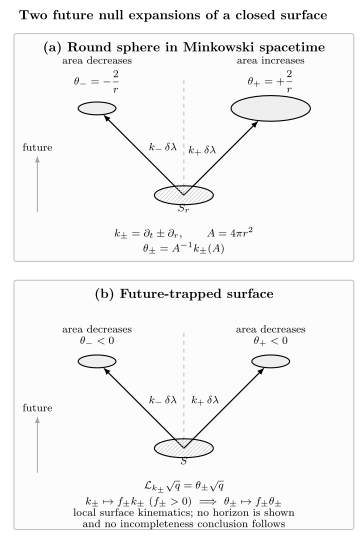
With future null normals normalized by , an ordinary Minkowski sphere has expansions and , whereas a future-trapped surface has two negative expansions. The normal-plane projection and displaced surface sizes are schematic, not to scale. The lower panel represents local expansion signs and does not locate an event horizon or establish incompleteness.
For a second check, use ingoing Eddington–Finkelstein coordinates in the Schwarzschild black-hole region,
and choose
For round spheres,
Outside the spheres are untrapped; at they are marginally outer trapped; inside, both future expansions are negative. This check uses a regular horizon-crossing chart and restores , so neither a coordinate singularity nor a mass-dimension ambiguity controls the sign change.
The numerical flat-space limits can look puzzling: setting gives and , rather than and from the first calculation. There is no disagreement. Since , the second pair becomes and . This is exactly the allowed boost with . Signs and the product agree. Comparing expansions requires comparing the null-normal normalization, even when the cross-normalization has already been fixed.
Quasi-local data and global consequences
Section titled “Quasi-local data and global consequences”The expansions of a fixed depend only on the metric and its first derivatives along that surface, once its null normals are chosen. In that sense trappedness is quasi-local. The existence of a closed trapped surface, the selection of an “outermost” one, and its location relative to infinity are nevertheless global questions on a slice or spacetime. Different slicings can contain different MOTSs even though the expansion signs of any one geometrically specified surface are invariant.
For the affinely parametrized, twist-free null geodesics normal to , null convergence and Raychaudhuri’s equation imply a focal point within affine interval if and the geodesics extend that far. If they do not extend that far, incompleteness is already present. The normalization used to specify must also fix the affine parameter; the bound changes consistently under a constant rescaling. The detailed kinematics belong to Null Focusing and Trapped-Surface Kinematics. Turning local focusing into a spacetime incompleteness theorem requires a separate compactness and achronality argument, supplied later by the Penrose singularity theorem.
A trapped surface is not an event horizon. The event horizon is the global boundary ; a trapped surface is codimension two and need not lie on any null boundary. Nor is a trapped surface a curvature singularity. The implication chain can fail when an energy condition, a causal hypothesis, asymptotic predictability, or completeness premise is absent. The physical comparison among horizons, trapped surfaces, and singularities is routed to Horizons, Trapped Surfaces, and Singularities.
Exercises
Section titled “Exercises”Verify the Schwarzschild expansions above directly from the change of area along the two null normals, and show that their sign classification is unchanged by the boost rescaling , with .
Solution
For any normal to a round sphere, . The chosen normals give
and hence the displayed expansions. At , while ; for both are negative. Under the positive boost, projection removes derivatives of because . Therefore is multiplied by and by . Positivity of both factors preserves zero and sign.