Local Balance Laws and Flux Integrals
Scrollable formula. Use Left and Right arrow keys to reveal hidden content.
Scrollable table. Use Left and Right arrow keys to reveal additional columns.
Scrollable figure. Use Left and Right arrow keys to inspect hidden content.
A divergence equation becomes a measurable finite-region balance law by integrating it and orienting every boundary outward: accumulation equals bulk production minus outward flux. Conservation is the source-free special case, and even then the content inside an open region can change.
Required background. Classical Fields and Their Actions supplies local field equations, while Events, Intervals, and Minkowski Geometry fixes causal and orientation conventions. Helpful background. Calculus and Linear Algebra for Relativity supplies the divergence theorem; Presymplectic Potentials and Currents develops boundary currents and their ambiguities.
Fixed spatial control volume
Section titled “Fixed spatial control volume”Assume first a continuously differentiable current in inertial Cartesian coordinates on Minkowski space,
where is the density, its spatial flux, and the production rate per spacetime volume. The simple component interpretation and measure below rely on this inertial slicing; the spacetime statement later is coordinate independent.
For a fixed region with outward unit normal , integrate at time :
The sign is operational. Positive leaves and reduces its content; negative outward flux is inward transport and increases it. The Euclidean divergence theorem and precisely this outward-positive convention are stated in MIT 18.02SC, “The Divergence Theorem,” p. 1, Eqs. (1)–(3).
If the boundary itself moves with velocity , Reynolds transport gives the relative-flux form
The term is swept content, not physical transport through a stationary surface. Setting recovers the boxed fixed-volume law.
For stress-energy,
gives the same law component by component. changes through the outward four-momentum flux and the applied force density . For , positive injects energy and is energy flux.
Spacetime slab and orientation
Section titled “Spacetime slab and orientation”Let be bounded by an initial spacelike slice , a final slice , and a timelike side . With a future-directed unit normal to each spacelike slice, define the future-oriented slice charge
The minus sign is required by : in an inertial frame, . A physical charge may of course have either sign.
For any smooth non-null boundary piece with outward unit normal , use the outward-normal-first directed measure
Keep future-directed on both caps and let be the outward unit spacelike normal on . Then
The final cap therefore contributes , the initial cap contributes , and the side contributes outward-positive flux.
Compare the two cap arrows in the figure. The final cap points outward toward the future, whereas the initial cap points outward toward the past. The arrows show outward boundary normals, not current trajectories. The vector remains the future-directed reference normal on both slices.
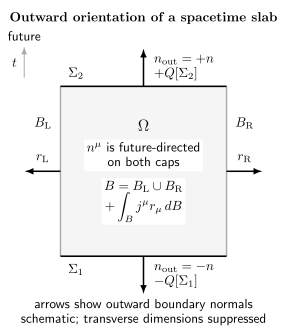
Outward normals point toward the future on the final cap, toward the past on the initial cap, and sideways on the timelike wall. Because is defined future-directed on both spacelike slices, the cap contributions are and ; both walls together give . The arrows denote boundary normals, not current trajectories. A -dimensional cross-section is shown; transverse dimensions are suppressed, and the figure is schematic and not to scale.
With those directed pieces fixed, Stokes’ theorem gives
This formula fixes all signs without treating a coordinate component as an invariant density. Reall states the induced-boundary orientation and Stokes theorem in Reall 2017, Chapter 9, §9.7, printed pp. 115–116, Eqs. (9.64)–(9.65). Tong, QFT §1.3.1, printed p. 13, Eqs. (1.31)–(1.33) gives the constant-time limit.
With no bulk source, a positive outward side-flux integral makes the later charge smaller.
When “conserved” is global
Section titled “When “conserved” is global”If , two slice charges agree only when the side flux vanishes or is included in the accounting. On all of space, this requires convergence and sufficient falloff at infinity. A nonzero source means the current describes a balance law, not a conservation law; sometimes the source is exchange with another subsystem, in which case adding both subsystem currents cancels it.
Across a smooth discontinuity hypersurface with conormal pointing from the minus side to the plus side, the distributional equation gives the jump condition
where is a surface source in the matching normalization. Without a surface source, the normal flux is continuous. This is the covariant ancestor of the Rankine–Hugoniot relations used in Fluid Waves, Shocks, and Instabilities.
Null boundaries need their natural directed surface element rather than a unit normal, because a null normal cannot be normalized to . Shocks and point particles replace classical derivatives by distributions, but the integrated statement remains well defined.
Exercise: luminosity through a sphere
Section titled “Exercise: luminosity through a sphere”A spherically symmetric system has no bulk source outside a compact core. A steady outward energy flux carries luminosity . Find the radial flux at radius . If the current accounts for the entire isolated system, so that its net bulk source also vanishes inside the sphere, find the rate of change of the enclosed energy. What changes if the chosen current instead describes a subsystem with production rate in the core?
Solution
Steady source-free balance in the exterior gives
so is independent of . By the definition of luminosity,
For a sphere outside the core, the outward normal is radial. For the source-free current of the complete isolated system,
The limit checks dimensions: energy per time divided by area is energy flux. If the current describes only a subsystem with nonzero production in the core, the balance law instead gives
Thus exterior flux alone does not determine the subsystem’s accumulation rate. If , the flux is inward and contributes positively to the enclosed energy.
Next connection
Section titled “Next connection”The same boundary analysis governs angular momentum. Angular Momentum, Spin Currents, and Symmetric Stress-Energy shows why a locally antisymmetric canonical tensor can exchange orbital and intrinsic angular momentum without violating the total balance.
References
Section titled “References”- Arthur Mattuck, “The Divergence Theorem,” MIT 18.02SC Multivariable Calculus, Fall 2010, official PDF, p. 1, Eqs. (1)–(3).
- Harvey S. Reall, General Relativity, University of Cambridge Part III lecture notes (2017), PDF, Chapter 9, §9.7, printed pp. 115–116, Eqs. (9.64)–(9.65).
- David Tong, Quantum Field Theory, University of Cambridge Part III lecture notes (2006/2007), official PDF, §1.3.1, printed p. 13, Eqs. (1.31)–(1.33).