Spherical Orbit-Space Geometry
Scrollable formula. Use Left and Right arrow keys to reveal hidden content.
Scrollable table. Use Left and Right arrow keys to reveal additional columns.
Scrollable figure. Use Left and Right arrow keys to inspect hidden content.
Quotienting a four-dimensional spherically symmetric spacetime by rotations leaves a two-dimensional Lorentzian orbit space , an invariant areal-radius function , and any rotation-invariant matter fields. On a regular region of spacelike two-sphere orbits, the full metric is the warped product ; all spherical field equations reduce to tensors and scalars on .
Required background. The Einstein Equation supplies the reduced field equations; Killing Fields and Isometry Groups supplies the group-action and orbit concepts.
Helpful background. The Riemann Curvature Tensor supplies the warped-product contractions; Formulations of General Relativity places this reduction among other formulations.
The SO(3) quotient
Section titled “The SO(3) quotient”Let a four-dimensional, time-oriented Lorentzian spacetime admit an effective local isometric action whose generic orbits are spacelike two-spheres. On a connected regular region away from fixed points and exceptional orbits, the quotient is two-dimensional and Lorentzian. Orthogonal transitivity follows from spherical symmetry, so in quotient coordinates ,
The scalar is not introduced by a coordinate choice. It is defined invariantly from the orbit area,
It can be used as a coordinate only where . A center is a fixed orbit with and requires separate smoothness conditions. A constant- region is an exceptional branch, not a failed coordinate gauge.
Connection and curvature
Section titled “Connection and curvature”Let and belong to , and write
Warped-product calculation gives
where is the unit-sphere metric. Mixed Ricci components vanish. Since in two dimensions, the base Einstein tensor becomes
and the angular block is
These identities are geometric and require no field equation. Substitution into Einstein’s equation turns the four-dimensional system into equations on . They can also be checked independently by inserting and itself: the resulting four-metric is Minkowski in spherical coordinates and every Ricci component vanishes.
Spherical matter data
Section titled “Spherical matter data”Rotation invariance constrains any symmetric stress tensor to a quotient block plus one angular-pressure scalar. The quotient block contains energy density, radial pressure, and radial flux relative to a chosen timelike quotient observer; there are no invariant mixed base–sphere components. Einstein’s base equations determine the Hessian and norm of , while the angular equation constrains the curvature of . Conservation supplies their compatibility relation.
This decomposition explains why spherical symmetry alone permits dynamics. A perfect fluid can change and in time, a null fluid can carry radial flux, and a scalar field can supply quotient anisotropy. Vacuum Birkhoff enhancement occurs only when the trace-free quotient source vanishes in the relevant field equations.
Invariant directions on the quotient
Section titled “Invariant directions on the quotient”Choose the quotient volume form consistently with the spacetime and sphere orientations. The Kodama vector is
It obeys
Thus is timelike where the areal-radius gradient is spacelike, null where it is null, and spacelike where it is timelike. In a dynamical spherical spacetime it need not be Killing. In vacuum Birkhoff reasoning, the trace-free reduced equation makes pure trace, which in turn makes Killing.
For future null vectors normalized by , the sphere expansions are
so
This gives a slicing-independent spherical diagnostic once the null normalization is stated.
The diagram below ties the quotient construction to that causal diagnostic. Read the upper panel as a local fiber picture on the regular region, then compare the three possible signs of in the lower panel.
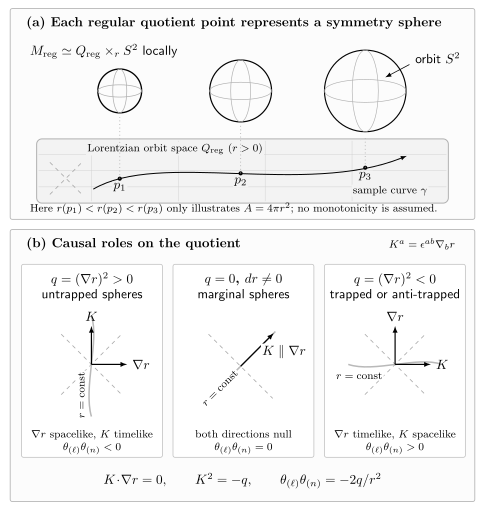
On the regular spherical-orbit region, each point of the two-dimensional Lorentzian quotient carries a round sphere of area ; the three fibers only illustrate different values of along one sample curve and do not assert monotonicity. With , is orthogonal to and has the opposite squared norm. Hence spacelike, null, and timelike correspond respectively to untrapped, marginal, and trapped or anti-trapped spheres through for . A symmetry center is a fixed-point orbit and is not represented as a sphere in the regular warped-product panel. The fiber and tangent-space drawings are schematic; the displayed identities and causal classifications are exact.
At an ordinary regular center, is a fixed point of the rotation group rather than a two-sphere orbit. Smoothness requires the circumference-to-radius relation to approach its flat value and, in suitable quotient coordinates, to approach one. A conical or distributional center violates those conditions. The formulas containing inverse powers of apply on and extend to a center only after this independent regularity check.
Schwarzschild provides another discriminant. On its exterior quotient, and is the normalized static generator. Inside the horizon the same invariant vector becomes spacelike while the quotient remains Lorentzian. The warped-product representation does not break at the horizon; only a diagonal choice of quotient coordinates does.
Regularity and scope
Section titled “Regularity and scope”The decomposition assumes ordinary spacelike orbits. It does not cover a symmetry center with the same coordinates, non-spherical constant-curvature orbit topology, distributional shells without junction data, or a region where the action changes orbit type. Global topology also does not follow from the local action. Schleich and Witt explicitly distinguish local from global spherical symmetry before proving their uniqueness result Schleich and Witt 2010, §II and Theorem 1, printed pp. 2–4, Open PDF. Bičák explains the invariant meaning of the Schwarzschild areal coordinate in Bičák 2000, §1.4, printed pp. 12–13, Open PDF.
The round-orbit assumption is consequential. Replacing the unit sphere by a flat or hyperbolic constant-curvature surface changes the constant angular-curvature term in the reduction. Such topological reductions are useful, but they are not the spherical theorem stated here.
Check your understanding
Section titled “Check your understanding”In a region with , what are the causal characters of and , and what does this say about the symmetry spheres?
Solution
Since , the areal-radius gradient is timelike. Because , the Kodama vector is spacelike. Also , so the two future null expansions have the same sign: the spheres are trapped if both are negative and anti-trapped if both are positive. The product alone does not decide which sign occurs.
References
Section titled “References”- Bičák, Jiří. “Selected Solutions of Einstein’s Field Equations: Their Role in General Relativity and Astrophysics.” Einstein’s Field Equations and Their Physical Implications, Lecture Notes in Physics 540 (2000), 1–126. arXiv:gr-qc/0004016, §§1.4 and 2.1, printed pp. 11–16 and 19–20.
- Schleich, Kristin, and Donald M. Witt. “A Simple Proof of Birkhoff’s Theorem for Cosmological Constant.” Journal of Mathematical Physics 51 (2010), 112502. doi:10.1063/1.3503447.