Why can a powerful star look faint?
Scrollable formula. Use Left and Right arrow keys to reveal hidden content.
Scrollable table. Use Left and Right arrow keys to reveal additional columns.
Scrollable figure. Use Left and Right arrow keys to inspect hidden content.
https://blackhole.org/universe/stars/brightness/
A distant streetlight can look fainter than a small lamp beside you. Stars pose the same problem on a much larger scale: what we receive depends both on what a source emits and on how far its light has spread.
To compare stars fairly, astronomers distinguish luminosity, the power a star emits, from flux, the power received per unit area. Distance connects them. Dust and the wavelengths we measure also matter.
Luminosity belongs to the source; flux describes the light here
Section titled “Luminosity belongs to the source; flux describes the light here”A star’s total luminosity counts the energy it emits each second across all wavelengths. Its unit is the watt, just as for other kinds of power. Astronomers call an all-wavelength measurement bolometric. What supplies that energy is a separate question, explored in why the Sun keeps shining.
Flux asks a different question: how much of that power reaches each square meter of a surface facing the incoming light? Its unit is watts per square meter. A telescope collects some of this incoming radiation and uses a calibrated detector to measure it.
Moving farther from a steady star does not reduce the star’s luminosity. It reduces the flux we receive. A larger telescope collects more light at the same location, but the astronomical flux per square meter is unchanged. The distinction between a detector’s collecting area and the incoming flux is part of photometry, the measurement of light (Wright 2004, “Flux”).
We will first imagine a steady star radiating equally in every direction, with no absorption between it and us. Distances are large compared with the star’s radius, and small enough that ordinary Euclidean geometry is appropriate.
Doubling the distance divides the flux by four
Section titled “Doubling the distance divides the flux by four”Imagine surrounding the star with a transparent sphere. All the outgoing light crosses that sphere. Now imagine a second sphere with twice the radius. The same power crosses it, but it has four times as much surface area. Each square meter therefore receives one-quarter as much power.
At three times the distance, the area is nine times as large and the flux is one-ninth as large. This is the inverse-square law. It follows from spreading light over a sphere, not from light “getting tired” as it travels (NASA/GSFC 2018, “Beam Me Up,” opening inverse-square explanation).
In the figure, each scene has the same source power and detector area. Compare the numerical bars as well as the distances.
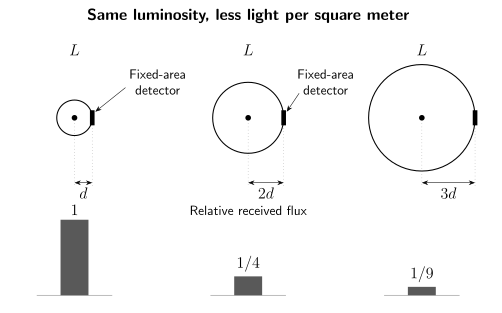
The emitted power is unchanged while the received flux falls as distance squared. The scenes are schematic cross-sections through spherical spreading; the bars quantitatively compare flux for equal luminosity, equal detector area, and no absorption.
| Distance from the same steady source | Relative sphere area | Relative received flux |
|---|---|---|
| 1 | 1 | |
| 4 | 1/4 | |
| 9 | 1/9 |
This also explains a fundamental ambiguity. A source with four times the luminosity at twice the distance gives us the same flux. Apparent brightness alone cannot tell us both luminosity and distance. A separate distance measurement, such as parallax, lets us infer how much power the star emits.
Show the mathematics: spreading power over a sphere
Write for luminosity, for distance, and for received flux. Since a sphere’s area is ,
The units are consistent: watts divided by square meters gives watts per square meter. Comparing two sources,
For and , the ratio is . These equations assume isotropic emission and no loss along the path. For distant cosmological sources, astronomers use a specifically defined luminosity distance; it need not equal other kinds of distance.
Magnitudes turn large ratios into manageable numbers
Section titled “Magnitudes turn large ratios into manageable numbers”Star catalogues often describe apparent brightness with a magnitude. The convention runs backward from everyday expectations: a larger magnitude means a fainter source. Negative magnitudes are allowed; they simply indicate sources brighter than the chosen zero point.
The scale is logarithmic. A difference of five magnitudes corresponds to a factor of 100 in flux. Thus a magnitude-8 star supplies one-hundredth the flux of a magnitude-3 star in the same measurement band and magnitude system. A difference of one magnitude corresponds to a factor of about 2.512 (Wright 2004, “Magnitude”).
To remove distance from the comparison, astronomers define absolute magnitude: the apparent magnitude a source would have at 10 pc, with interstellar extinction removed. It still matters which wavelengths we mean. A visual-band absolute magnitude is not the same quantity as an all-wavelength luminosity.
Try logarithms: connect flux, magnitude, and distance
For two fluxes measured in the same band and system,
The minus sign makes the larger flux have the smaller magnitude. For , the magnitude difference is .
Let be apparent magnitude and absolute magnitude in the same band. Using inverse-square dilution and neglecting extinction gives
At 10 pc, the logarithm is zero and . Moving the same source from 10 to 100 pc reduces its flux by 100 and increases its magnitude by five. Doubling its distance increases the magnitude by .
Bolometric magnitudes use the same logarithmic structure for all-wavelength luminosity and flux, with specified zero points (IAU 2015, Resolution B2, equations 2 and 4). A filter-band measurement cannot be silently substituted for the bolometric flux.
Dust and filters change the comparison
Section titled “Dust and filters change the comparison”A real detector usually samples a limited band of wavelengths. Two stars with the same total luminosity can distribute that energy differently across the spectrum, so one can be brighter in a blue filter and the other in an infrared filter. To infer total luminosity, astronomers need enough information about that distribution to estimate the unmeasured light.
Interstellar dust can absorb light and scatter it out of the direct path. It usually removes shorter-wavelength optical light more strongly, making a star appear dimmer and redder (ESA/Hubble 2023, explanation of extinction and reddening). Dust-corrected measurements and an appropriate model are needed before attributing all the dimming to distance. A star can also vary with time; comparing different observing dates may compare different source states.
The spectrum of starlight helps us investigate these effects. Distance, spectrum, and flux together tell a much richer story than “this star looks bright.”
Compare two equally bright dots
Section titled “Compare two equally bright dots”Stars A and B have the same measured flux in the same band. B is three times farther away. Assume no dust and steady, isotropic emission. Which has the larger luminosity in that band, and by what factor? If the spectra differ, have we also established the ratio of their total luminosities?
Answer and explanation
B has nine times A’s luminosity in the measured band. Its light spreads over nine times the area, so it must emit nine times the power in that band to give the same flux here.
We have not established the ratio of total luminosities if the spectra differ. We would need measurements or justified estimates across the remaining wavelengths. Nor could we infer the nine-to-one band luminosity ratio without checking our assumption about dust.
As a transfer question, suppose the two sources instead have the same luminosity and B is three times farther away. B’s flux is one-ninth of A’s. State what is held fixed before using the inverse-square rule.
For educators
Prepare two circles or spheres labeled with radii and , and equal detector-sized patches on each. The objective is to separate power emitted, power received per square meter, and power collected by a telescope. The main activity needs ratios; magnitudes add optional logarithms.
For a 5–10 minute activity, explain why the larger sphere has four times the area, then predict the flux on one patch. Expected reasoning holds luminosity fixed and spreads it over four times the area. Address the misconception that a bigger telescope changes the incoming flux per square meter: it changes the collected power.
For a 20-minute investigation, give groups equally bright sources at distance ratios of two or three. Ask them to infer band luminosity ratios, then introduce dust or different spectra. A good answer gives four or nine only under the original assumptions and says why the new information changes what can be inferred. Use the printed diagram and table; the magnitude formula is an extension, not required for the reasoning.
With luminosity separated from apparent brightness, the next puzzle becomes sharper: Why are some stars bright but cool?
References
Section titled “References”- ESA/Hubble (2023). Hubble Dispels Dust to See a Glittering Globular Cluster. 7 September 2023. Terzan 12 and interstellar reddening.
- International Astronomical Union (2015). Resolution B2 on Recommended Zero Points for the Absolute and Apparent Bolometric Magnitude Scales. Adopted 13 August 2015. Resolution; Open PDF.
- NASA Goddard Space Flight Center (2018). Beam Me Up: Student Handout. Neil Gehrels Swift Learning Center; updated 11 December 2018. Inverse-square and beaming explanation.
- Wright, E. L. (2004). Magnitudes and Colors. UCLA cosmology tutorial; updated 20 February 2004. Flux, magnitude, and absolute magnitude.