How do you weigh a star?
Scrollable formula. Use Left and Right arrow keys to reveal hidden content.
Scrollable table. Use Left and Right arrow keys to reveal additional columns.
Scrollable figure. Use Left and Right arrow keys to inspect hidden content.
https://blackhole.org/universe/stars/weighing-stars/
You cannot put a star on a balance, but you can watch what its gravity does. In a binary system, two stars orbit their shared center of mass. Measure the orbit’s size and how long it takes, and gravity connects those measurements to mass.
The important word is orbit. A single photograph gives positions on the sky, not the complete three-dimensional motion. We will first solve an ideal case, then ask what information real observations may be missing.
Two stars share one center
Section titled “Two stars share one center”Both stars move. The center of mass, or barycenter, lies closer to the more massive star. In an isolated binary, the more massive star travels around a smaller orbit; the less massive star travels around a larger one. They take the same time to complete a revolution.
Consider a deliberately constructed circular system viewed face-on. Star A orbits one astronomical unit from the center; star B orbits three astronomical units from it. One astronomical unit, or AU, is approximately the Earth–Sun distance. The stars are on opposite sides, so their separation is four AU.
The diagram compares orbital distances, not stellar sizes. Follow the two circles and notice that the central cross is not a third object.
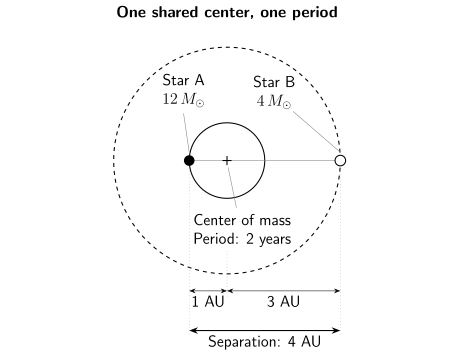
In this constructed circular binary, both stars complete an orbit in two years. Their one-to-three orbital-radius ratio implies a three-to-one mass ratio. Orbital distances share one scale; the star symbols do not represent physical radii.
The center-of-mass condition says mass times distance must balance on each side. Because A is three times closer to the center, it must have three times B’s mass. This gives a ratio. To get actual masses, we also need the period.
Orbital size and period reveal total mass
Section titled “Orbital size and period reveal total mass”Suppose this binary completes each revolution in two years. For an isolated system obeying Newtonian gravity, Kepler’s relation connects total mass with the cube of the relative orbit’s size divided by the square of its period (NASA/GSFC 2020, Eqs. 1–4).
With distances in AU and periods in years, the numerical relation is particularly convenient: total mass in solar masses is approximately orbital size cubed divided by period squared. For our system, four cubed divided by two squared is sixteen. Combining that total with the three-to-one ratio gives twelve solar masses for A and four for B.
| Quantity | Star A | Star B |
|---|---|---|
| Orbital radius in this circular example | 1 AU | 3 AU |
| Period | 2 years | 2 years |
| Inferred mass | 12 solar masses | 4 solar masses |
The relation also works for elliptical two-body orbits, provided we use the semimajor axis: half the ellipse’s longest diameter. The required relative semimajor axis is the sum of the two individual semimajor axes about the barycenter. It is not an arbitrary separation measured in one photograph.
Try the mathematics: combine a total and a ratio
For masses , individual semimajor axes , common period , and gravitational constant ,
Thus
The unit conversion is approximate at the precision used here. In our example, and , so . The two masses are and .
The approximation assumes an isolated Newtonian two-body system. Close compact binaries can need relativistic corrections, while interacting stars can exchange mass and disturb the simple picture.
What a real telescope may leave out
Section titled “What a real telescope may leave out”An angular separation on the sky needs a distance before it becomes a physical length. A tilted orbit also projects to a different shape. Several observations over time help separate orientation from the orbit’s actual shape and size.
Sometimes the telescope cannot distinguish the stars as separate points. Their spectral lines may instead shift back and forth as they approach and recede. This measures only the line-of-sight part of their velocity. A face-on circular orbit can have no orbital radial-velocity signal even though both stars are moving.
If only one star’s spectral motion is measured, the data usually constrain a combination of masses and orbital inclination, not a unique companion mass. Additional information—an eclipse, an astrometric orbit, or a justified estimate of the visible star’s mass—can reduce that uncertainty. Brightness alone cannot fill every gap.
Try the binary-star laboratory to turn the same orbit from edge-on to face-on. It connects the sky view to both radial-velocity curves and lets you construct two different systems with identical spectroscopic signals. For the distance behind a resolved orbit’s physical scale, see stellar parallax.
Predict a slower binary
Section titled “Predict a slower binary”A second binary has the same four-AU relative semimajor axis but takes four years instead of two. Is its total mass larger or smaller? What can you say about its individual masses?
Answer and transfer
Its total mass is smaller: solar masses. Doubling the period at fixed orbital size divides the inferred total mass by four.
The individual masses are still unknown unless we have the mass ratio. If the individual orbital sizes are again one and three AU, the masses are three and one solar masses. Without that information, many pairs add to four.
For another check, keep the period fixed and double the relative semimajor axis. The inferred total mass becomes eight times larger. Always state which measurement is held fixed; “a wider binary is heavier” by itself is incomplete.
For educators
Prepare separate cards for the period, the relative orbital size, and the two distances from the center of mass. The objective is to identify which information gives a total mass, which gives a mass ratio, and when individual masses follow. No astronomy background is needed; ratios and simple algebra support the calculations.
For a 5–10 minute activity, distribute the cards between two groups and ask what each can conclude before sharing. Expected reasoning gives a three-to-one mass ratio from the one-to-three orbital-radius ratio, and a total of sixteen solar masses only after using the two-year period and four-AU relative size. Address the misconception that the larger orbital radius belongs to the more massive star.
For a 20-minute investigation, change the period while holding orbital size fixed, then change the viewing direction using the lab or a tilted paper sketch. Successful answers divide the total mass by four when the period doubles, but do not interpret an apparently smaller projected orbit as a smaller physical orbit without an orientation model. Ask students to label each conclusion “total,” “ratio,” or “individual mass” and name the missing information.
Mass is a crucial input to a stellar model. To connect it to a star’s long-lived energy supply, continue with why the Sun keeps shining.
References
Section titled “References”- NASA/Goddard Space Flight Center (2020). Deriving Kepler’s Formula for Binary Stars. Imagine the Universe!, updated 23 September 2020. Derivation, Eqs. 1–4.
Further reading
Section titled “Further reading”For an optional derivation of the shared center and relative orbit, read The Newtonian Two-Body Problem. Preparation: Newtonian mechanics, calculus, and vectors.