Are we alone?
Scrollable formula. Use Left and Right arrow keys to reveal hidden content.
Scrollable table. Use Left and Right arrow keys to reveal additional columns.
Scrollable figure. Use Left and Right arrow keys to inspect hidden content.
https://blackhole.org/universe/life/are-we-alone/
We know that life exists on Earth. We do not yet know whether it exists elsewhere. As checked on 27 September 2026, no life beyond Earth has been confirmed; NASA reports no credible evidence of extraterrestrial life (NASA, UAP FAQs, question 1).
That unanswered question can still guide precise investigations. Scientists search for environments that could support life, signs that life may have changed an environment, and possible traces of technology. Each search needs a way to distinguish its hoped-for signal from alternatives.
Habitable does not mean inhabited
Section titled “Habitable does not mean inhabited”An environment is habitable when conditions could support a specified kind of life. For life as we know it, liquid water, useful chemical ingredients, and accessible energy are important. Finding one of these is a reason to investigate, not a detection of organisms.
The familiar “habitable zone” around a star concerns where surface liquid water might be possible under suitable atmospheric conditions. It does not guarantee oceans or life, and it does not include every possible habitat: subsurface environments can be important too.
This distinction also applies to molecules. Organic molecules contain carbon in particular chemical structures; the word does not establish that living things made them. Likewise, detecting a planet is an achievement of its own, but a transit does not by itself reveal whether the planet is inhabited.
A possible biosignature needs an environment
Section titled “A possible biosignature needs an environment”A biosignature is a feature that can provide evidence of past or present life. Potential examples include particular chemical patterns, structures in rocks, or atmospheric gases. Interpretation depends on whether nonliving processes can produce a similar result (NASA, “What is a biosignature?”, grades 9–12).
Oxygen illustrates the challenge. On Earth, photosynthetic life maintains a large atmospheric oxygen supply. But nonbiological chemistry can also produce oxygen in some planetary environments. A detection therefore invites questions about the host star, other gases, surface conditions, and which processes produce and remove the oxygen. A published example explores an abiotic photocatalytic source (NASA 2015, oxygen study summary).
The diagram starts with a hypothetical oxygen signal. The branches represent explanations to test, not equally likely outcomes and not numerical probabilities.
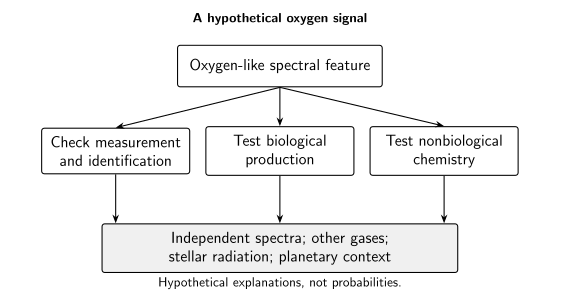
Useful follow-up distinguishes competing explanations. This schematic is a hypothetical investigation, not a reported life detection or a confidence scale. Agreement between repeated measurements establishes the signal more securely; environmental evidence is still needed to interpret its cause.
| Hypothetical observation | Possible interpretation | Alternative to test | Useful follow-up |
|---|---|---|---|
| Oxygen-like spectral feature | Biological oxygen production | Nonbiological chemistry or a mistaken spectral identification | Other gases, stellar radiation, and independent spectra |
| Organized structures in a sample | Past biological activity | Mineral growth or contamination | Chemistry, geological context, and independent sample analysis |
| Repeating narrow-band radio signal | Technology | Human interference or an instrumental effect | Independent instruments and tests of sky position |
No single checklist makes a discovery automatic. Green and colleagues proposed a framework for communicating evidence gradually, emphasizing that false starts are part of scientific investigation. It was a proposal for discussion, not a universally adopted certification scale (Green et al. 2021, abstract).
A spectrum tests chemistry before it tests biology
Section titled “A spectrum tests chemistry before it tests biology”A distant planet is usually unresolved: its atmosphere does not arrive as a labeled sample. Researchers compare its measured spectrum with models of absorption, emission, clouds, and the instrument. Different combinations of gases and atmospheric conditions can sometimes explain similar features.
Keep three questions separate:
| Question | Evidence needed | What remains open |
|---|---|---|
| Is the spectral feature real? | Repeatable measurements and checks of calibration and noise | Its chemical identity |
| Does a particular gas explain it? | Several compatible spectral features and comparisons with alternative atmospheric models | How that gas was produced |
| Does biology best explain the gas in this environment? | A production-and-removal model, planetary context, and tests of nonbiological sources | Residual uncertainty and untested explanations |
These are connected questions, not automatic promotion steps. A highly significant departure from one noise model is not the same number as the probability that life exists. Catling and colleagues’ assessment framework explicitly compares the data expected with and without life in a specified environment, including assumptions about how likely life was beforehand (Catling et al. 2018, §2, pp. 710–713, PDF).
The opposite mistake is also possible. Life might exist without making a globally detectable signal: a small subsurface ecosystem, for example, need not change an entire planet’s observed spectrum. A nondetection constrains signals of the kinds and strengths the observations could have found; it does not automatically establish a lifeless planet (Schwieterman et al. 2018, §8, pp. 694–695, PDF).
Together with habitability, these distinctions help choose the next useful observation. Improving a noisy spectrum tests the feature. Measuring other gases or the star’s radiation can test its cause. The best next step depends on which uncertainty is limiting the conclusion.
Technology is another kind of searchable trace
Section titled “Technology is another kind of searchable trace”For a complete signal-evaluation example, investigate how we would recognize a signal from another civilization. It separates a detected feature from its interpretation and asks which follow-up could expose interference.
A technosignature would be evidence of technology beyond Earth. Radio searches look for particular patterns, but a surprising signal must first survive tests for terrestrial interference and instrument behavior. Repetition at an independent observatory is valuable; so is showing that the signal follows a specific celestial source rather than appearing wherever the telescope points.
A search with no detection also says something, but its scope matters. It may have tested certain directions, frequency ranges, signal strengths, and times. It cannot establish that no technology exists anywhere.
Even a confirmed detection would not guarantee a conversation. For a hypothetical source four light-years away, a light-speed message takes four years to arrive. An immediate reply takes another four years to return, neglecting relative motion. Distance is a physical communication limit, not merely a delay in our instruments.
Try the mathematics: what the Drake equation can organize
Preparation: multiplying factors, interpreting fractions, and checking units.
One conditional estimate writes
is the rate of suitable star formation in the Milky Way; is the fraction with planets; is the average number of suitable planets per planetary system. The next fractions concern the appearance of life, intelligence, and detectable technology. is the average duration of the detectable phase, while is an estimated number of detectable civilizations in our Galaxy. These definitions organize the question rather than solve every factor (SETI Institute, “Drake Equation,” term definitions).
With in inverse years and in years, the units cancel. Holding every other assumption fixed, ten times longer detectability gives ten times larger . That is a sensitivity calculation, not a measurement that civilizations are common. Poorly known factors cannot become reliable simply by multiplying them.
Choose a follow-up that could change your mind
Section titled “Choose a follow-up that could change your mind”A telescope finds a repeating radio signal. It appears at the same strength when the telescope points toward the candidate star and when it points elsewhere. Which deserves priority: announcing a civilization, drawing its imagined planet, or checking local interference?
Answer and transfer
Check local interference and instrument behavior. A signal that does not depend on pointing toward the proposed source weakens that source interpretation. Independent measurements and a careful directional test can help distinguish the explanations.
For the oxygen example, the parallel move is to test the measurement and environmental chemistry. Another attractive image would not settle whether biology produced the gas. A useful observation is one for which the competing explanations predict different outcomes.
For educators
Preparation and objective. No prior astrobiology is needed. Students should distinguish suitable conditions, a measured signal, and a biological interpretation; the optional equation uses products and units.
Short activity, about 10 minutes. Choose one hypothetical observation from the first table and propose an alternative explanation and a follow-up. Expected answer: a useful test makes competing explanations predict different outcomes, such as checking whether a radio signal follows the target direction.
Longer extension, about 30 minutes. Give groups the same hypothetical atmospheric feature and assign measurement, gas-identification, and biological-cause questions. Each group proposes a check, then explains which conclusions its check cannot establish. Include a nondetection case: students should specify the signal strength and wavelength range that were tested before claiming absence.
Misconception to discuss. “A robust gas detection is a robust life detection.” Confirming the gas still leaves its sources and sinks to explain. The radio answer above makes the same point about a source interpretation. Avoid voting on whether aliens exist or inventing confidence percentages from incomplete information.
References
Section titled “References”- Catling, D. C., et al. (2018). “Exoplanet Biosignatures: A Framework for Their Assessment.” Astrobiology 18, 709–738. DOI; Open PDF.
- Green, J., Hoehler, T., Neveu, M., Domagal-Goldman, S., Scalice, D., and Voytek, M. (2021). “Call for a Framework for Reporting Evidence for Life Beyond Earth.” Nature 598, 575–579. Open manuscript, arXiv:2107.10975; published article DOI.
- NASA (2015). Oxygen on Exoplanets Isn’t Proof of Life. NASA Science, 9 September 2015. Study summary.
- NASA. UAP FAQs, questions 1–2; accessed 27 September 2026. Current evidence statement.
- NASA. What Is a Biosignature? Astrobiology Learning Progressions, grades 9–12. Educational explanation.
- Schwieterman, E. W., et al. (2018). “Exoplanet Biosignatures: A Review of Remotely Detectable Signs of Life.” Astrobiology 18, 663–708. DOI; Open PDF.
- SETI Institute. Drake Equation. SETI 101. Definitions and interpretation.