Why do some dead stars pulse?
Scrollable formula. Use Left and Right arrow keys to reveal hidden content.
Scrollable table. Use Left and Right arrow keys to reveal additional columns.
Scrollable figure. Use Left and Right arrow keys to inspect hidden content.
https://blackhole.org/universe/stellar-evolution/neutron-stars/
A telescope can receive a remarkably regular sequence of flashes from the remains of a star. In many cases, the object is a pulsar: a rotating neutron star whose changing viewing geometry produces a repeating signal.
“Dead star” is shorthand for a remnant that no longer lives by ordinary core hydrogen fusion. It does not mean dark, cold, or inactive. A neutron star can retain heat, spin, carry a strong magnetic field, and interact with surrounding matter. A pulse need not be a new explosion.
A neutron star packs stellar mass into a small remnant
Section titled “A neutron star packs stellar mass into a small remnant”When some massive stellar cores collapse, the outcome is a neutron star rather than a black hole. Matter becomes extraordinarily dense, and reactions convert many protons and electrons into neutrons. The resulting object is neutron-rich, but it is not simply a ball made only of neutrons.
Its outer crust contains nuclei and electrons. Deeper inside, the composition and pressure depend on the behavior of very dense matter. Quantum effects and particle interactions provide pressure; relativistic gravity is essential to a realistic model. Which forms of matter occur in the deepest core remains an active research question (Lattimer and Prakash 2007, §§I–II and V, PDF).
A useful scale is a mass comparable to the Sun’s compressed into a radius of roughly a dozen kilometers. Individual masses and radii differ; this is an order-of-magnitude description, not one universal size. Nor does every massive star follow this pathway: mass loss, composition, and companions affect stellar endings.
Estimate a density without pretending to know the interior
Construct an example with mass and radius . Dividing mass by the volume of a sphere gives
This scale estimate uses Euclidean volume. It is neither a measured density profile nor the proper-volume average of a relativistic stellar model. The central density need not equal it.
At fixed mass, halving the radius makes this estimate eight times larger, because the volume decreases by . That calculation illustrates how compactness changes density; it does not prove that the smaller imagined star could remain stable. Stability requires a dense-matter model and relativistic gravity.
A rotating beam can make steady emission look intermittent
Section titled “A rotating beam can make steady emission look intermittent”A lighthouse keeps its lamp on while the beam turns. Someone at one fixed position sees the light brighten only when the beam points toward them. Pulsar signals can work in a related way: radiation concentrated in particular directions sweeps through our line of sight as the neutron star rotates.
The magnetic field shapes the surrounding plasma and emission. The magnetic and rotation axes need not line up, and the observer’s direction matters. Radiation patterns differ among radio, X-ray, and gamma-ray pulsars; a lighthouse is a geometry model, not a complete account of how the radiation is produced (NASA/GSFC 2017, “Pulsars”).
In the simple drawing below, keep your eye on the observer at the right. The observer stays put; the same beam turns. The three panels show times within one rotation period, called .
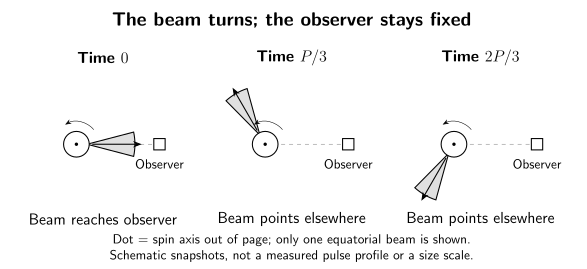
In this one-beam toy geometry, the emitter keeps radiating as the star rotates, but the fixed observer sees a pulse only when the beam points toward them. The spin axis points out of the page and the illustrated beam sweeps in the page. Real neutron-star emission has a more complicated three-dimensional geometry and may produce several peaks per rotation. Schematic, not to scale.
An observer outside the beam’s swept region would miss these pulses. A neutron star may also be too faint, or lack detectable beamed emission in the wavelengths being measured. Failing to see a pulse therefore does not prove that no neutron star is present.
Conversely, a periodic signal alone does not identify a pulsar. Orbiting objects, eclipses, and variable stars also repeat. Astronomers compare the timescale, spectrum, pulse shape, location, and other evidence before interpreting a source.
Period tells us about rotation, not the whole star
Section titled “Period tells us about rotation, not the whole star”Suppose the same recognizable pulse pattern returns at 0.0, 0.4, 0.8, and 1.2 seconds. Its repeat period is 0.4 seconds; it repeats 2.5 times each second. Frequency counts cycles per second, measured in hertz.
Connect period and frequency
For one complete repeating pattern per rotation,
If the period doubles, the frequency halves. But a real profile can have more than one peak per rotation. Two similar peaks do not automatically mean two full rotations. Identifying the repeating shape and its harmonics is part of the measurement.
This period by itself does not determine the mass or radius. Many different objects could share one rotation period. Additional observations and a model are needed to connect the timing to stellar structure.
Why can a compact remnant spin rapidly? Contraction can increase rotation speed when angular momentum is approximately conserved. A figure skater drawing in their arms offers a useful analogy, although a collapsing star also loses matter and can exchange angular momentum.
Try a rotation estimate: shrinking can shorten the period
The moment of inertia measures how the distribution of mass affects rotation about an axis. In a Newtonian toy model, , where is mass, is radius, and is a dimensionless factor describing that distribution. With rotation period , angular momentum is .
Hold mass fixed, preserve the same relative distribution of matter, and allow no external torque. Then and are constant, so
Halving the radius quarters the period. This toy scaling explains the direction of the effect, not the actual birth period of a neutron star. Real collapse changes the mass distribution, can eject matter and angular momentum, and eventually requires relativistic stellar physics.
Rotation can supply the energy we observe
Section titled “Rotation can supply the energy we observe”For a rotation-powered pulsar, radiation and escaping particles draw on rotational energy. Its spin generally slows over long times. Timing observations can measure a gradually increasing period, although individual stars can also show timing noise and sudden changes called glitches. The Crab pulsar is a classic example connecting a slowing remnant with an energized surrounding nebula (Fraknoi, Morrison, and Wolff 2022, §23.4, “Tests of the Model”).
Not all neutron-star emission draws on the same supply. Accreting systems release gravitational energy from infalling matter; cooling surfaces emit stored heat; magnetar activity draws strongly on magnetic energy. “It emits light” is therefore not the same statement as “hydrogen fusion powers it.” Compare the different supplies with the Sun’s nuclear energy.
The evidence can go beyond timing. NASA’s NICER mission measures X-ray pulse profiles, including how brightness changes through a rotation. Researchers compare those profiles with models of emitting surface regions and light propagation in curved spacetime to infer mass and radius. The inference depends on the emission geometry and other model assumptions; it is not a direct photograph of the interior (Riley et al. 2019, abstract).
This is a recurring astronomical method: observe a signal, calculate what candidate models predict, and check which models remain consistent with the data. A successful model must explain more than a regular flash.
Move the observer, then change the star
Section titled “Move the observer, then change the star”In our one-beam toy, observer A lies in the plane swept by the beam. Observer B lies far above that plane and outside the beam. Which observer sees periodic pulses? If the rotation period becomes twice as long while the beam geometry stays fixed, what changes?
Answer and a test of the interpretation
A sees pulses when the beam crosses their direction. B does not see this beam, even though both observers are looking toward the same rotating star.
Doubling the period doubles the interval between corresponding pulses and halves their repetition frequency for A. It does not make the beam point toward B. Visibility and repetition rate answer different questions.
Now imagine two equally spaced, identical beams rather than one. Successive peaks could arrive half a rotation apart. A measured separation between peaks would then need interpretation before being called the rotation period. Additional features in the pulse profile or other observations can help distinguish these possibilities.
For educators
No astronomy background is required. Prepare a paper circle, an arrow for a beam, and two observer markers; ratios help with the optional calculations. The objective is to distinguish rotation, pulse visibility, and energy supply, and to state what a periodic signal leaves unknown.
For a 5–10 minute activity, rotate the paper arrow while the observer markers remain fixed. Ask students to mark phases at which each observer receives light. Expected reasoning refers to direction and rotation, rather than a lamp switching on or a fresh explosion. A drawn beam avoids flashing lights and requires no device.
For a 20-minute investigation, compare one-beam and two-beam paper models, then interpret the synthetic pulse times above. Ask what happens when the observer moves outside the swept region and what extra evidence would support a neutron-star interpretation. Successful answers separate “no detected pulses” from “no neutron star,” and do not infer mass, radius, or an interior composition from the period alone.
To see how gravity reveals a mass, try weighing stars in binary systems. To compare neutron stars with objects that have horizons, continue to Black Holes: Start Here.
References
Section titled “References”- Fraknoi, A., Morrison, D., and Wolff, S. C. (2022). Astronomy 2e. OpenStax, Rice University, §23.4, “Pulsars and the Discovery of Neutron Stars.” Pulsar model and tests.
- Lattimer, J. M., and Prakash, M. (2007). “Neutron Star Observations: Prognosis for Equation of State Constraints.” Physics Reports 442, 109–165. DOI; Open PDF.
- NASA/Goddard Space Flight Center (2017). Neutron Stars. Imagine the Universe!, sections “Pulsars” and “Magnetars”; text updated March 2017. Neutron-star emission.
- Riley, T. E., Watts, A. L., Bogdanov, S., et al. (2019). “A NICER View of PSR J0030+0451: Millisecond Pulsar Parameter Estimation.” The Astrophysical Journal Letters 887, L21. DOI; open manuscript.
Further reading
Section titled “Further reading”For optional treatments of the two physical questions, read Neutron-Star Composition for the layers and uncertain core, and The Rotating Magnetic-Dipole Model for a model of rotational energy loss and its limits. Preparation: university thermodynamics, electromagnetism, calculus, and general relativity.