Why do we have seasons?
Scrollable formula. Use Left and Right arrow keys to reveal hidden content.
Scrollable table. Use Left and Right arrow keys to reveal additional columns.
Scrollable figure. Use Left and Right arrow keys to inspect hidden content.
https://blackhole.org/universe/sky/seasons/
Earth’s seasons begin with a tilted axis. During one part of our yearly orbit, the Northern Hemisphere receives sunlight for longer each day and the midday Sun stands higher. Six months later, the Southern Hemisphere has that advantage. The changing distance from Earth to the Sun affects the sunlight we receive, but it cannot explain these opposite seasons on the same planet.
For more context, Sky coordinates introduces altitude: an object’s angle above the horizon. This page explains the particular angles it needs.
Predict first. Imagine Earth kept its present orbit but its spin axis stood perpendicular to the orbital plane. Would June still bring long northern days and short southern days?
A tilted Earth keeps its direction
Section titled “A tilted Earth keeps its direction”Earth rotates around an imaginary line through its poles, its spin axis. That axis makes an angle of about 23.4° with the direction perpendicular to Earth’s orbital plane. Over a single year, it points in nearly the same direction in space. The axis does not turn to keep the North Pole facing the Sun.
Compare the two positions below. In June the north end leans toward the Sun; in December it leans away. The south end necessarily does the opposite. This geometry accounts for the reversed seasonal pattern in the two hemispheres. USNO n.d., “The Seasons and the Earth’s Orbit,” § The Tilt of the Earth’s Axis and its Elliptical Orbit
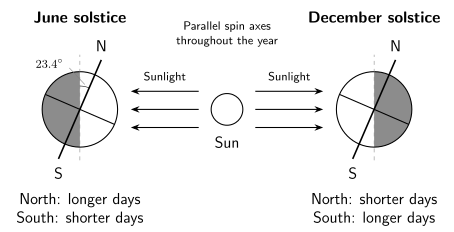
One tilt, opposite seasons. The same axis direction gives the Northern Hemisphere more direct sunlight and longer days in June, and the Southern Hemisphere that advantage in December. This side view shows the solstice geometry; body sizes and separations are schematic. White halves face the Sun; dashed lines are perpendicular to the orbital plane.
Notice what does not happen: Earth does not lean one way in June and reverse its lean in December. Its position relative to the Sun changes. Keeping that distinction clear makes the rest of the explanation much easier.
Higher sunlight and longer days
Section titled “Higher sunlight and longer days”First consider the Sun’s height. A beam falling straight onto a surface concentrates its energy on a smaller area than the same beam meeting that surface obliquely. You can model this indoors by shining an ordinary torch onto a card, then tilting the card. The patch spreads out. The torch has not become weaker; the same beam covers more surface.
Now consider duration. A place in the hemisphere tilted toward the Sun follows a longer path through daylight as Earth rotates. It receives sunlight for more hours. Near that hemisphere’s pole, the whole daily circle can remain on the illuminated side: the Sun does not set. The opposite polar region can stay in darkness. NASA Space Place 2025, “What Causes the Seasons?,” § It’s all about Earth’s tilt
The following calculation separates these effects. It describes an imaginary observer at latitude 45° north, with a level horizon and no atmosphere. “Daylight” here means the time the centre of the Sun is geometrically above the horizon. These are model values, not a local sunrise forecast.
| Seasonal position | Midday Sun’s altitude | Geometric daylight |
|---|---|---|
| June solstice | 68.4° | About 15.4 hours |
| Either equinox | 45.0° | 12.0 hours |
| December solstice | 21.6° | About 8.6 hours |
In June, this observer gets both a higher midday Sun and a longer exposure to daylight. At 45° south, exchange the June and December rows. The geometry reverses even though both observers are almost the same distance from the Sun.
Solstices and equinoxes are landmarks
Section titled “Solstices and equinoxes are landmarks”A solstice occurs when the Sun reaches its greatest angular distance north or south of the celestial equator. The June solstice gives the Northern Hemisphere its longest daylight and the December solstice its shortest, subject to the special polar cases. An equinox occurs when the Sun crosses the celestial equator between those extremes.
“Equal night” is a useful memory aid for equinox, but observed daylight is not exactly twelve hours everywhere. We see the Sun’s upper edge before its centre rises, and Earth’s atmosphere bends light so that the Sun can appear above the horizon while geometrically below it. Landscape and observer height matter too. Our simplified table deliberately leaves these effects out. USNO n.d., “Length of Day and Night at the Equinoxes,” sunrise and refraction discussion
These landmarks describe sunlight, not a promise about tomorrow’s weather. Land and oceans store heat, and winds, clouds, and ocean currents affect temperature. The hottest or coldest part of the year therefore need not fall on a solstice. Tropical regions may have more conspicuous wet and dry seasons than the familiar four-season pattern of many temperate climates.
Distance is a useful check
Section titled “Distance is a useful check”Earth’s closest approach to the Sun currently occurs in early January; its farthest occurs in early July. That alone defeats the idea that northern summer must mean “closer to the Sun.” Distance changes do affect received sunlight, and can influence seasonal differences, but the yearly tilt geometry explains why north and south receive opposite patterns. NASA Space Place 2025, § Earth’s lopsided orbit
The opening prediction now has an answer. With zero tilt, the strong yearly north–south exchange would disappear. An ideal spherical Earth would have roughly twelve geometric daylight hours at nonpolar latitudes throughout the year. Its changing orbital distance would still vary the incoming sunlight for both hemispheres together.
Show the math: turn a solar direction into daylight
This extension uses trigonometry. Let the observer’s latitude be , positive northward, and the Sun’s declination be , its angle north of the celestial equator. At local solar noon the Sun reaches altitude
For and , this gives . The opposite solstice uses , giving .
To calculate duration, let measure Earth’s rotation from local solar noon. Taking the dot product of the direction toward the Sun and the observer’s upward direction gives
At the ideal horizon, . Thus the sunset angle and daylight duration satisfy
where is in radians in the duration formula. At 45° north this gives 15.419, 12, and 8.581 hours for the table’s three declinations. The calculation holds declination fixed over a day. If the required cosine is outside , there is no ordinary horizon crossing: the polar-day or polar-night case needs separate treatment.
Try the other hemisphere
Section titled “Try the other hemisphere”Two schools at 45° north and 45° south compare June daylight. One student says the southern school must be farther from the Sun because it has the shorter day. How would you correct the explanation?
Answer
Use the axis, not distance, to explain the difference. The northern school’s daily path spends more time on Earth’s illuminated half in June, while the southern school’s spends less. Our model gives about 15.4 versus 8.6 daylight hours. Both schools share Earth’s orbital distance to excellent approximation; their positions and the tilted axis determine how sunlight meets the surface.
For classrooms and clubs
Preparation: labelled diagrams, paper, and optionally a card and ordinary torch. Objective: explain solar height and daylight duration as two distinct consequences of tilt. In 15 minutes, keep a drawn axis pointing the same way while placing Earth on opposite sides of a drawn Sun; label the hemisphere with longer days. The north has longer days in June and the south in December because the same axis direction produces opposite Sun-facing tilts at the two positions. The common error is rotating the axis toward the Sun at both positions.
For a longer extension, calculate or graph the three table rows for latitude 30° north. The model gives June/equinox/December noon altitudes of 83.4°/60°/36.6° and daylight durations of about 13.9/12/10.1 hours. Compared with 45° north, the noon Sun is higher and the seasonal daylight swing is smaller. The table and spoken hemisphere comparisons support a seated or nonvisual discussion. Keep lamps away from faces; this activity requires no solar viewing.
Next, connect the seasonal year to calendar rules, or investigate a different orbital tilt in eclipses.
References
Section titled “References”- NASA Space Place. “What Causes the Seasons?” NASA/JPL-Caltech, updated July 29, 2025. Tilt and orbital-distance explanation.
- U.S. Naval Observatory. “Length of Day and Night at the Equinoxes.” Astronomical Applications Department, n.d. Sunrise definitions and refraction. Accessed September 27, 2026.
- U.S. Naval Observatory. “The Seasons and the Earth’s Orbit.” Astronomical Applications Department, n.d. Obliquity and orbital geometry. Accessed September 27, 2026.