Why do we need leap years?
Scrollable formula. Use Left and Right arrow keys to reveal hidden content.
Scrollable table. Use Left and Right arrow keys to reveal additional columns.
Scrollable figure. Use Left and Right arrow keys to inspect hidden content.
https://blackhole.org/universe/sky/time-and-calendars/
Earth does not complete its seasonal cycle in a whole number of days. A calendar that counted exactly 365 days every year would gradually drift through the seasons. Leap days are a carefully chosen correction: occasional extra days keep a civil calendar close to an astronomical cycle.
Predict first. The years 2000 and 2100 are both divisible by four. Does the Gregorian calendar give both of them a February 29? Try deciding before reading the rule.
Natural cycles do not fit into neat boxes
Section titled “Natural cycles do not fit into neat boxes”A day connects to Earth’s rotation. A year connects to Earth’s motion around the Sun. A lunar phase cycle connects to the changing Sun–Earth–Moon geometry. These are different motions, so nature has no reason to make one an exact whole-number multiple of another.
For a calendar that follows the seasons, the relevant cycle is the tropical year, approximately 365.2422 days. That extra 0.2422 day is nearly six hours. Ignore it for a century and the calendar becomes roughly 24 days out of step with the seasonal cycle. USNO n.d., “Leap Years,” § Background
The Moon’s phase cycle lasts about 29.5 days. Twelve such cycles total roughly 354 days, noticeably shorter than a seasonal year. This is why simply making every month one lunar cycle does not also produce a 365-day year. Different calendar systems choose different ways to handle the mismatch; here we focus on the Gregorian calendar. NASA n.d., “Moon Phases,” § All Moon Phases
The Gregorian rule
Section titled “The Gregorian rule”The Gregorian calendar uses three steps:
- A year divisible by 4 normally has an extra day.
- A year divisible by 100 does not have that extra day.
- A year divisible by 400 does have it after all.
Thus 2024 is a leap year, 2100 is not, and 2000 is. The century exceptions make the average year slightly shorter than the simple every-four-years rule. USNO n.d., “Leap Years,” § The Rule
The diagram counts the leap days in one complete 400-year cycle. Check why its first century has one more than the other three.
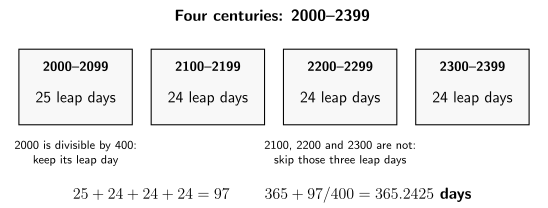
The Gregorian 400-year rule adds 97 days, making the average year 365.2425 days. The diagram illustrates calendar arithmetic for 2000–2399; it does not depict the historical adoption of calendars in different countries.
| Year | Divisible by 4? | A century year? | Divisible by 400? | February 29? |
|---|---|---|---|---|
| 2024 | Yes | No | No | Yes |
| 2025 | No | No | No | No |
| 2000 | Yes | Yes | Yes | Yes |
| 2100 | Yes | Yes | No | No |
| 2400 | Yes | Yes | Yes | Yes |
A useful method is to check divisibility by 400 first, then 100, then 4. This prevents you from stopping too early at “divisible by four.”
A correction, not a perfect copy of nature
Section titled “A correction, not a perfect copy of nature”If every fourth year were a leap year, the average length would be 365.25 days. That is close to the seasonal cycle but a little too long. Skipping three leap days every 400 years improves the match to 365.2425 days.
The remaining difference from the quoted 365.2422 days is small, but the astronomical cycle itself is not a fixed decimal forever. Earth’s motions have slow changes and irregularities. A calendar is a useful convention, not an exact machine that reproduces every detail of celestial motion.
Nor does a leap year explain why seasons occur. Earth’s tilted rotation axis changes how directly sunlight strikes each hemisphere and how long the Sun stays above the horizon. Leap-day rules help dates stay aligned with that repeating pattern; they do not cause it. Northern and southern hemispheres have opposite seasons on the same date. USNO n.d., “The Seasons and the Earth’s Orbit,” seasonal explanation
Show the math: 97 leap days
In 400 consecutive Gregorian years, there are 100 multiples of four. Remove the four century years, then restore the one divisible by 400:
Therefore the total number of days is , and the mean year is
The calendar pattern repeats after 400 years. Applying this rule to dates before a place adopted it is called using the proleptic Gregorian calendar; it need not match the calendar that people there actually used.
What would happen without the correction?
Section titled “What would happen without the correction?”Imagine a school that defines its “year” as exactly 365 days forever. After about a century, would its anniversary occur at the same point in the seasons?
Answer
No. Its year is about 0.2422 day shorter than the seasonal cycle, so its anniversary arrives about 24 days earlier within the seasonal cycle after a century. Conversely, a particular seasonal event would receive a later calendar date. Those are two descriptions of the same drift.
A common mix-up: leap days and leap seconds address different problems. Leap days help a calendar follow the seasonal year. Adjustments involving seconds concern the relationship between timekeeping and Earth’s rotation; adding February 29 is not a fix for a slow clock.
For classrooms and clubs
Preparation: whole-number division and remainders. Objective: explain why a simple correction needs its own correction. Spend 15 minutes classifying 1900, 2000, 2028, 2100, and 2400. Only 2000, 2028, and 2400 are Gregorian leap years: the century exception removes 1900 and 2100, while the divisible-by-400 rule restores 2000 and 2400. Read the rule aloud for learners using a verbal rather than tabular approach.
For a longer extension, count leap years in the four centuries from 2000 through 2399. The counts are 25, 24, 24, and 24: 97 extra days in 400 years, giving days per mean calendar year. The common misconception is that the calendar changes Earth’s orbit. A civil rule labels days so dates track the seasonal cycle; it does not make that physical cycle an exact whole number of days.
Connect these cycles to the phases of the Moon, or learn how time helps turn sky coordinates into a local direction.
References
Section titled “References”- NASA Science. “Moon Phases.” NASA, n.d. Phase-cycle explanation. Accessed September 27, 2026.
- U.S. Naval Observatory, Astronomical Applications Department. “Leap Years.” n.d. Gregorian rules and astronomical background. Accessed September 27, 2026.
- U.S. Naval Observatory, Astronomical Applications Department. “The Seasons and the Earth’s Orbit.” n.d. Seasonal geometry. Accessed September 27, 2026.