Why are there two tidal bulges?
Scrollable formula. Use Left and Right arrow keys to reveal hidden content.
Scrollable table. Use Left and Right arrow keys to reveal additional columns.
Scrollable figure. Use Left and Right arrow keys to inspect hidden content.
https://blackhole.org/universe/sky/tides/
The Moon pulls Earth’s oceans, but it also pulls Earth itself. The difference between those pulls produces a tide: a tendency to stretch along the Earth–Moon direction. This explains the familiar drawing with two ocean bulges. It does not predict high tide at a particular beach, where the shape and motion of the ocean matter too.
Predict first. Lunar gravity attracts everything toward the Moon. How could it make water on Earth’s far side move away from Earth’s centre?
The Moon pulls different parts of Earth differently
Section titled “The Moon pulls different parts of Earth differently”Imagine three freely falling test particles arranged along the Earth–Moon line: one at Earth’s centre, one on the side nearest the Moon, and one on the far side. For this comparison, isolate the Moon’s gravity and momentarily leave out Earth’s own gravity and the forces holding Earth together.
All three accelerations point toward the Moon. The near particle accelerates most strongly because it is closest. The centre accelerates less, and the far particle less still. Relative to the moving centre, the near particle gets ahead and the far particle falls behind. Both separate from the centre.
The second panel subtracts the centre’s acceleration from every arrow in the first. Notice that the far-side arrow changes direction only after this subtraction.
1. All three lunar pulls point the same way
Read the positions from far side to near side. The Moon is to the right →
Far sideWeaker pull
CentreReference pull
Near sideStronger pull
2. Follow the freely falling centre
Subtract the centre's pull from each of those three arrows.
Far sideFalls behind the centre
CentreZero after subtraction
Near sideGets ahead of the centre
Relative arrows are enlarged 20 times compared with the full-pull arrows above.
View the complete tidal-stretching diagram
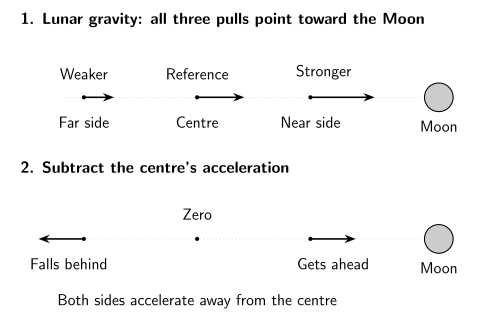
Tidal stretching comes from differences in gravity. Top: lunar acceleration at three positions. Bottom: acceleration relative to Earth’s freely falling centre, using axes that do not rotate. Arrow lengths exaggerate the differences; distances and body sizes are schematic. The diagram shows neither ocean height nor the time of high tide.
| Position | Lunar pull compared with the centre | Motion relative to the centre due to this difference |
|---|---|---|
| Near side | Stronger, toward the Moon | Toward the Moon: outward from Earth’s centre |
| Centre | The reference acceleration | Zero after subtraction |
| Far side | Weaker, still toward the Moon | Away from the Moon: outward from Earth’s centre |
This is the distinction between gravitational attraction and tidal acceleration. The far-side effect does not require the Moon to repel anything. In directions perpendicular to the Earth–Moon line, the corresponding differences tend to compress rather than stretch. Fitzpatrick 2016, § 12.2, Eqs. 12.10–12.14
Two bulges are a useful idealization
Section titled “Two bulges are a useful idealization”Now restore Earth’s gravity, which keeps ocean water bound, and the pressure forces that resist its redistribution. In an ideal equilibrium picture with an ocean covering the whole planet, the tidal forcing slightly elongates the water surface along the Earth–Moon line. There is a raised region at each end. Water does not need to escape Earth to change its level.
Real oceans cannot continually settle into that simple equilibrium shape. Continents block flows; water depth and basin shape change the response; Earth’s rotation and friction affect the moving water. Some coasts have two roughly similar high tides each lunar day, some have two unequal high tides, and some have one. A lunar day is the interval between successive passages of the Moon across a local meridian, roughly 24 hours 50 minutes. Two idealized bulges do not imply two equal high tides everywhere. NOAA n.d., “Types and Causes of Tidal Cycles”
Local tide predictions therefore use observations and models of the actual response. Wind and atmospheric pressure can change observed water levels as well. The Moon’s direction alone does not tell you when a beach will have its highest water. NOAA n.d., “What Affects Tides in Addition to the Sun and Moon?”
The Sun changes the tidal range
Section titled “The Sun changes the tidal range”The Sun also produces tides. Around new and full Moon, the solar and lunar stretching directions are nearly aligned, tending to increase the difference between high and low water: spring tides. “Spring” here does not refer to the season. At full Moon, the Sun and Moon pull Earth in opposite directions, but their tidal stretching is along nearly the same line.
Around first and last quarter, their stretching directions are approximately perpendicular. They partly offset one another’s effect, giving a smaller typical range: neap tides. The exact local range and its timing also depend on ocean response and the changing distances and orientations. NOAA n.d., “What Are Spring and Neap Tides?”
Use Moon phases to picture these arrangements. They need not line up closely enough to produce an eclipse: a tide is a gravitational response, whereas an eclipse requires a shadow to reach the relevant observer or body.
Show the math: why distance matters cubically
Preparation: algebra with fractions and powers, including positive and negative quantities.
Let the Moon have mass , and let its centre be distance from Earth’s centre. Place a test particle at coordinate along the line toward the Moon, with at Earth’s centre. Treat the Moon as spherical. At positions inside Earth’s extent, , its gravitational acceleration along that line is .
Subtract the centre’s acceleration:
For , the factors and are close to and . Thus
The signs reproduce the diagram: positive on the near side, negative on the far side. Since has units of length cubed divided by time squared, this expression has acceleration units. At a fixed position , doubling the source distance reduces the leading tidal acceleration to , whereas the source’s pull at the centre falls to . This difference explains why comparing total gravitational attractions is insufficient when comparing tides. NOAA n.d., “What Causes Tides?,” distance dependence
This calculation isolates the external forcing. It contains no ocean depth, coastline, water pressure, or flow, so it cannot supply a tide height in metres.
Try subtracting a shared acceleration
Section titled “Try subtracting a shared acceleration”Use invented acceleration units. The Moon pulls the far particle with strength 8, the centre with 10, and the near particle with 12, all in the same direction. What remains when you follow the centre? Would adding the same acceleration of 5 to all three change the stretching?
Answer
Subtract 10: the relative accelerations are , , and . The far and near particles separate from the centre in opposite directions. Adding 5 to every original value gives 13, 15, and 17; subtracting the new centre value, 15, leaves the same differences. A shared acceleration moves the group together. Its spatial variation changes the separation. These invented equal differences illustrate the leading approximation, not exact lunar values.
For classrooms and clubs
Preparation: subtraction with positive and negative numbers; use the table or spoken directions instead of the diagram if preferred. Objective: distinguish an attractive gravitational pull from motion relative to Earth’s centre. In 20 minutes, give three learners paper arrows labelled 8, 10, and 12, all pointing toward a drawn Moon. Calculate the differences before drawing the new arrows. The expected reasoning is that the centre accelerates more than the far side, not that gravity reverses there.
For a longer extension, compare two otherwise identical imaginary moons, with one twice as far away. Learners using ratios should find one-quarter of the central attraction but one-eighth of the leading tidal forcing. Ask why neither answer supplies a local high-tide forecast: the ocean’s response is still missing. The common misconceptions are that the Moon repels far-side water and that every coast must have two equal daily high tides. All activities can be completed indoors.
Next, connect changing gravitational directions to orbits, or explore how stretching matters near black holes.
References
Section titled “References”- Fitzpatrick, Richard. Fluid Mechanics. University of Texas at Austin, 2016. § 12.2, “Tide Generating Potential,” Eqs. 12.10–12.14.
- National Oceanic and Atmospheric Administration, National Ocean Service. “Types and Causes of Tidal Cycles.” Tides and Water Levels Tutorial, n.d. Tidal patterns. Accessed September 27, 2026.
- National Oceanic and Atmospheric Administration, National Ocean Service. “What Affects Tides in Addition to the Sun and Moon?” Tides and Water Levels Tutorial, n.d. Ocean basins and weather. Accessed September 27, 2026.
- National Oceanic and Atmospheric Administration, National Ocean Service. “What Are Spring and Neap Tides?” n.d. Lunar phases and tidal range. Accessed September 27, 2026.
- National Oceanic and Atmospheric Administration, National Ocean Service. “What Causes Tides?” Tides and Water Levels Tutorial, n.d. Attraction and tidal forcing. Accessed September 27, 2026.
Further reading
Section titled “Further reading”For an optional mathematical derivation, read Tidal Gravity and Relative Acceleration. It develops the relative-acceleration equation and the stretching and compression around a point mass. Preparation: calculus, vectors, and matrices.