Why isn't there an eclipse every month?
Scrollable formula. Use Left and Right arrow keys to reveal hidden content.
Scrollable table. Use Left and Right arrow keys to reveal additional columns.
Scrollable figure. Use Left and Right arrow keys to inspect hidden content.
https://blackhole.org/universe/sky/eclipses/
A new Moon passes between Earth and the Sun, yet it usually does not cover the Sun. A full Moon lies on the opposite side of Earth, yet it usually stays out of Earth’s shadow. The missing ingredient is height: the Moon’s orbit is tilted, so the three bodies usually miss the alignment that an eclipse needs.
For more context, Moon phases explains how the Sun lights the Moon and why new and full Moon have different Sun–Earth–Moon arrangements.
Predict first. If the Moon’s orbital plane exactly matched Earth’s orbital plane, would eclipses become more frequent or less frequent?
The Moon’s tilted orbit
Section titled “The Moon’s tilted orbit”The plane of Earth’s orbit around the Sun is called the ecliptic plane. The Moon’s orbital plane is tilted by about 5° relative to it. The two planes intersect along a line; the two places where the Moon’s orbit crosses that line are called nodes.
At most new Moons, the Moon passes north or south of the Sun’s apparent position rather than directly across its disk. At most full Moons, it passes north or south of Earth’s shadow. A solar eclipse needs a new Moon sufficiently near a node; a lunar eclipse needs a full Moon sufficiently near a node. “Near” matters because the bodies and their shadows have finite widths. NASA n.d., “Eclipses and the Moon,” § The Moon’s Tilted Orbit
The side views below reveal the dimension that a flat, overhead phase diagram hides. Compare the Moon’s position with the Earth–Sun line.
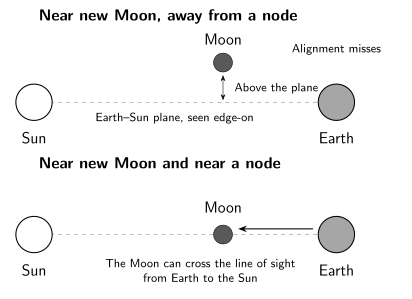
Phase alone does not guarantee an eclipse. Most new Moons miss the required alignment; near a node, the Moon can obscure the Sun for some observers. These side views are schematic: sizes, distances, and the vertical displacement are exaggerated. The dashed line is an alignment reference, not the edge of a shadow.
Crossing a node alone is not enough either. A quarter Moon can cross the ecliptic without being between Earth and the Sun or inside Earth’s shadow. An eclipse needs the appropriate phase and the appropriate alignment. Our diagram explains this requirement; it cannot predict an eclipse date or viewing location.
A solar eclipse depends on the observer
Section titled “A solar eclipse depends on the observer”During a solar eclipse, the Moon blocks some or all of the Sun’s bright disk for particular observers on Earth. Move to another part of Earth and the Moon appears in a slightly different direction against the Sun. This is why an eclipse can be total in one place, partial elsewhere, and absent farther away.
In a total solar eclipse, the Moon completely covers the bright solar disk for an observer in the totality path. In a partial eclipse, the disks overlap only partly. In an annular eclipse, the Moon lies in front of the Sun but appears too small to cover it completely, leaving a bright ring. Both orbital distance and the observer’s position matter. A total eclipse can also have partial phases before and after totality. NASA n.d., “Types of Solar Eclipses,” §§ Total, Annular, and Partial Solar Eclipse
The Sun is physically much bigger than the Moon. What determines covering is angular size, how wide each looks on the sky. Hold a small paper disk at different distances from your face, without looking toward any bright light. Moving it farther away makes it look smaller even though its actual diameter stays unchanged.
A lunar eclipse changes the Moon’s illumination
Section titled “A lunar eclipse changes the Moon’s illumination”During a lunar eclipse, Earth blocks sunlight from reaching part or all of the Moon. Earth’s shadow has an umbra, where the Sun’s bright disk is fully hidden, and a penumbra, where it is only partly hidden. The Moon can enter just the penumbra, part of the umbra, or entirely the umbra. These produce penumbral, partial, and total lunar eclipses.
The Moon may remain dimly visible and reddish during totality because some sunlight reaches it after passing through Earth’s atmosphere. A lunar eclipse can be seen from the broad part of Earth’s night side where the Moon is above the horizon. It does not require standing in a narrow track of the Moon’s shadow. NASA n.d., “Eclipses and the Moon,” §§ Lunar Eclipse Basics and Types of Lunar Eclipses
This is different from an ordinary crescent. A crescent shows the Moon’s own night side beside its sunlit side. In a lunar eclipse, Earth’s shadow changes how the Moon is illuminated. The distinction explains why the normal monthly phase cycle is not a monthly series of eclipses.
Keep the investigation indoors
Section titled “Keep the investigation indoors”You can reason about eclipses using the diagram, paper disks, or a ball and an ordinary room lamp. Do not use direct solar viewing for this activity.
For an actual solar eclipse, follow NASA’s eclipse safety guidance, §§ Eclipse Eye Safety and Eye Safety for Partial and Annular Solar Eclipses with appropriate adult or expert supervision. Ordinary sunglasses are not safe solar viewers. Never look through unfiltered binoculars, cameras, or telescopes while wearing eclipse glasses; concentrated sunlight can damage the glasses and injure your eyes. Optical equipment needs suitable filters and expert setup. Partial and annular eclipses have no interval when the bright Sun is completely covered. Viewing a lunar eclipse with unaided eyes needs no solar filter.
Show the math: size divided by distance
For a small object of diameter at distance , its angular diameter is approximately
with in radians. Use the same units for and ; the ratio is dimensionless. This small-angle approximation works when is much smaller than .
A constructed example makes the comparison clear:
| Disk diameter | Distance from observer | Approximate angular diameter |
|---|---|---|
| 1 cm | 100 cm | 0.010 radians |
| 2 cm | 200 cm | 0.010 radians |
| 1 cm | 120 cm | 0.0083 radians |
The first two disks can appear equally wide despite their different physical sizes. Move only the smaller disk to 120 centimetres and it looks smaller. If it is centred in front of the larger apparent disk, it cannot cover that disk completely. These numbers are an indoor geometry example, not the actual Sun–Moon distances or a prediction of eclipse type.
Try a quarter Moon
Section titled “Try a quarter Moon”A student hears that an eclipse can happen when the Moon crosses a node. They predict a lunar eclipse at a quarter Moon that happens to be crossing the ecliptic. What is missing?
Answer
Earth’s shadow extends away from the Sun. A quarter Moon is roughly to the side of that direction as seen from Earth, so it is not inside the shadow. Being near a node removes the north–south miss, but it does not fix the phase arrangement. A lunar eclipse requires a full Moon near the appropriate alignment.
For classrooms and clubs
Preparation: distinguish new, quarter, and full Moon. Objective: combine phase and orbital tilt instead of using either condition alone. In 15 minutes, draw three Sun–Earth–Moon arrangements and mark where Earth’s shadow would extend. Then lift a Moon marker above the paper to show why a flat diagram overpredicts eclipses. A spoken description of “toward the Sun,” “away from the Sun,” and “above the plane” supports a nonvisual version. The common misconception is that new or full phase alone guarantees an eclipse; a Moon near an orbital node must also have the right phase.
For a longer extension, compare a paper disk 1 cm wide at 100 cm distance with one 2 cm wide at 200 cm. They have the same diameter-to-distance ratio and approximately the same angular size, despite their different physical sizes. The answer to the opening prediction is more frequent eclipses: removing orbital tilt removes the usual vertical miss, though apparent size and observer position still determine the solar eclipse type. Use paper disks indoors, not the Sun, for the comparison.
Next, test the ordinary phase cycle in the Moon laboratory, or explore how Earth’s different tilt causes seasons.
References
Section titled “References”- NASA Science. “Eclipse Viewing Safety.” NASA, n.d. Eye safety and optical-equipment guidance. Accessed September 27, 2026.
- NASA Science. “Eclipses and the Moon.” NASA, n.d. Orbital tilt, lunar eclipses, and solar alignment. Accessed September 27, 2026.
- NASA Science. “Types of Solar Eclipses.” NASA, n.d. Total, annular, partial, and hybrid eclipses. Accessed September 27, 2026.