How does gravity bend what we see?
Scrollable formula. Use Left and Right arrow keys to reveal hidden content.
Scrollable table. Use Left and Right arrow keys to reveal additional columns.
Scrollable figure. Use Left and Right arrow keys to inspect hidden content.
https://blackhole.org/universe/galaxies/gravitational-lensing/
An astronomical image can contain several images of the same distant object. Light following different paths through a foreground gravitational field can reach us from different directions. The object has not been duplicated; its light has been redirected.
This effect, gravitational lensing, lets astronomers study foreground mass and sometimes see distant sources more clearly. Understanding it requires separating the source, its apparent images, and the model used to connect them.
Light paths connect one source to several apparent directions
Section titled “Light paths connect one source to several apparent directions”In general relativity, light follows paths determined by spacetime geometry. Near a mass, those paths differ from the straight lines we would draw in an otherwise empty, flat region. The mass need not be luminous: its gravitational field is what matters.
Imagine a distant source almost behind a compact foreground mass. Light passing on either side can reach the same observer. We assign each incoming ray an apparent direction on the sky. Following those directions backward as straight lines places the images away from the unlensed source position.
In the diagram, trace the solid paths from the source to the observer. Then compare them with the dashed extensions. The extensions locate apparent images; they are not additional physical light paths.
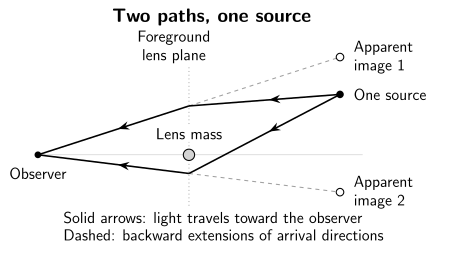
One source can produce two apparent images. This side-view schematic uses a compact point-mass lens with an offset source in the weak-field, small-angle, thin-lens description. Bending is represented at one plane and angles are exaggerated. Dashed extensions mark inferred viewing directions, not extra rays. Distances and object sizes are not to scale.
The thin-lens approximation treats the region of appreciable deflection as short compared with the observer–lens and lens–source distances. Actual rays bend smoothly; the sharp corners are a convenient approximation. The underlying small-angle geometry and its cosmological distance definitions are developed in Carroll 2014, §8.6, pp. 350–352.
Alignment changes the image pattern
Section titled “Alignment changes the image pattern”For an ideal point-mass lens and a source slightly off the observer–lens line, there are two images on opposite sides of the lens. Perfect alignment instead gives a circular Einstein ring in the ideal symmetric model. An extended source or a nonspherical lens makes more varied arcs and image patterns.
The images need not be equally bright. Sometimes an instrument cannot separate them, and the measurable effect is a change in their combined brightness as source and lens move relative to one another. This is one route to detecting microlensing (Narayan and Bartelmann 1997, §§2.1.5–2.2.1, PDF).
“Strong lensing” usually describes conspicuous multiple images or arcs; “weak lensing” describes smaller distortions measured statistically across many sources. Strong lensing in this sense can still occur where gravity is a small perturbation of spacetime. It does not require light to pass near a black-hole horizon.
Try the mathematics: two solutions for one source
Preparation: angles, rearranging an equation, and square roots. The main explanation does not require this calculation.
For an isolated point mass , a ray with impact parameter has weak-field deflection angle
Here is the gravitational constant, is light speed, and is the ray’s closest-approach scale in the undeflected approximation. We require and use angles in radians.
Let be the unlensed source angle and the image angle, measured relative to the lens. The thin point-lens equation along their common sky line is
and are observer-to-lens and observer-to-source angular-diameter distances; is the lens-to-source angular-diameter distance. These cosmological distances do not generally add like ordinary ruler lengths.
Multiplying by gives a quadratic with solutions
For , the images lie at approximately and . The minus sign denotes the other side of the lens, not a negative distance. Substituting either value into the lens equation recovers the same source angle.
For , the two signed solutions describe a cut through a ring; rotational symmetry supplies the other directions. This is a point-lens example, not a rule that every real galaxy produces exactly two images. The equations and assumptions are given in Carroll 2014, §8.6, Eqs. (8.131)–(8.139).
Magnification changes received flux without making the source brighter
Section titled “Magnification changes received flux without making the source brighter”Lensing can enlarge the apparent area of an extended source on the sky. In transparent, geometric-optics lensing, surface brightness is conserved: each resolved patch retains the brightness per unit apparent angular area that it would have without the lens. A larger apparent area can therefore deliver more total flux (Carroll 2014, §8.6, pp. 353–354).
That distinction matters. The source need not emit more energy when we see it magnified. Nor has the lens created a second galaxy. It has changed how the source’s light reaches particular directions.
Real observations add dust absorption, finite resolution, and source variability. Different paths can also have different travel times, so multiple images of a varying source may show different stages of its behavior. Comparing appropriately delayed light curves and spectra helps test a shared-source interpretation (Narayan and Bartelmann 1997, §3.3, PDF).
A mass map is an inference with assumptions
Section titled “A mass map is an inference with assumptions”The measured quantities include image positions, shapes, brightnesses, and sometimes time delays. To infer mass, astronomers choose a gravity model and solve for lens configurations compatible with those observations and the source distances.
One distorted galaxy does not reveal its original shape. Weak-lensing analyses therefore compare many background sources, account for their varied intrinsic shapes, and correct instrumental distortions. Multiple-image systems supply different constraints.
Even precise measurements need not select a unique mass map. For example, certain changes to the projected mass distribution can preserve the measured relative distortions while changing magnification. Additional distance information, magnification measurements, or dynamical evidence can help constrain such ambiguities (Narayan and Bartelmann 1997, §§4.2.1–4.2.3, PDF).
Lensing is valuable partly because its assumptions differ from those in galaxy rotation measurements. Agreement across methods supports a common gravitational explanation. A lensing mass map still does not identify a dark-matter particle.
Near a black hole, very strongly bent paths require a treatment beyond this weak-field example. The black-hole imaging explanation separates an emitting ring, a shadow, and an event horizon.
Predict what an extra image tells you
Section titled “Predict what an extra image tells you”A telescope detects two close images with very similar spectra. One brightens, and later the other shows a similar variation. Is that enough to announce two identical galaxies? What would make a lens interpretation convincing?
Answer and transfer
The delayed repetition supports the possibility of two paths from one varying source. Look for a plausible foreground lens and a model that explains the image positions, relative behavior, and delay. Chance similarities, intervening absorption, and measurement errors still require checks.
For a quantitative transfer, hold all the distances in the point-lens model fixed and multiply its mass by four. The Einstein angle doubles because it is proportional to the square root of mass. This does not mean every possible image angle doubles when the unlensed source angle is held fixed: the lens equation also contains .
For educators
Preparation and objective. Students need directions and basic geometry; square roots are only needed for the optional calculation. The goal is to explain why image count need not equal source count.
Short activity, about 10 minutes. Trace the two solid paths with a finger, then draw their dashed backward extensions on paper. Expected answer: both real paths start at one source, while their final directions point toward different apparent images. The extensions are not extra paths taken by light.
Longer extension, about 30 minutes. Groups design a hypothetical pair of delayed brightness records, label them as invented, and explain which measurements would test whether they come from one source. Add a fourfold lens-mass change and calculate the new Einstein angle. Expected scaling: twice as large at fixed distances; other image positions require solving the equation again.
Misconception to discuss. “A mass map is a photograph of dark matter.” Require students to name both a measured quantity and an assumption in the inference. The explained task above supplies an additional check using timing instead of image appearance alone.
References
Section titled “References”- Carroll, S. M. (2014). Spacetime and Geometry: An Introduction to General Relativity. Pearson New International Edition, §8.6, pp. 349–354. Author’s book page.
- Narayan, R., and Bartelmann, M. (1996; revised 1997). “Lectures on Gravitational Lensing.” Lectures for the 1995 Jerusalem Winter School, arXiv:astro-ph/9606001. Citations use version 2. Manuscript record; Open PDF.
Further reading
Section titled “Further reading”For optional derivations, Light Deflection and Shapiro Delay develops weak-field bending, while Strong-Lensing Mass and Time-Delay Tests connects image positions and delays to uncertain mass models. Preparation: calculus and general relativity; the second treatment also uses statistical inference.