How big is our Solar System?
Scrollable formula. Use Left and Right arrow keys to reveal hidden content.
Scrollable table. Use Left and Right arrow keys to reveal additional columns.
Scrollable figure. Use Left and Right arrow keys to inspect hidden content.
https://blackhole.org/universe/solar-system/scale/
Most Solar System pictures make the planets large enough to recognize and squeeze the gaps between them. A model that uses one scale for both size and distance feels very different: small worlds are separated by long stretches of space. Let Earth’s orbital distance become one metre, and see what happens.
Predict first. In that model, would Earth be as wide as a tennis ball, a pea, or less than a grain of sand? Make a guess before looking at the diameter calculation.
A metre for Earth’s orbit
Section titled “A metre for Earth’s orbit”An astronomical unit, abbreviated AU, is a distance of about 150 million kilometres, close to Earth’s average distance from the Sun. It is a convenient ruler for planetary orbits. Our model uses 1 AU = 1 metre. Jupiter is then about 5.2 metres from the Sun, and Neptune about 30 metres away.
The values below describe approximate orbital distances, not the changing distance between Earth and another planet. The planets travel around the Sun on different orbits; they are not normally arranged in a straight line. NASA 2020, “Cosmic Distances,” astronomical-unit explanation
Look first at the long ruler. The lower ruler enlarges its inner two metres so that the four inner orbits can be distinguished.
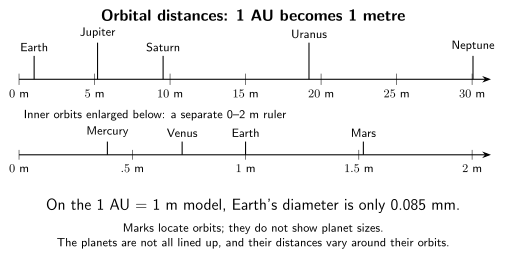
Orbital distances on a model where 1 AU becomes 1 metre. Positions follow the rounded NASA/JPL reference values; the lower ruler has a separately labelled scale. Marks indicate orbital distances and exaggerate planet sizes. This is a distance comparison, not a snapshot of the planets’ positions.
| Planet | Approximate orbital distance (AU) | Distance in the model |
|---|---|---|
| Mercury | 0.39 | 39 cm |
| Venus | 0.72 | 72 cm |
| Earth | 1.00 | 1 m |
| Mars | 1.52 | 1.52 m |
| Jupiter | 5.2 | 5.2 m |
| Saturn | 9.54 | 9.54 m |
| Uranus | 19.2 | 19.2 m |
| Neptune | 30.06 | 30.06 m |
These rounded teaching values come from NASA/JPL n.d., “Solar System Sizes and Distances,” AU table, PDF. They are enough to expose the spacing pattern without pretending to predict a spacecraft’s route.
How small would the planets be?
Section titled “How small would the planets be?”Use the same shrinking factor for Earth’s diameter. A diameter of about 12,756 kilometres becomes 0.085 millimetres in this model. That is much smaller than a typical grain of sand. The Sun becomes about 9.3 millimetres wide. The distance from the Sun to Earth is therefore about a metre between a small bead-sized Sun and a barely visible Earth.
Those two sizes are the answer to the opening prediction. If we put a pea at Earth’s marker, the pea is a useful label, but its size is no longer to scale. NASA/JPL n.d., reference guide, diameter table, PDF
Show the math: use one scale factor
Using the reference guide’s rounded Earth–Sun distance of 149,600,000 kilometres, every real length is divided by the same number:
Earth’s diameter gives
The ratio is dimensionless because kilometres cancel. If you make every model distance ten times smaller, every model diameter must also become ten times smaller. Changing only the spaces or only the sizes creates two different scales.
A useful model has a stated boundary
Section titled “A useful model has a stated boundary”This model reaches Neptune, the outermost of the eight planets. That does not mean the Solar System ends there. Known icy bodies and an inferred distant reservoir of comets extend much farther out. “How big?” needs a second question: are we measuring the planetary region, the Sun’s influence on the surrounding gas, or the extent of objects bound to its gravity? These boundaries answer different physical questions. NASA n.d., “Solar System Facts,” § Size and Distance
The ruler also shows distance, not travel time. A light-year is another distance unit: how far light travels in a year. It does not mean the age of an object, and it does not say how long a spacecraft would take to reach it.
From the Moon to the Milky Way
Section titled “From the Moon to the Milky Way”Beyond the planets, familiar distances quickly become small. The ruler below changes the question: each equal step represents a factor of ten in distance. It compares lengths, not the positions of objects at one moment.
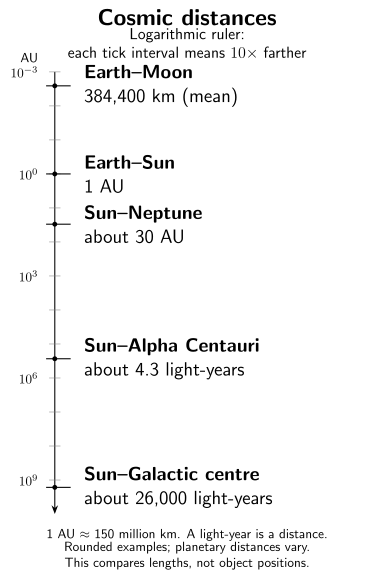
Each tick multiplies the distance by ten. Earth–Moon is about 384,400 km on average; Earth–Sun uses the 1 AU reference; Neptune orbits at about 30 AU; Alpha Centauri is about 4.3 light-years away; and the Galactic centre is about 26,000 light-years away. These are rounded representative pairwise distances, not a map or a shared time snapshot. Planetary distances vary. NASA 2020, “Cosmic Distances”, NASA, “Moon Facts,” § Size and Distance and NASA 2018, Galactic-centre overview provide the reference scales.
Try a tabletop Solar System
Section titled “Try a tabletop Solar System”You have only three metres of clear indoor space. Keep Neptune near the far end by changing the model to 1 AU = 10 centimetres. Where do Earth and Jupiter go, and what happens to the model Sun?
Answer
Earth goes 10 centimetres from the Sun and Jupiter 52 centimetres away. Neptune goes about 3 metres away. All diameters shrink by ten as well: the Sun is about 0.93 millimetres across, and Earth about 0.0085 millimetres. Use clearly labelled position markers rather than claiming that large paper circles show the planets’ true scaled sizes.
For classrooms and clubs
Preparation: ratios, a measuring tape, paper labels, and a clear indoor route or tabletop. Objective: apply one proportional scale to distances and diameters. Allow 20 minutes. Mark the Sun, Earth, Jupiter, and Neptune on the 1-metre-per-AU model. Earth, Jupiter, and Neptune belong about 1, 5.2, and 30.1 metres from the Sun. Keep walkways clear; the numerical table supports a seated alternative.
For a longer extension, shrink the model to 10 centimetres per AU. All lengths become one-tenth as large: Neptune is about 3.01 metres away, the Sun about 0.93 millimetres wide, and Earth about 0.0085 millimetres wide. The common misconception is that visible planet markers must have correct scaled diameters. Learners should explain that readable labels mark positions while deliberately enlarged dots cannot simultaneously represent physical sizes at this scale.
Next, investigate why these distances affect orbital periods, or ask how the planetary arrangement grew from a shared disk.
References
Section titled “References”- Mohon, Lee. “Scientists Take Viewers to the Center of the Milky Way.” NASA, 10 January 2018. Galactic-centre overview.
- NASA Science. “Moon Facts.” § Size and Distance. Lunar scale.
- NASA Jet Propulsion Laboratory. “Reference Guide: Solar System Sizes and Distances.” JPL Education, n.d. One-page reference guide, PDF. Accessed September 27, 2026.
- NASA Science Editorial Team. “Cosmic Distances.” NASA, May 18, 2020. Distance units and examples.
- NASA Science. “Solar System Facts.” NASA, n.d. § Size and Distance. Accessed September 27, 2026.