How do we measure the distance to a star?
Scrollable formula. Use Left and Right arrow keys to reveal hidden content.
Scrollable table. Use Left and Right arrow keys to reveal additional columns.
Scrollable figure. Use Left and Right arrow keys to inspect hidden content.
https://blackhole.org/universe/stars/distances/
Two stars can sit beside each other in the sky while being enormously far apart in space. A sky position tells us a direction. To turn that direction into a three-dimensional map, we also need distance.
For nearby stars, one powerful method is parallax: observe from different places and measure how the direction changes. We already have a moving observing platform. Earth travels around the Sun.
Parallax makes distance visible
Section titled “Parallax makes distance visible”Hold a finger in front of a distant wall. Look at it with one eye, then the other, keeping your head still. The finger appears to shift against the wall because your eyes see it from different positions. Move the finger farther away and repeat. The apparent shift becomes smaller.
The finger has not jumped sideways. You changed the viewing direction. The separation between your eyes is the baseline of this miniature distance measurement.
Astronomers use the same geometry with a much longer baseline. Observations taken from opposite sides of Earth’s orbit are separated by about two astronomical units. One astronomical unit, or AU, is approximately the Earth–Sun distance. Nearby stars change direction against a much more distant background as the observer moves (ESA, “Parallax”).
There is a factor of two to watch. The parallax angle, written , corresponds to a one-AU transverse baseline. In the favorable geometry below, opposite orbital positions give a total change of direction of . Look at the two small angles at the star, then the two equal baseline segments beneath them.
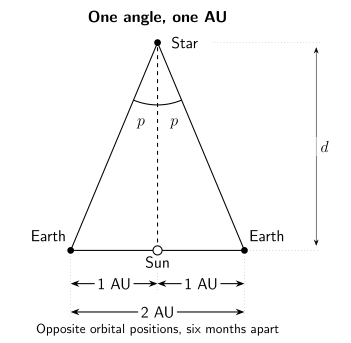
The parallax angle uses half of the two-AU baseline. This schematic assumes a circular Earth orbit, a stationary star, and a baseline perpendicular to the Sun–star direction. Angles are greatly exaggerated; the star is much farther away than the drawing suggests.
Not every pair of dates gives the maximum shift. The projection depends on the star’s direction and where Earth is in its orbit. Repeated observations fit the full annual pattern, which generally traces an ellipse on the sky, rather than assuming any two measurements are enough.
A tiny angle becomes a distance
Section titled “A tiny angle becomes a distance”An arcsecond is one three-thousand-six-hundredth of a degree. A milliarcsecond, abbreviated mas, is one thousandth of an arcsecond. Stellar parallaxes are small enough that these units are useful.
Astronomers define the parsec, abbreviated pc, so that the small-angle parallax calculation is particularly simple: distance in parsecs is one divided by parallax in arcseconds. One parsec is about 3.26 light-years. A light-year is a distance—the distance light travels in a year—not a time measurement for a star’s age.
For a constructed example, suppose the measured parallax is 50 mas with a small uncertainty. That is 0.050 arcsecond, so the distance estimate is pc, about 65 light-years. The angle has to be converted before taking the reciprocal.
| Parallax in a geometric example | Inferred distance |
|---|---|
| 100 mas = 0.100 arcsecond | 10 pc |
| 50 mas = 0.050 arcsecond | 20 pc |
| 10 mas = 0.010 arcsecond | 100 pc |
The relationship goes the opposite way to the numbers in the first column: smaller parallax means greater distance. This method does not require the star to have a known luminosity or to resemble the Sun.
Show the geometry: why the reciprocal works
For the right triangle in the diagram, with distance and angle ,
At these tiny angles, when is in radians. There are arcseconds in a radian. The parsec is defined as exactly (IAU 2015, Resolution B2, note 4). Therefore
This is a small-angle geometrical relation. It becomes a distance estimate when a noisy measured angle replaces the true parallax.
Stars also move, and measurements have uncertainty
Section titled “Stars also move, and measurements have uncertainty”Earth’s annual motion is not the only reason a star changes position. The star has its own motion through space. Its changing direction on the sky is called proper motion. Over a sufficiently short part of its trajectory, this can look like a steady drift, with the yearly parallax pattern superimposed. Astronomers fit both effects using many observations over time (ESA, “Proper motion”). Binary orbital motion and instrument calibration can add further complications.
A reported angle also has an uncertainty. Near 50 mas, changing the input from 49 to 51 mas changes the inverse-parallax distance from about 20.41 to 19.61 pc. The resulting distances are not equally spaced around 20 pc. This calculation shows sensitivity to the input; by itself it is not a complete statistical uncertainty analysis.
When the measured parallax is comparable to its uncertainty, simply taking its reciprocal can be misleading. Noise can even produce a negative fitted parallax. That does not place a star at a negative physical distance. It means the noisy position measurements favored an annual pattern with the opposite sign. Distance inference must then account for measurement uncertainty and other justified information. Throwing away all negative measurements can bias a sample (Luri et al. 2018, §§3.1–3.3).
Parallax is therefore both a geometrical idea and a measurement problem. The geometry explains the relation; the data and their uncertainties determine how well we can use it.
Read a six-month shift
Section titled “Read a six-month shift”In a favorable, idealized observation, a star’s two extreme apparent positions are 80 mas apart, six months apart. Ignore proper motion and measurement error. What is its parallax, and how far away is it? What changes if another star has half as much total shift?
Answer and explanation
The full shift is , so the parallax is 40 mas, or 0.040 arcsecond. The distance is pc.
Half the total shift means half the parallax: 20 mas. The second star is twice as far away, at 50 pc. Using the full 80-mas shift as the first star’s parallax would incorrectly halve its distance.
For real data, first check whether the observing dates sample the extrema and whether the fitted motion includes proper motion and other relevant effects. The ideal example tells us what the geometry means, not how to reduce a complete astrometric catalogue.
For educators
Prepare a distant visual reference and a sketch of Earth’s orbit; no astronomy background is needed. The objective is to connect a changed viewpoint to an angular shift, then distinguish the one-AU parallax angle from the full six-month shift. Simple division is enough for the numerical activity; trigonometry is optional.
For a 5–10 minute activity, use the finger experiment and ask what moved: the finger or the viewpoint. Then label one AU, two AU, , and on the sketch. Expected reasoning says that a more distant target shifts less and that the 80-mas full shift in the question corresponds to a 40-mas parallax. Address the common factor-of-two error before calculating.
For a 20-minute investigation, give groups the same 50-mas example with inputs of 49, 50, and 51 mas. Compare reciprocal distances and explain why their spacings differ. Successful answers distinguish a sensitivity calculation from a statistical uncertainty interval. Finish by adding proper motion to the sketch: repeated observations must separate steady drift from an annual pattern. The printed table supports the entire investigation without a device.
A distance turns an angular binary orbit into a physical size for weighing stars. It also lets us ask whether a star looks faint because it emits little light or because it is far away: Why can a powerful star look faint?
References
Section titled “References”- European Space Agency. How does Gaia study the Milky Way? Sections “Parallax” and “Proper motion.” Mission explanation.
- International Astronomical Union (2015). Resolution B2 on Recommended Zero Points for the Absolute and Apparent Bolometric Magnitude Scales. Adopted 13 August 2015; note 4 defines the parsec. Resolution; Open PDF.
- Luri, X., Brown, A. G. A., Sarro, L. M., et al. (2018). “Gaia Data Release 2: Using Gaia parallaxes.” Astronomy & Astrophysics 616, A9. DOI; open author text.