Black Holes: Start Here
Scrollable formula. Use Left and Right arrow keys to reveal hidden content.
Scrollable table. Use Left and Right arrow keys to reveal additional columns.
Scrollable figure. Use Left and Right arrow keys to inspect hidden content.
https://blackhole.org/universe/black-holes/start-here/
How can we study a region from which light cannot escape? We observe what happens outside it: stars move, hot gas shines, and merging compact objects send gravitational waves through space. Different measurements test different parts of the black-hole explanation.
A black hole is a region of spacetime from which no future-directed light signal can escape to sufficiently faraway observers. Its boundary is the event horizon. That definition concerns which journeys are possible, not the darkness of a material surface.
The horizon is a boundary, not a shell
Section titled “The horizon is a boundary, not a shell”There is no solid wall at an event horizon. In classical general relativity, a freely falling observer can cross the horizon of a sufficiently large black hole without a special local collision there. Once inside, even an outward-directed light signal cannot reach the distant exterior. The geometry of spacetime constrains every future-directed path (Carroll 2014, §5.6, pp. 218–223).
Black holes are therefore different from very dark planets. Covering a planet with an absorbing surface would make it hard to see, but would not prevent a sufficiently powerful rocket from leaving.
Matter approaching a black hole can become extremely hot and radiate before crossing the horizon. Gas need not fall straight inward: it can orbit, form an accretion flow, or be expelled. Jets associated with black holes arise from the surrounding region; they are not material escaping from inside the event horizon.
Four kinds of evidence test the explanation
Section titled “Four kinds of evidence test the explanation”The diagram separates measured signals from model conclusions. The arrows mean “constrains,” not “photographs directly.”
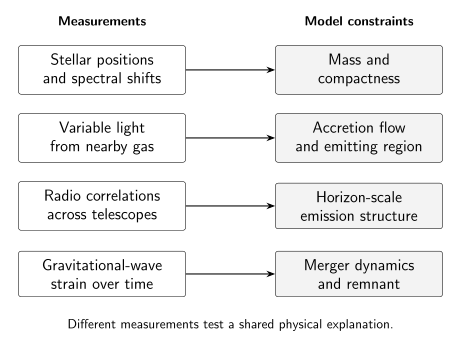
Independent observations constrain mass, compactness, nearby plasma, and strong-gravity dynamics. This is a schematic evidence comparison, not an astronomical image or a claim that every signal independently proves an event horizon.
Orbiting stars. Changing positions and spectral lines reveal motion around an unseen mass. The star S2 near our Galactic center provided a test of gravitational and motion-related redshifts near the compact object Sagittarius A*. Orbital evidence constrains the mass concentrated there; it does not draw the horizon (GRAVITY Collaboration 2018, abstract).
Radiation from nearby gas. Rapid changes and energetic emission indicate matter in a compact, active environment. But neutron stars and other sources also produce X-rays. A convincing identification combines radiation with mass and size constraints. Our binary-star example shows how dynamics can supply information that brightness cannot.
Gravitational waves. In 2015, the two LIGO detectors measured a changing strain, a tiny fractional difference between changes in their arm lengths. The signal matched the general-relativistic pattern of compact objects spiraling together, merging, and settling into a black-hole remnant. This was a detection of gravitational waves, not a camera view (Abbott et al. 2016, abstract). Follow the steps from detector strain to a merging binary to see how that inference is tested.
Horizon-scale radio structure. The Event Horizon Telescope combines radio measurements from widely separated telescopes. Algorithms reconstruct an image from their correlations. Its Sagittarius A* result, published in 2022 using 2017 observations at 1.3 millimeters, shows ring-like emission around a central brightness depression. The displayed colors represent radio intensity, not visible orange light from a surface. The reconstructed emission and shadow are not a photograph of the event horizon itself (Event Horizon Telescope Collaboration 2022, Paper I, abstract).
Each method has assumptions and uncertainties. Their agreement is powerful because a successful explanation must account for several kinds of observation, not merely resemble one attractive picture.
Mass sets a useful size scale
Section titled “Mass sets a useful size scale”For an ideal, isolated black hole with no rotation or electric charge, the horizon radius increases in direct proportion to mass. One solar mass corresponds to a radius of about 2.95 kilometers. Ten solar masses give about 29.5 kilometers.
That is a radius, so the corresponding diameter is twice as large. Neither quantity is the diameter of an observed bright ring: light bending and the emitting gas affect the image. Most astrophysical black holes rotate, so the simple formula is a starting model. Calculating a radius from an estimated mass does not prove that an event horizon exists.
Try the mathematics: the Schwarzschild radius
Preparation: proportionality, simple algebra, and powers of ten.
For mass in this nonrotating, uncharged model,
Here is the gravitational constant and is the speed of light. Mass in kilograms gives radius in meters when SI units are used. Doubling doubles .
The black-hole scale lab uses the nominal solar mass parameter and exact SI light speed to keep this conversion consistent. Equating Newtonian escape speed to light speed happens to give the same radius, but Newtonian mechanics does not supply the spacetime definition of an event horizon.
Predict the gravity far away
Section titled “Predict the gravity far away”As a thought experiment, replace the Sun with a black hole of exactly the same mass at the same location, with no mass loss or kick. Leave Earth at the same position and velocity. Would Earth suddenly be sucked inward?
Answer and transfer
No. In this idealized comparison, the distant gravitational field has the same central mass, so Earth’s orbit does not suddenly change. The loss of sunlight would be disastrous, but it is a separate effect. Close to the center, the difference is crucial: the black hole allows access to a compact region that was previously inside the star.
This is not a realistic account of stellar collapse. Actual formation can eject mass or impart motion, which can change an orbit. The transferable lesson is to ask what mass and distance have changed before claiming that gravity has become stronger.
Falling clocks and stretching bodies
Section titled “Falling clocks and stretching bodies”Imagine an isolated black hole and a freely falling traveler, setting aside the dangerous gas and radiation around many real systems. The traveler’s own clock reaches and crosses the horizon in a finite time. A distant observer receives the outgoing signals at increasingly long intervals; their frequencies decrease through redshift, and they fade. The observer does not see a bright traveler frozen forever. The two descriptions concern different clocks and the light that connects them (Carroll 2014, §5.6, pp. 218–223).
Gravity also acts differently on nearby parts of an extended body. These tidal effects can stretch it along one direction and squeeze it along others. At a Schwarzschild horizon, the tidal difference across a fixed-size body becomes weaker as the black hole’s mass grows. A stellar-mass horizon can have enormous tides; a supermassive horizon can have much gentler ones. Deeper inward, they grow. Horizon crossing and destructive stretching are therefore different events.
For the model scaling, tidal acceleration across a small length is proportional to . At a horizon with , this scales as . Continue with what happens near a black hole for a traveler–receiver comparison and a worked tidal calculation. The more technical falling-observer explanation develops the signal and clock comparison using equations.
Open questions remain inside the successful model
Section titled “Open questions remain inside the successful model”Some black holes form after stellar core collapse, but not every massive star becomes a black hole. Core structure, mass loss, composition, and companions affect the outcome; some collapses leave neutron stars. How the earliest supermassive black holes grew is a broader research question.
Classical singularity theorems establish incomplete spacetime paths under specified assumptions, not a known material dot inside a black hole. That incompleteness marks a limit of the classical description; see why a singularity need not be a place. Hawking radiation is a theoretical prediction and has not been directly detected from astrophysical black holes.
For educators
Preparation and objective. No prior astronomy is needed for the main text. Students should distinguish an event horizon from a surface and connect each evidence channel to the property it constrains.
Short activity, about 10 minutes. Sort statements into measurement, inference, or open question. Radio correlations are measurements; a reconstructed ring depends on analysis; the black-hole interpretation also invokes gravity and plasma models. An inference can be strongly supported without being a direct photograph.
Longer extension, about 30 minutes. Use the scale lab to compare one, ten, and one hundred solar masses, recording radii and diameters. Expected result: both scale linearly with mass, but each diameter is twice its radius. Then solve the same-mass Sun replacement question above and name the assumptions that make the orbital conclusion work.
Misconception to discuss. “A black hole sucks more strongly than any other object.” At the same large distance and the same central mass, the idealized orbital field is the same. Compactness permits much closer approaches; it does not replace the dependence on mass and distance.
References
Section titled “References”- Abbott, B. P., et al. (LIGO Scientific Collaboration and Virgo Collaboration) (2016). “Observation of Gravitational Waves from a Binary Black Hole Merger.” Physical Review Letters 116, 061102. DOI; collaboration article and Open PDF.
- Carroll, S. M. (2014). Spacetime and Geometry: An Introduction to General Relativity. Pearson New International Edition, §5.6, pp. 218–223. Author’s book page.
- Event Horizon Telescope Collaboration (2022). “First Sagittarius A* Event Horizon Telescope Results. I. The Shadow of the Supermassive Black Hole in the Center of the Milky Way.” The Astrophysical Journal Letters 930, L12. DOI.
- GRAVITY Collaboration (2018). “Detection of the gravitational redshift in the orbit of the star S2 near the Galactic centre massive black hole.” Astronomy & Astrophysics 615, L15. DOI; open manuscript.
Further reading
Section titled “Further reading”For optional treatments of formation and horizon definitions, read Massive-Star Evolution Toward Collapse and A Black Hole Is Not Defined by Newtonian Escape Speed. Preparation: stellar structure and calculus for the first; Newtonian mechanics and general relativity for the second. The linked explanations of falling observers and singularities also use calculus and spacetime geometry.