Why do galaxies have different shapes?
Scrollable formula. Use Left and Right arrow keys to reveal hidden content.
Scrollable table. Use Left and Right arrow keys to reveal additional columns.
Scrollable figure. Use Left and Right arrow keys to inspect hidden content.
https://blackhole.org/universe/galaxies/galaxy-types/
Galaxies have different shapes because their stars, gas and dust have different arrangements and histories. Rotation, star formation and gravitational encounters all matter—but so do our viewing direction and the light our telescope detects. A galaxy’s shape is useful evidence, not a complete biography.
Spiral arms, smooth light and irregular structure
Section titled “Spiral arms, smooth light and irregular structure”Start with three Hubble observations. Look for curved arms, a smooth central concentration, or uneven patches without an orderly spiral pattern. The pictures preserve their source frames but do not have a common physical or angular scale: the largest-looking galaxy on this page need not be the largest in space.
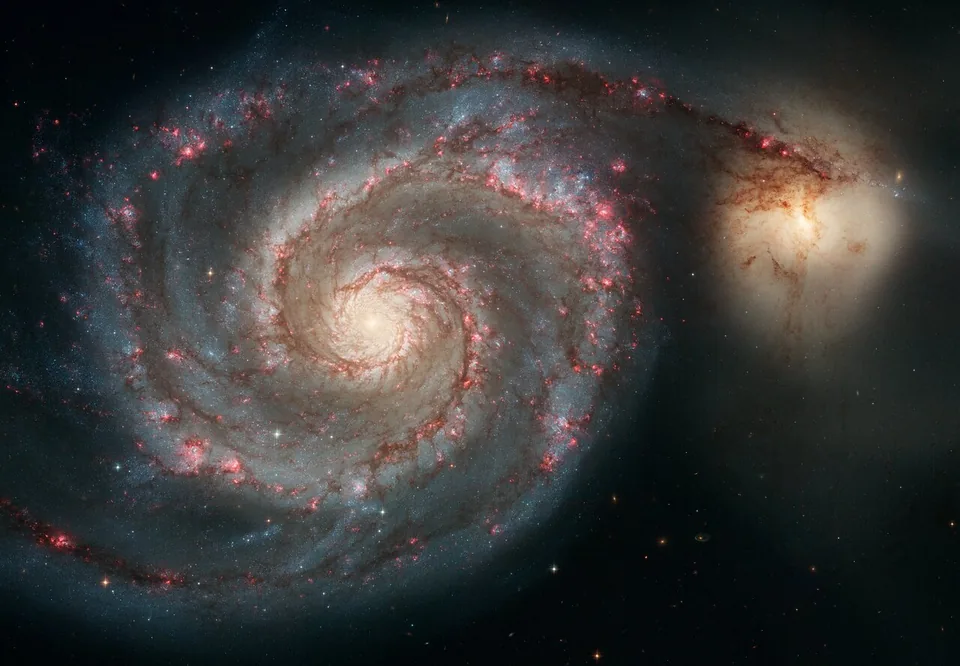
M51 is a spiral galaxy viewed nearly face-on. Hubble's multiband composite reveals curved arms, dust lanes and star-forming regions.
Credit: NASA, ESA, S. Beckwith (STScI), and The Hubble Heritage Team (STScI/AURA). Image source · Reuse terms
About this observation
Hubble ACS, January 2005; 435 nm B, 555 nm V, 658 nm H-alpha+[N II], and 814 nm I. Visible and near-infrared multiband composite. A near-face-on view makes spiral structure easy to see; the apparent image size alone does not establish the galaxy's physical size.
Resized for this page; displayed images retain the source's colors and full frame. These images do not share a common physical scale.
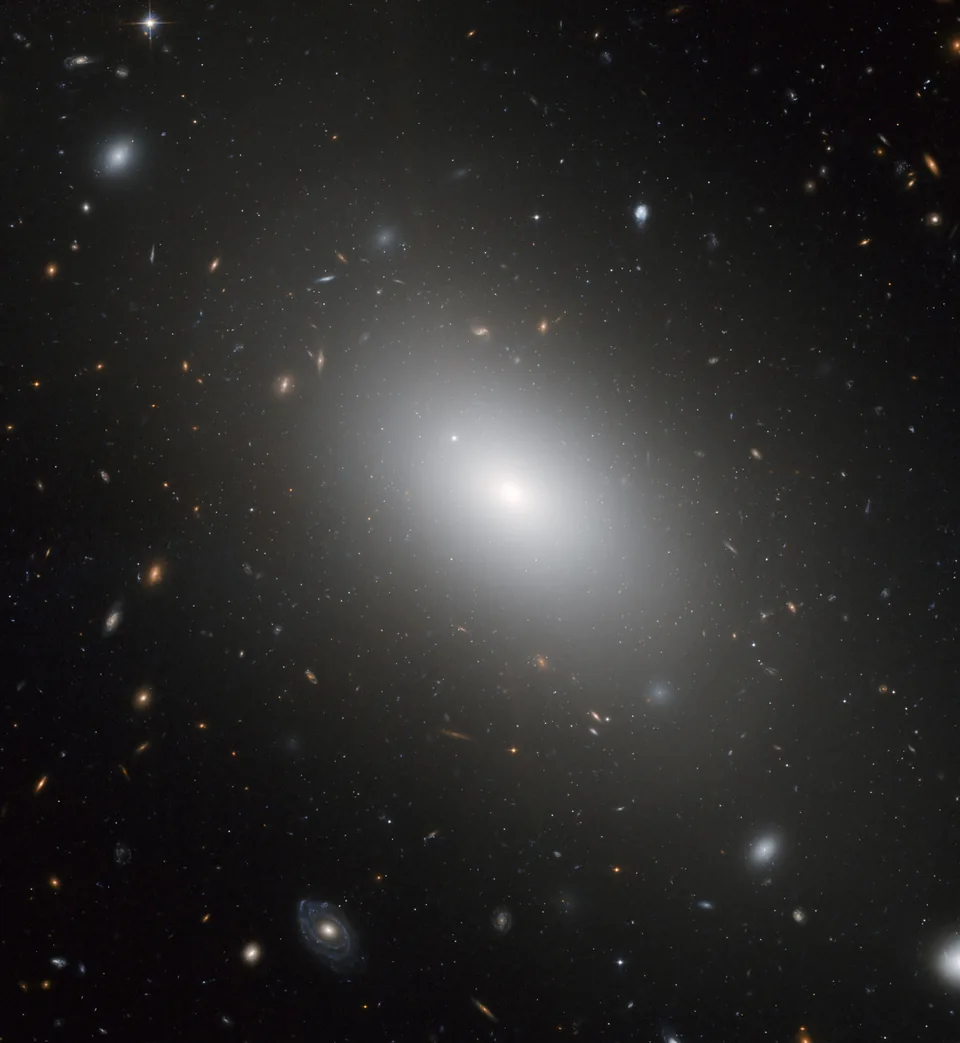
NGC 1132 has a smooth elliptical light distribution rather than obvious spiral arms. Its Hubble composite includes visible and near-infrared measurements.
Credit: NASA, ESA and the Hubble Heritage (STScI/AURA)-ESA/Hubble Collaboration. Acknowledgment: M. West (ESO, Chile). Image source · Reuse terms
About this observation
Hubble ACS; B 475 nm and Z 850 nm; released 5 February 2008. Blue and near-infrared measurements with a constructed intermediate green channel. Separate galaxy pictures are not at a common physical or angular scale.
Resized for this page; displayed images retain the source's colors and full frame. These images do not share a common physical scale.
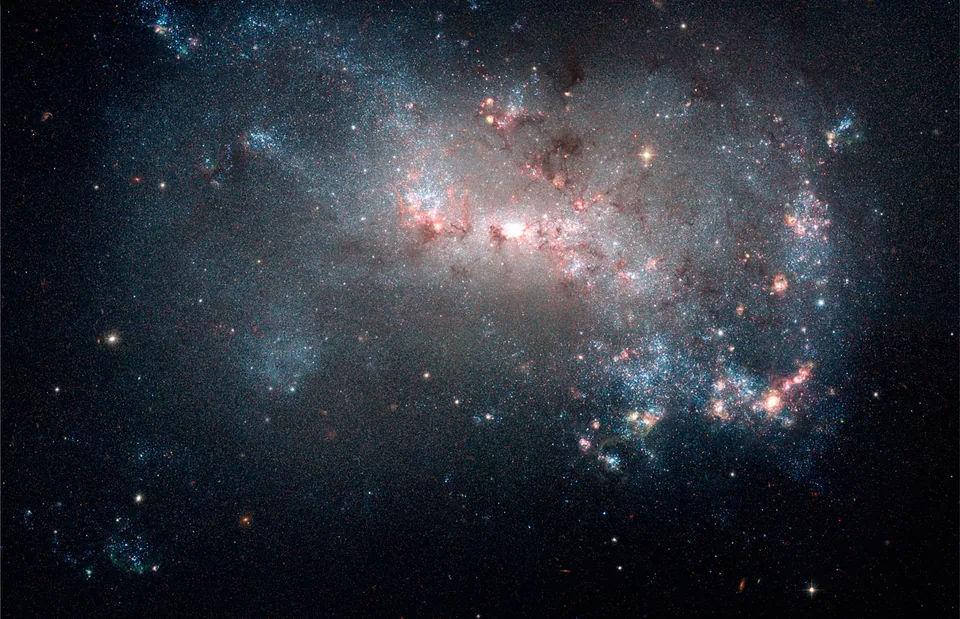
NGC 4449 lacks the orderly arms of a grand-design spiral. Hubble's multiband composite shows irregular patches of stars, dust and glowing gas.
Credit: NASA, ESA, A. Aloisi (STScI/ESA), and The Hubble Heritage (STScI/AURA)-ESA/Hubble Collaboration. Image source · Reuse terms
About this observation
Hubble ACS; 435 nm B, 555 nm V, 658 nm H-alpha and 814 nm I; released 3 July 2007. Visible/near-infrared composite; H-alpha helps identify glowing star-forming gas. Irregular appearance describes structure, rather than a compulsory early stage in every galaxy's history.
Resized for this page; displayed images retain the source's colors and full frame. These images do not share a common physical scale.
The Whirlpool Galaxy, M51, shows two prominent spiral arms. Dust lanes and bright star-forming regions help outline its disk, viewed nearly face-on. NGC 1132 is an elliptical galaxy: its light fades smoothly outward without obvious spiral arms. NGC 4449 has a more irregular arrangement, with uneven bright regions and obscuring dust. These descriptions concern the observed patterns, not a judgment that one shape is better or more advanced than another. The linked image records identify each observation and its measured bands.
The broad families provide a starting vocabulary:
| Family | A useful visible clue | What the name does not establish |
|---|---|---|
| Spiral | Arms in a disk, often around a central bulge | That every star is young |
| Elliptical | Smooth light distribution, appearing round or oval | A single age, mass or merger history |
| Lenticular | A disk and central bulge without clear spiral arms | That every smooth-looking galaxy lacks a disk |
| Irregular | No simple spiral or elliptical pattern | That gravity is absent or the galaxy is newly born |
Spirals can also have a bar, an elongated arrangement of stars across the centre. These categories describe morphology—the visible form—not separate physical laws. NASA, “Types of Galaxies,” §§ Spiral, Elliptical, Lenticular and Irregular Galaxies
A galaxy is not a rigid spinning object
Section titled “A galaxy is not a rigid spinning object”In a disk, many stars share a broad sense of rotation, but different stars have their own orbits. Spiral arms are patterns in the distribution of stars and gas; imagining the entire galaxy as a rigid pinwheel is misleading. Gas can cool, collect and form new stars, adding bright structure to the light we see.
Gravitational encounters can stretch galaxies into tails, rearrange stellar orbits and disturb their gas. Some encounters lead to mergers. A galaxy’s resulting form depends on its constituents and history, so lining up our three pictures does not produce a compulsory sequence of stages. An irregular galaxy is not necessarily “on its way” to becoming M51, and M51 need not pass through NGC 1132’s exact history. NASA, “Galaxy Evolution,” §§ Collisions and Mergers
For NGC 1132, the possibility of a merger-built origin is supported by more than the oval appearance, including the surrounding system of galaxies and star clusters. Its image record describes that interpretation as a likely history, not something established by smoothness alone. ESA/Hubble 2008, “The Gargantuan Galaxy NGC 1132,” image description
Our view can hide the clues
Section titled “Our view can hide the clues”Tilt a round plate away from you. Its outline becomes an ellipse even though the plate has not changed shape. Similarly, a disk galaxy viewed edge-on can appear narrow, with spiral arms difficult to separate. An oval image is therefore not enough by itself to establish that a galaxy belongs to the elliptical family.
Wavelength matters too. A blue or ultraviolet view emphasizes different stellar populations from a near-infrared view; dust can obscure some structures more strongly than others. The displayed colours above combine several measured bands. Reading an astronomical image explains why they require a colour key.
Finally, faint detail may fall below a telescope’s sensitivity or become unresolved. “I cannot see arms” can mean the galaxy lacks them, or that this particular observation cannot reveal them. Galaxy Zoo’s classification study explicitly corrects for a tendency to miss finer features in smaller, dimmer images. A confident classification should include its observational limits. Willett et al. 2013, § 3.3, “Classification Bias”
Show the math: an inclined circular disk
Preparation: ratios and the cosine of an angle. The plate demonstration gives the same idea without calculation.
Model a galaxy as a perfectly thin circular disk of radius , seen from very far away. Let mean face-on and mean edge-on. Tilting around one diameter leaves that diameter unchanged while shortening the perpendicular one in projection:
Their ratio is
An apparent ratio therefore corresponds to in this model. The limiting cases work: a face-on disk is round, and an exactly edge-on zero-thickness disk projects to a line.
Real disks have thickness, bulges, dust and sometimes intrinsically noncircular structure. This elementary projection does not determine the inclination of an arbitrary galaxy, and it is not a fit to the images above.
Classify the evidence, then test the uncertainty
Section titled “Classify the evidence, then test the uncertainty”Choose one of the three observations and write a two-sentence description: first identify a feature you can see; then state an inference it supports. Add one observation that would help test an uncertainty.
Compare possible answers
For M51: “Curved arms surround a central bright region. This supports a spiral-disk classification; measuring a velocity field would help test its rotation and orientation.” For NGC 1132: “The light fades smoothly in an oval shape. An elliptical classification fits this view; deeper images could test for faint shells or other traces of past encounters.” For NGC 4449: “Bright patches lack an orderly spiral arrangement. This supports an irregular classification; observations at other wavelengths could separate young stars, dust and gas.”
Each answer connects a visible feature to a bounded inference. A colour alone, or an image with its source and wavelength information removed, provides a weaker basis.
Now imagine that a distant galaxy appears as a single fuzzy spot. Can you reliably place it in one of the four families?
Show the explanation
Usually not from that image alone. The structures needed for the distinction are unresolved. “Insufficient detail” is a useful result; forcing a label would confuse limited information with an observed absence of structure.
Next, investigate how we map the Milky Way from inside it, or follow galaxy motions to the dark-matter question.
For classrooms and clubs
Objective: justify a morphological description and identify one limit of the evidence. No astronomy background is needed; the optional mathematics uses ratios and trigonometry.
In 15 minutes: compare the three photographs using the feature descriptions as an equivalent nonvisual activity. Ask groups to separate “visible arms” from “rotating disk” and “smooth oval” from “formed in a particular merger.” Give credit for a reasoned uncertainty, not only for a category name.
In 30 minutes: tilt a circular card to demonstrate projection, then compare full-size and small thumbnail views of the same galaxy. Record which details become hard to distinguish without claiming the galaxy itself changed. A text-only extension can compare descriptions that include or omit arms, dust and faint tails. Discuss why classification differences caused by image quality must be separated from genuine cosmic evolution.
References
Section titled “References”- ESA/Hubble (2005). Out of This Whirl: The Whirlpool Galaxy (M51) and Companion Galaxy. Image heic0506a, 25 April 2005. Observation and filter information.
- ESA/Hubble (2007). Stellar Fireworks Are Ablaze in Galaxy NGC 4449. Image heic0711a, 3 July 2007. Observation and filter information.
- ESA/Hubble (2008). The Gargantuan Galaxy NGC 1132. Image heic0804a, 5 February 2008. Observation and interpretation.
- NASA Science. Galaxy Evolution. Collisions, mergers and galaxy history. Accessed 28 September 2026.
- NASA Science. Types of Galaxies. Morphological families. Accessed 28 September 2026.
- Willett, Kyle W., et al. (2013). “Galaxy Zoo 2: Detailed Morphological Classifications for 304,122 Galaxies from the Sloan Digital Sky Survey.” Monthly Notices of the Royal Astronomical Society 435, 2835–2860. Open article, arXiv:1308.3496; DOI: 10.1093/mnras/stt1458.