What happens when stars grow old?
Scrollable formula. Use Left and Right arrow keys to reveal hidden content.
Scrollable table. Use Left and Right arrow keys to reveal additional columns.
Scrollable figure. Use Left and Right arrow keys to inspect hidden content.
https://blackhole.org/universe/stellar-evolution/lives-and-remnants/
A star changes because its interior changes. Nuclear reactions alter the core’s composition; gravity and pressure respond; the surface may expand, contract, heat, or cool. The outcome depends on much more than how bright the star looks today.
Many stars like the Sun leave white dwarfs. Some massive stars leave neutron stars or black holes. These are useful broad pathways, not a timetable that assigns every star an inevitable ending from its birth mass alone.
Hydrogen fusion changes a star from within
Section titled “Hydrogen fusion changes a star from within”Stars begin in contracting clouds of gas. As gravity draws matter inward, compression and released gravitational energy raise the temperature. If conditions become suitable, nuclear fusion can supply energy for a long period.
During the main sequence, a star fuses hydrogen into helium in its core. The net reaction turns four protons into a helium-4 nucleus through a sequence of reactions, including reactions that change protons into neutrons. Energy escapes as radiation and neutrinos. This is nuclear transformation, not chemical burning with oxygen.
Pressure inside the star counters gravity. Fusion helps maintain the hot conditions that support that pressure; it is not itself an outward force. The Sun’s energy supply and pressure support illustrate the difference. When the supply of core hydrogen changes, the star must adjust. A contracting core can heat while the outer layers expand, so a cooler surface does not necessarily mean a cooler center.
The H–R diagram tracks surface temperature and total luminosity. Explaining a star’s movement across it requires an interior model as well as observations.
A Sun-like star leaves a compact core
Section titled “A Sun-like star leaves a compact core”After core hydrogen is exhausted, hydrogen fusion can continue in a shell around the core. The outer layers expand into a giant. Later stages can include helium fusion, which produces carbon and oxygen. Eventually the star loses much of its envelope and exposes a hot, compact remnant: a white dwarf. NASA’s overview describes these broad stages and distinguishes them from the massive-star pathway (NASA, “Red Giants” and “White Dwarfs”).
A white dwarf is not a small main-sequence star. It usually shines by losing stored heat rather than by sustained core hydrogen fusion. Its support depends strongly on electron degeneracy pressure, a quantum property of crowded electrons that does not require them to behave like an ordinary hot gas.
An isolated white dwarf cools gradually. In a binary, matter transfer or a merger can change the outcome. A Type Ia supernova involves a thermonuclear disruption associated with a white dwarf; it is physically different from the collapse of a massive stellar core.
Continue with how a white dwarf resists gravity to separate its quantum pressure, stored heat, and light output—and see how observations of Sirius B test that picture.
Massive stars have several possible endings
Section titled “Massive stars have several possible endings”Massive stars can reach conditions for further nuclear burning stages. An iron-rich core presents a problem: fusing iron-group nuclei does not release energy in the way earlier burning stages do. If the core loses adequate pressure support, rapid collapse follows.
Some collapses leave neutron stars, extremely compact objects supported by dense-matter pressure and quantum effects. Some lead to black holes, including cases in which initially ejected material falls back. A pulsar is an observable kind of rotating neutron star; a magnetar is a neutron star with exceptionally strong magnetic activity. They are not compulsory stages every remnant passes through. Explore why some neutron stars pulse and why others need not send detectable pulses toward us.
The branches below are conditional. Follow the arrows as possible histories; do not read horizontal position as time or the boxes as a scale of physical sizes.
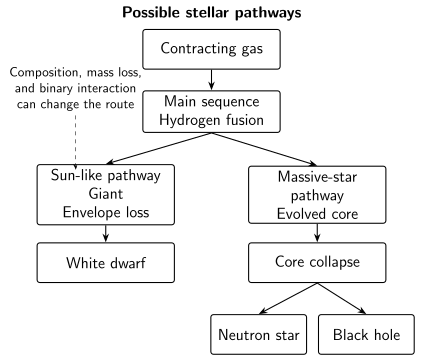
Stellar outcomes depend on the changing core and envelope. These schematic pathways omit many intermediate stages. Initial composition, mass loss, and binary interactions can change the route; lengths and box sizes carry no time or size scale.
Birth mass matters greatly, but a single sharp boundary cannot reliably separate all neutron-star and black-hole outcomes. For example, a calibrated set of one-dimensional, solar-composition models found successful and failed explosions interspersed across initial mass. That result illustrates the dependence on core structure; it is not a universal map for all stellar populations (Sukhbold et al. 2016, abstract and model scope).
More fuel need not mean a longer life
Section titled “More fuel need not mean a longer life”A larger fuel store lasts longer only if consumption does not rise too much. A rough stellar lifetime estimate is available nuclear energy divided by luminosity, the rate of energy loss.
Imagine a model with ten times the usable fuel of another but one thousand times its luminosity. Before calculating, predict which runs out first.
Answer and the limit of the estimate
The more luminous model uses its energy much faster. Its lifetime ratio is : one-hundredth as long, assuming the same energy released per unit fuel.
This is an illustrative scaling, not a measured age or a complete stellar model. Actual usable fuel fractions, internal mixing, composition, and luminosity change during evolution. The exercise explains why “more mass means more fuel, so a longer life” misses a crucial second quantity.
Transfer the reasoning to two hypothetical stars with the same usable fuel but luminosities in a two-to-one ratio. Under the same constant-luminosity approximation, the brighter one lasts half as long.
For educators
Prepare cards for hydrogen depletion, core contraction, envelope loss, collapse, and the three remnant types. The objective is to connect changes inside a star to conditional outcomes, rather than memorize one universal life cycle. No astronomy background is needed; the fuel-versus-luminosity comparison uses ratios.
For a 5–10 minute activity, replace an arrow labeled “gets old” with a specific physical change. Expected reasoning distinguishes a cooling white dwarf from a collapsing massive core and allows a contracting center with an expanding envelope. Address the misconception that a cooler visible surface means the entire star is cooling.
For a 20-minute investigation, compare the two fuel budgets in the question, then add mass transfer from a companion to one proposed pathway. A good answer explains both why more fuel can still mean a shorter life and why birth mass alone cannot fix every ending. Have groups mark which parts of their paper pathway remain justified and which require more information, without inventing a universal neutron-star–black-hole mass boundary.
Continue with Black Holes: Start Here to separate a remnant’s formation story from the evidence used to identify it.
References
Section titled “References”- NASA. Types of Stars, especially “Main Sequence Stars,” “Red Giants,” “White Dwarfs,” and “Neutron Stars.” NASA Science. Overview.
- Sukhbold, T., Ertl, T., Woosley, S. E., Brown, J. M., and Janka, H.-T. (2016). “Core-Collapse Supernovae from 9 to 120 Solar Masses Based on Neutrino-powered Explosions.” The Astrophysical Journal 821, 38. DOI; open manuscript.
Further reading
Section titled “Further reading”For an optional account of how burning, mixing, and mass loss shape a massive star before collapse, read Massive-Star Evolution Toward Collapse. Preparation: stellar structure, thermodynamics, and calculus.