How do we detect merging black holes?
Scrollable formula. Use Left and Right arrow keys to reveal hidden content.
Scrollable table. Use Left and Right arrow keys to reveal additional columns.
Scrollable figure. Use Left and Right arrow keys to inspect hidden content.
https://blackhole.org/universe/black-holes/gravitational-waves/
Two black holes can announce their merger without sending us a photograph. Their changing gravitational field produces waves that travel outward. When a wave reaches Earth, instruments can detect its tiny effect on the relative separation of carefully isolated mirrors.
The first direct detection, GW150914, reached the two LIGO observatories on 14 September 2015 and was reported in 2016. The instruments measured a changing strain. Interpreting that pattern as a black-hole merger required a model, calibration, and checks against noise (Abbott et al. 2016, detection paper, abstract and §§II–IV, PDF).
Gravitational waves change relative distances
Section titled “Gravitational waves change relative distances”A gravitational wave is a propagating disturbance of spacetime geometry. One way to describe its physical effect is to imagine freely falling objects arranged in a circle. For one wave polarization, their separations alternately stretch along one direction and squeeze along the perpendicular direction. The pattern then reverses.
This is a tidal effect: relative motion matters. Moving the entire circle together without changing any separation would be a different situation. Nor does a wave require air or another material to carry it. A gravitational wave can cross a vacuum.
An interferometer compares two perpendicular directions. In an ideal orientation, one arm grows slightly longer while the other grows slightly shorter. The drawing exaggerates this change so that we can see which lengths are being compared.
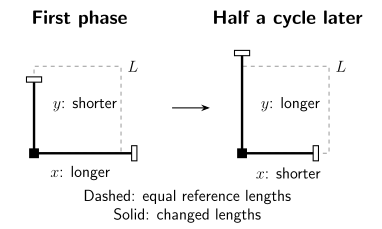
A wave can change two perpendicular lengths in opposite senses. This schematic shows a plus-polarized wave arriving perpendicular to the arm plane in the long-wavelength limit. Solid lines show distorted lengths; dashed lines mark the equal reference lengths. Distortions are greatly exaggerated, and the drawing contains no GW150914 measurements.
| Moment in the drawing | Horizontal arm | Vertical arm | Difference between arm changes |
|---|---|---|---|
| First phase | Longer | Shorter | Positive |
| Half a cycle later | Shorter | Longer | Negative |
Real detector response depends on the wave’s direction and polarization. The drawing is a particularly simple orientation, not the response to every source.
Laser light turns a length comparison into a signal
Section titled “Laser light turns a length comparison into a signal”LIGO sends laser light down two arms, reflects it from mirrors, and combines the returning light. The waves of light interfere: their relative timing affects how much light reaches the output detector. A changing difference between the arms therefore produces an optical signal.
The actual instruments have optical cavities, suspended mirrors, feedback controls, and calibration systems. They do not watch a ruler physically slide past a mirror. The general interferometer principle is explained in Carroll 2014, §7.7, pp. 316–318.
Each LIGO arm is four kilometers long. A strain of about corresponds to a differential arm-length change of roughly meters. That is why isolating the mirrors from vibration and measuring the instrument’s response are central parts of the experiment (Abbott et al. 2016, detection paper, §III, PDF).
Try the mathematics: a tiny change divided by a long arm
Preparation: ratios, signed numbers, and powers of ten.
Let the reference length of each arm be , and let its small change be or . In the low-frequency, equal-arm description, define detector strain by
This is dimensionless: meters divide by meters. For the ideal plus polarization drawn above,
The factor of one-half applies to each arm separately. Subtracting their opposite changes gives , not . With m and , the changes are m and m.
These first-order relations assume a weak wave, mirrors acting approximately as free test masses at the frequencies of interest, and wavelength much longer than the arms. An arbitrary arrival direction mixes the two wave polarizations through the detector’s orientation. Calibration also accounts for the real optical and mechanical response.
A rising frequency tells us about a shrinking orbit
Section titled “A rising frequency tells us about a shrinking orbit”Two compact objects in an inspiraling binary lose orbital energy to gravitational waves. As their separation decreases, they orbit faster, and the dominant wave frequency rises. The increasing frequency is called a chirp.
For a slowly evolving, nearly circular binary, the leading gravitational-wave pattern repeats twice per orbit. Near merger, a simple Newtonian orbit is insufficient; general-relativistic calculations connect the inspiral, merger, and final settling. The latter stage is called ringdown (Abbott et al. 2017, §§2–4 and Appendix C, PDF).
The binary-star lab deliberately holds a circular orbit fixed. It explains orbital speeds and their projection along our line of sight, but omits radiation reaction and cannot simulate an inspiral.
The measured chirp constrains combinations of masses. Its amplitude and detailed shape also depend on distance, orientation, and spin. For cosmologically distant sources, expansion stretches the observed time scale; source-frame masses require accounting for redshift. A graph of strain therefore does not display two independently weighed masses or a unique distance without analysis.
If a recording is played through a speaker, the speaker turns the changing signal into pressure waves in air. The original wave crossed space as a gravitational disturbance. Calling it a “chirp” does not mean sound traveled from the black holes to Earth.
Several checks connect a signal to a source
Section titled “Several checks connect a signal to a source”A bump in one instrument could be a local disturbance. The GW150914 analyses looked for a consistent transient in separated detectors and tested what chance coincidences of noise could produce. Artificial time shifts larger than the allowed intersite travel delay supplied one background test; environmental checks addressed possible correlated disturbances (Abbott et al. 2016, minimal-assumption search, §II, PDF).
Researchers also compared approaches. Searches for coherent bursts did not require a detailed binary waveform to find the event. Binary models then supplied a more specific interpretation. Agreement between different reconstructions and general-relativistic waveforms helps test whether the result is an artifact of one analysis (Abbott et al. 2016, minimal-assumption search, §§III and V, PDF).
The observations support the merger of compact objects with the properties expected of black holes. They do not photograph an event horizon or reveal what happens at a singularity. This evidence complements stellar orbits and black-hole radio imaging.
Predict which displacement the detector notices
Section titled “Predict which displacement the detector notices”Suppose both ideal arms change by exactly the same amount at the same time. Is their difference changed? Now suppose one lengthens while the other shortens by the same amount.
Answer and transfer
Equal changes subtract to zero. Opposite changes add in the difference, making this detector channel sensitive to the second pattern. Real instruments do not reject every common disturbance perfectly, so this arithmetic is not a guarantee against noise.
Next imagine a candidate recorded strongly at one site and absent at another. That fact alone is not a complete verdict: different orientations and sensitivities can give different responses. Ask what the proposed wave predicts for each detector, whether the arrival times agree, and whether local disturbances explain the measurements.
For educators
Preparation and objective. The main activity uses subtraction and comparison; the optional calculation adds scientific notation. Students should distinguish a measured differential strain from an inferred binary source.
Short activity, about 10 minutes. Draw two equal arms on paper. Label hypothetical changes and in arbitrary units and calculate the differences. Expected answers are zero and four; no lasers or physical stretching experiment is needed.
Longer extension, about 30 minutes. Give groups statements about changing detector output, a consistent arrival delay, a fitted mass, and sound played through a speaker. Ask them to classify measurement, analysis, or representation and propose one additional check. A mass estimate needs a waveform model; audio playback needs a conversion to sound.
Misconception to discuss. “The two signals must look identical.” Detectors view different projections and have different noise. A good answer asks for consistency with those responses, not visual identity. Use the explained displacement task above to check that students subtract the two arm changes rather than adding their signed values.
References
Section titled “References”- Abbott, B. P., et al. (LIGO Scientific Collaboration and Virgo Collaboration) (2016). “Observation of Gravitational Waves from a Binary Black Hole Merger.” Physical Review Letters 116, 061102. DOI; Open PDF.
- Abbott, B. P., et al. (LIGO Scientific Collaboration and Virgo Collaboration) (2016). “Observing Gravitational-Wave Transient GW150914 with Minimal Assumptions.” Physical Review D 93, 122004. DOI; Open PDF.
- Abbott, B. P., et al. (LIGO Scientific Collaboration and Virgo Collaboration) (2017; published online 2016). “The Basic Physics of the Binary Black Hole Merger GW150914.” Annalen der Physik 529, 1600209. DOI; Open PDF.
- Carroll, S. M. (2014). Spacetime and Geometry: An Introduction to General Relativity. Pearson New International Edition, §§7.3 and 7.7. Author’s book page.
Further reading
Section titled “Further reading”For an optional derivation of the arm-length comparison and its strain normalization, read Michelson Interferometer Response. Preparation: wave optics, calculus, and vectors and tensors.