Why do planets mostly orbit in one plane?
Scrollable formula. Use Left and Right arrow keys to reveal hidden content.
Scrollable table. Use Left and Right arrow keys to reveal additional columns.
Scrollable figure. Use Left and Right arrow keys to inspect hidden content.
https://blackhole.org/universe/solar-system/formation/
The eight planets travel around the Sun in the same direction and nearly the same plane. Their arrangement preserves a clue to their origin: they grew in a rotating disk of gas and dust around the young Sun, about 4.6 billion years ago. Gravity drew material together, while rotation and energy loss helped shape the disk. The shared plane is an inheritance, not a rule that gravity imposes on every possible orbit. NASA 2026, “Planetary Systems,” § Construction Zone
Predict first. Two small clouds have the same mass and size. One has much more overall rotation than the other. Should we expect them to collapse into identical arrangements?
A collapsing cloud retains its rotation
Section titled “A collapsing cloud retains its rotation”A star begins forming when a region of a cold gas cloud collapses under gravity. Material in that region is already moving. Individual motions need not line up perfectly, but their combined rotation generally does not cancel completely. The quantity that measures rotational motion is angular momentum. Its total changes only when angular momentum is transferred across the chosen system’s boundary or an external twisting influence—a torque—acts.
For a small parcel moving around a centre, angular momentum depends on both sideways speed and distance from the rotation axis. Bringing it closer while preserving its angular momentum increases its sideways speed. This makes rotation increasingly important during collapse. A parcel with substantial angular momentum cannot simply fall straight to the centre without transferring some of that angular momentum elsewhere.
Rotation alone does not explain a thin disk. Gas streams interact, shocks convert organized motion into heat, and radiation carries energy away. Motions above and below the emerging disk can be damped, while the net rotational motion remains. Gravity draws material toward the disk’s middle plane; pressure and continuing stirring prevent a gas disk from becoming infinitely thin. Collisions and gas drag also affect how solid grains settle.
The diagram separates these two ingredients: a preferred rotation direction and energy loss. The shrinking cloud and disk are schematic stages, not pictures of our own Solar System forming.
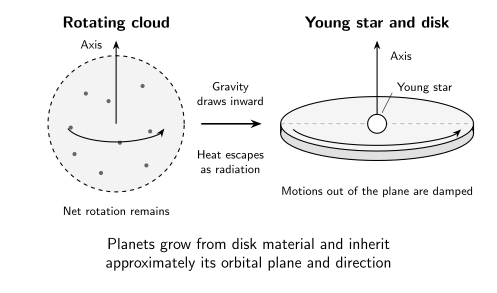
A shared disk explains a shared orbital plane. Gravity, angular-momentum transfer, and energy loss act together as a rotating cloud forms a star and disk. The disk is shown obliquely; its drawn axis is perpendicular to its plane. Shapes, separations, and arrow lengths are schematic, and the stages have no common size or time scale.
An elementary collision helps explain the energy argument. Imagine equal masses meeting with opposite upward and downward motions but the same sideways motion. Their vertical momenta cancel; their shared sideways momentum does not. If they merge, some kinetic energy becomes heat. Cooling can remove that heat without cancelling all their rotation. This is an illustration of dissipation, not a complete model of a turbulent, magnetic cloud.
Material can continue accreting onto the young star because angular momentum is redistributed through the disk and can also leave with outflows. The whole cloud is not a rigid wheel, and an individual parcel’s angular momentum need not stay fixed throughout its history.
A common plane can contain different planets
Section titled “A common plane can contain different planets”A disk contains gas and solid particles. Where it is warm, some rock-forming materials can remain solid while water is vapour. In colder regions, water ice adds to the available solids. The boundary where water can persist as ice is often called the water snow line; its location changes as the disk evolves. It is not a permanent dividing circle marked on today’s Solar System.
Small particles can stick, bounce, fragment, drift, or collect in denser regions. Building planetesimals—bodies large enough for their own gravity to become important in further growth—is a difficult step, not an automatic sequence in which every collision makes a larger rock. Gas pressure variations can concentrate drifting solids and help growth. Andrews et al. 2018, § I, planetesimal growth and particle trapping
Once substantial cores form, their ability to retain large gas envelopes depends on their growth and the remaining gas supply. Disk gas disperses, while collisions between larger solid bodies can continue. Temperature, growth rate, gas loss, and gravitational interactions together help produce different kinds of worlds. NASA 2024, “How Do Planets Form?,” growth and temperature discussion
| Part of the explanation | What it helps explain | What it does not fix by itself |
|---|---|---|
| A common rotating disk | Similar orbital planes and directions | The exact orbit of each planet |
| Different thermal conditions | Which materials can remain solid | A planet’s final composition after mixing and collisions |
| Growth while gas remains | Acquisition of a substantial gas envelope | The outcome for every core |
| Exchanges of momentum | Changes of orbit during and after growth | A unique history inferred from today’s position alone |
The evidence is more than a neat arrangement
Section titled “The evidence is more than a neat arrangement”Astronomers observe disks around other young stars, and meteorites preserve chemical and physical clues from our own early Solar System. Those are different kinds of evidence: observations of other systems show processes still occurring; ancient material helps reconstruct our particular past. NASA 2026, “Planetary Systems,” § Detecting Disks
For example, ALMA’s DSHARP survey measured millimetre emission from 20 disks and found abundant rings and other structure. These targets were selected preferentially from large, bright disks, so they are not an unbiased census of all young systems. A ring or gap is evidence about the emitting material, not by itself a photograph of a planet. Planet–disk interactions are one possible explanation; concentrating dust through gas dynamics can also produce structure. Andrews et al. 2018, §§ II and VI
As with any astronomical image, interpreting brightness requires knowing the wavelength and how matter emits and absorbs there. The most persuasive history must fit the orbital arrangement, the material evidence, and observations of young systems together.
Why some orbits break the pattern
Section titled “Why some orbits break the pattern”The planets’ orbits are close to a common plane, not perfectly coplanar. Other Solar System bodies can depart much more strongly. Encounters with planets exchange energy and angular momentum, stretching and tilting smaller bodies’ orbits. The scattered population beyond Neptune includes many such inclined, elongated paths. NASA n.d., “Kuiper Belt: Facts,” § Scattered Disk
Planetary orbits can also move inward or outward through interactions with a disk or other bodies: orbital migration. Consequently, a present orbit need not mark a birthplace. A planet’s daily spin axis is a further, distinct property; it need not remain perpendicular to its orbital plane. Shared origin gives a pattern with a history, not a prohibition against exceptions.
Show the math: rotation sets a characteristic radius
Preparation: rearranging algebraic equations and comparing squared ratios; angular momentum is defined below.
Consider a parcel orbiting a much larger central mass . In this limited model, the central mass stays fixed, pressure is neglected in the final orbit, and the parcel loses energy without a torque changing its specific angular momentum —angular momentum per unit mass. At radius , its sideways speed gives .
For a circular orbit, inward gravitational acceleration supplies the needed centripetal acceleration:
Substituting gives the circular-orbit radius
The units check: has units of length squared per time, so has units of length. A parcel with half the specific angular momentum has one-quarter the circularization radius in this model. The opening clouds therefore need not form identical arrangements: rotational motion matters as well as mass and size.
This is a scale estimate, not a prediction of a whole disk’s edge or its planetary orbits. Real disks transport angular momentum, exchange mass, feel pressure forces, and evolve as the central star grows. A parcel must change to move through a sequence of smaller circular orbits around a fixed .
Try an inclined planet
Section titled “Try an inclined planet”A planet is found on an orbit tilted relative to its neighbours. Does that observation alone refute formation in a disk?
Answer
No. It rules out a story in which everything formed perfectly aligned and nothing subsequently changed. It does not distinguish later gravitational encounters from a disk whose orientation was itself disturbed. To choose between histories, astronomers need more evidence, such as companion orbits, the degree of orbital elongation, and the system’s age. Gravity allows inclined orbits; the disk explanation concerns why a common plane is a natural starting pattern.
For classrooms and clubs
Preparation: directions, simple ratios, and optionally algebra; no equipment is required. Objective: explain why both retained rotation and energy loss matter. In 20 minutes, draw two equal incoming momentum arrows with the same horizontal component and opposite vertical components. Add them: the vertical components cancel while the horizontal components add. Discuss where the lost kinetic energy goes in an inelastic collision, and why cooling is needed for that heat to escape. A table of signed components gives an equivalent text-only activity.
For a longer extension, use values in the ratio 1:2:3 around the same central mass. The circularization radii should be in the ratio 1:4:9. Explain why those are not predicted planetary spacings. The common misconception is that gravity requires every orbit to lie in one universal plane; the inclined-orbit example shows that the observed pattern reflects formation and subsequent interactions instead.
Next, explore how orbits work today, then compare our system with the worlds found through exoplanet searches.
References
Section titled “References”- Andrews, Sean M., et al. “The Disk Substructures at High Angular Resolution Project (DSHARP). I. Motivation, Sample, Calibration, and Overview.” The Astrophysical Journal Letters 869 (2018), L41. DOI: 10.3847/2041-8213/aaf741. Open article, arXiv:1812.04040.
- NASA Science. “How Do Planets Form?” Updated October 29, 2024. Planetary growth and thermal conditions.
- NASA Science. “Kuiper Belt: Facts.” n.d. § Scattered Disk. Accessed September 27, 2026.
- NASA Science. “Planetary Systems.” Updated August 12, 2026. Construction Zone and Detecting Disks.
Further reading
Section titled “Further reading”For the conservation laws behind the contraction argument, read Conservation Laws, Scaling, and the Virial Theorem. This optional treatment supplies the mechanics; disk formation still requires the dissipation and cooling discussed here. Preparation: calculus and Newtonian mechanics.