Why do planets stay in orbit?
Scrollable formula. Use Left and Right arrow keys to reveal hidden content.
Scrollable table. Use Left and Right arrow keys to reveal additional columns.
Scrollable figure. Use Left and Right arrow keys to inspect hidden content.
https://blackhole.org/universe/solar-system/orbits/
A planet is falling toward the Sun while moving sideways. Gravity continually bends its path, and its sideways motion carries it past the place it would otherwise fall into. In a bound orbit, that combination brings the planet around again. It does not need an engine to keep moving or a second force pushing outward to balance gravity in an inertial description.
For more context, Solar System scale introduces the astronomical unit and separates planet sizes from their orbital distances. The optional calculation below uses ratios, algebra, and a square root.
Predict first. Imagine two small planets orbiting the same star. One has an orbital semimajor axis four times the other’s. Does it take four times as long to complete an orbit?
Gravity changes a planet’s velocity
Section titled “Gravity changes a planet’s velocity”Velocity includes both speed and direction. A planet moving around a perfect circle continually changes direction, even if its speed stays constant. That change requires acceleration toward the centre of the circle. Gravity supplies it. A freely falling orbit therefore does not mean that gravity has switched off. NASA/JPL 2025, Basics of Space Flight, Chapter 3, § Acceleration in Orbit
Imagine taking a short snapshot of the motion. Without gravity, the planet would continue along a straight line tangent to its present path. With gravity, its next position is displaced inward from that line. Repeat this reasoning through many short steps and the curved path emerges. The planet’s motion is not a succession of stops and restarts; the snapshots help us describe continuous motion.
Not every speed or direction produces a safe, bound orbit. An object can collide with the central body, follow a long ellipse, or escape along an unbound path. Other planets, gas drag, tides, and radiation can change real trajectories. We will first use the clean two-body model: two isolated spherical bodies, treated as point masses for their external gravity, moving under Newtonian gravity.
An ellipse puts the Sun at a focus
Section titled “An ellipse puts the Sun at a focus”For a bound, noncolliding orbit in this model, the relative path is an ellipse. An ellipse has two special points called foci. The sum of the distances from any point on the ellipse to the two foci is constant. The major axis is its longest diameter, and the semimajor axis, , is half that length.
For a planet much lighter than the Sun, we can picture the Sun nearly fixed at one focus. It is not generally at the centre of the ellipse. The circle is the special case in which the foci coincide. Eccentricity, , measures the departure from a circle: is circular, while larger values below one describe more elongated ellipses. NASA Science Editorial Team 2024, “Orbits and Kepler’s Laws,” § Here are Kepler’s Three Laws
The example below deliberately uses a conspicuous eccentricity of 0.6. Earth’s orbit is much closer to circular. Look at the two shaded regions: their shapes differ, but their areas and travel times are equal.
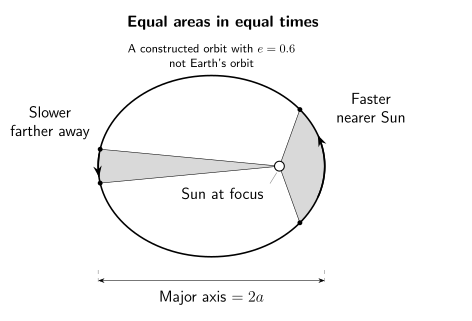
Equal time means equal swept area. This constructed Kepler ellipse has eccentricity 0.6 and the Sun at one focus. The two shaded sectors each occupy the same fraction of an orbital period; the planet traverses a longer arc near the Sun. Body sizes are schematic, and this exaggerated ellipse is not Earth’s orbit.
Equal areas explain changing speed
Section titled “Equal areas explain changing speed”Imagine the line from the Sun to the planet sweeping across the orbital plane as the planet moves. Kepler’s second law says that it sweeps equal areas in equal times. The exact swept region has a curved outer boundary along the orbit. A triangle formed by joining two positions is only an approximation to that region over a short interval.
Close to the Sun, the sweeping line is short, so it must turn farther during the same time to cover the required area. The planet moves fastest at perihelion, its closest approach to the Sun, and slowest at aphelion, its farthest point. Equal time steps therefore do not usually produce equal spacing along the ellipse. NASA/JPL 2025, Chapter 3, § Kepler’s Laws
This also gives a useful drawing test. If a diagram puts equally spaced dots around an elongated ellipse and labels every gap “one month,” something is wrong with that timing. A correct geometric shape is not enough; its time labels must respect the dynamics.
Wider orbits take disproportionately longer
Section titled “Wider orbits take disproportionately longer”For two bodies with masses and , the period obeys
Here is Newton’s gravitational constant, and is the semimajor axis of the relative orbit, measured using the separation between the bodies. In SI units, use kilograms for masses, metres for , and seconds for . Both bodies move around their common centre of mass. In a Sun–planet example the Sun’s motion is small, but in a pair of comparable stars it cannot be ignored. This is the mass–period connection used when weighing stars. Fraknoi, Morrison, and Wolff 2022, § 18.2, “Masses from the Orbits of Binary Stars”
For small planets around the same star, the mass factor is almost the same. Compare periods by taking the ratio:
An orbital semimajor axis four times larger gives a period eight times longer: . The path is longer, and the typical speed is lower. For a star of about one solar mass, a negligible-mass planet at 1 AU has a period about one year; at 4 AU the two-body prediction is about eight years. These are model examples, not an exact timetable for an interacting planetary system.
Show the math: check the circular case
Take a planet of mass much lighter than its star of mass , in a circular orbit of radius and speed . Newtonian attraction supplies the required centripetal acceleration:
The planet’s mass cancels. This does not mean the planet has no gravity; it is the approximation in which its effect on the star’s motion is negligible. Since a circle’s circumference is ,
The dimensions work: has units of length cubed divided by time squared, so has units of time squared. In the full two-body solution, replace by and use the relative semimajor axis . Deriving that ellipse result requires solving the gravitational equation of motion; the circular calculation is a check, not its complete proof. At fixed and total mass, the two-body period is independent of eccentricity.
Try changing the star
Section titled “Try changing the star”Two negligible-mass planets have the same semimajor axis, but one orbits a star four times as massive. Which has the shorter period, and by what factor?
Answer
The planet around the more massive star has half the period. At fixed , the equation gives proportional to , so is proportional to . A fourfold mass increase gives . Keeping the orbit’s size fixed is essential: changing both size and mass would require both factors.
For classrooms and clubs
Preparation: ratios and reading a labelled diagram. Objective: connect orbit shape, timing, and central mass. In 15 minutes, compare the two shaded sectors. Near the star, the planet travels farther along its orbit in the same time because the radius is smaller while the swept area stays equal. Then calculate periods for semimajor-axis ratios 1, 4, and 9: the period ratios are 1, 8, and 27 around the same dominant mass.
For a longer extension, keep semimajor axis fixed and use central masses in the ratio 1:4:9. The period ratios become 1:1/2:1/3, since period scales with the inverse square root of mass. A common misconception is that an outward force must cancel gravity; in this inertial description, an unbalanced gravitational force is precisely what bends the path. Describing the short-radius/long-arc comparison aloud supports readers who cannot inspect the figure.
Next, ask why the planets inherited nearly one orbital plane, or connect orbital measurements with the binary-star laboratory.
References
Section titled “References”- Fraknoi, Andrew, David Morrison, and Sidney Wolff. Astronomy 2e. Houston: OpenStax, 2022. § 18.2, “Measuring Stellar Masses,” total-mass form of Kepler’s law.
- NASA Jet Propulsion Laboratory. Basics of Space Flight. Chapter 3, “Gravity & Mechanics,” updated January 16, 2025. §§ Acceleration in Orbit and Kepler’s Laws.
- NASA Science Editorial Team. “Orbits and Kepler’s Laws.” NASA Science, updated October 28, 2024. Planetary orbit geometry and laws.
Further reading
Section titled “Further reading”For an optional derivation of orbital shapes, periods, and orbital elements, read Kepler Orbits and Orbital Elements. Preparation: Newtonian mechanics, calculus, and vectors.