Why do astronomers talk about dark energy?
Scrollable formula. Use Left and Right arrow keys to reveal hidden content.
Scrollable table. Use Left and Right arrow keys to reveal additional columns.
Scrollable figure. Use Left and Right arrow keys to inspect hidden content.
https://blackhole.org/universe/cosmology/dark-energy/
Cosmic expansion has a history: its behavior can change as the universe’s contents change. Astronomers investigate that history by comparing distances with redshifts and asking which models fit. Measurements of distant Type Ia supernovae helped establish that the late-time expansion is accelerating.
Dark energy names a component invoked in general-relativistic cosmological models to account for that acceleration. The name does not tell us its microscopic nature, nor does it mean the unseen mass used to explain galaxy rotation.
A distant explosion becomes a distance test
Section titled “A distant explosion becomes a distance test”A supernova’s apparent brightness depends on its luminosity and distance, as well as intervening material and the observing instrument. If astronomers can estimate its intrinsic luminosity, the received light helps determine a luminosity distance: the distance defined by the usual inverse-square flux relation.
Type Ia supernovae are useful because their changing brightness and colors allow empirical corrections. They are standardized candles, not perfectly identical explosions. Astronomers measure a light curve over time, classify the event, account for relevant effects, and compare it with calibrated examples.
The host galaxy’s spectrum supplies a redshift. Pairing redshift with inferred luminosity distance tests the expansion model. The 1998 study by Riess and colleagues found distant supernovae farther away than expected in their tested models without a cosmological constant and favored accelerated expansion. It explicitly investigated systematic effects such as dust, evolution, and selection (Riess et al. 1998, abstract).
Redshift alone does not establish acceleration. Nor does a faint object by itself: it might simply be intrinsically faint or obscured.
Compare two specified universes
Section titled “Compare two specified universes”Consider two flat cosmological models with the same present Hubble constant. One contains only pressureless matter. The other has 30 percent matter and 70 percent cosmological-constant contribution to the present critical density. For this example, neglect radiation.
At the same redshift of 0.5, these models predict different luminosity distances. The comparison below is calculated from their expansion histories; it does not contain supernova measurements or fit a survey.
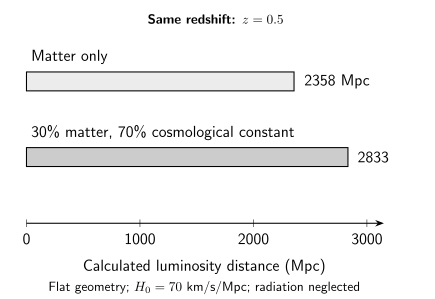
A model’s expansion history changes the predicted luminosity distance at a given redshift. Both examples are spatially flat, neglect radiation, and use a present Hubble constant of 70 km/s/Mpc. The bars show calculated distances, not observed supernovae or present-day ruler distances.
| Model at redshift 0.5 | Calculated luminosity distance | Flux of the same-luminosity source, relative to matter-only |
|---|---|---|
| Matter only | About 2,358 Mpc | 1 |
| 30% matter, 70% cosmological constant | About 2,833 Mpc | About 0.693 |
A megaparsec, or Mpc, is one million parsecs. Because the second luminosity distance is larger, the same standardized source looks dimmer in that example. This explains the direction of the comparison. Real inference needs many observations, calibration, uncertainty estimates, and tests of competing explanations.
Acceleration does not require a growing Hubble parameter
Section titled “Acceleration does not require a growing Hubble parameter”The scale factor, , describes the growth of average cosmic separations. Accelerated expansion means its rate of change increases: a graph of against cosmic time bends upward.
The Hubble parameter measures the growth rate relative to the current scale factor, . These are different quantities. A growing denominator allows to decrease even while expansion accelerates.
As a mathematical illustration, let be proportional to for positive time . The expansion rate is proportional to and increases, but decreases. This example distinguishes the definitions; it is not a fit to our universe’s full history.
In general relativity, both energy density and pressure affect the acceleration. A cosmological constant has the negative pressure needed to produce an accelerating contribution (Carroll 2014, §8.3, pp. 335–336). Other proposed explanations can vary with time. Determining the nature of that contribution remains a research problem.
Try the mathematics: where the distance numbers come from
Preparation: algebra, ratios, and the idea of a definite integral as an accumulated contribution. The table and flux comparison can be used without evaluating the integral.
For the flat, radiation-free examples above,
is luminosity distance, is redshift, is light speed, is today’s Hubble constant, and is today’s matter density divided by critical density. Flatness in this two-component example gives a cosmological-constant fraction .
The integral adds up how the changing expansion rate affects light propagation. With km/s/Mpc and , it gives approximately Mpc for and Mpc for .
Using , the ratio of fluxes is . Luminosity distance packages redshift and light-propagation effects; it is not simply today’s physical separation. The geometric distance relations are developed in Carroll 2014, §8.5, pp. 346–348.
Predict an apparent acceleration signal
Section titled “Predict an apparent acceleration signal”Suppose an uncorrected effect makes distant supernovae look dimmer without changing their measured redshifts. Would their inferred luminosity distances become larger or smaller? Could that imitate part of the cosmological signal?
Answer and transfer
They would appear farther away if the analysis assumed the same intrinsic luminosities. Yes: that could imitate part of a distance–redshift difference. This is why extinction, calibration, selection, and possible source evolution must be tested rather than treated as afterthoughts.
Now suppose every inferred distance, nearby and distant, is multiplied by the same factor. That changes the overall calibration. It is different from a redshift-dependent change in the shape of the distance relation. Comparing observations across redshift helps distinguish these effects.
For educators
Preparation and objective. Ratios suffice for the table; rates of change and integrals belong to the optional depth. Students should explain why brightness plus redshift tests an expansion model and why faintness alone is insufficient.
Short activity, about 10 minutes. Separate recorded flux, inferred luminosity distance, and tested cosmology. Use the two-bar table to predict which identical-luminosity source appears dimmer. Expected answer: the larger luminosity distance gives less flux.
Longer extension, about 30 minutes. Reproduce the flux ratio of about 0.693 and solve the uncorrected-dimming question. Groups then compare a uniform calibration change with one increasing with redshift. Expected distinction: the first changes the overall distance scale; the second can distort the relation’s shape and mimic part of a cosmological signal.
Misconception to discuss. “Acceleration requires the Hubble parameter to increase.” The example has an increasing growth rate but decreasing . For readers without calculus, compare the increase in over successive equal time intervals with its fractional increase. Dark matter and dark energy also answer different observational questions.
For the next question, compare possible cosmic futures under explicit assumptions. An expansion measurement is not, by itself, a measurement of the universe’s eventual fate.
References
Section titled “References”- Carroll, S. M. (2014). Spacetime and Geometry: An Introduction to General Relativity. Pearson New International Edition, §§8.3–8.5. Author’s book page.
- Riess, A. G., et al. (1998). “Observational Evidence from Supernovae for an Accelerating Universe and a Cosmological Constant.” The Astronomical Journal 116, 1009–1038. DOI; open manuscript.
Further reading
Section titled “Further reading”For an optional derivation of the acceleration condition and the role of a cosmological constant, read Cosmological Constant and Accelerated Expansion. Preparation: calculus, fluid energy and pressure, and general relativity.