What did the young universe make?
Scrollable formula. Use Left and Right arrow keys to reveal hidden content.
Scrollable table. Use Left and Right arrow keys to reveal additional columns.
Scrollable figure. Use Left and Right arrow keys to inspect hidden content.
https://blackhole.org/universe/cosmology/primordial-elements/
The young universe made a large supply of helium and small amounts of several other light nuclei. Most ordinary matter remained hydrogen. This was not yet the manufacture of planets, rocks, or the carbon in our bodies.
Big Bang nucleosynthesis, or BBN, describes nuclear reactions during the first few minutes of the hot, expanding universe. Its predicted chemical starting mixture gives us a test of that history which is different from measuring galaxy distances or the microwave background.
Cooling opened a short window for nuclear assembly
Section titled “Cooling opened a short window for nuclear assembly”A hydrogen nucleus is a single proton. A helium-4 nucleus contains two protons and two neutrons. Protons and neutrons are collectively called nucleons. An isotope’s number counts its nucleons: deuterium, or hydrogen-2, has one proton and one neutron.
To build helium, the early universe first needed a supply of small nuclei that could survive. At very high temperatures, energetic photons rapidly broke apart newly formed deuterium. Expansion cooled the radiation until enough deuterium could persist and take part in further reactions.
There was then a race between nuclear reactions and continuing expansion. Falling temperature and density eventually made further processing inefficient. Almost all surviving neutrons ended up in helium-4, while many protons remained as hydrogen nuclei. Trace deuterium, helium-3, and mass-seven nuclei, whose protons and neutrons add up to seven, also remained (Carroll 2014, §8.7, pp. 363–364).
This process formed nuclei, not a neutral hydrogen atmosphere. Electrons joined nuclei much later, during the cooling transition associated with the cosmic microwave background’s last scattering.
The early reactions did not produce an appreciable supply of all the heavier elements. The absence of stable nuclei with five or eight nucleons obstructs simple assembly routes; the falling density and limited reaction time also matter. Later stellar processes made most heavier nuclei (Fields, Molaro, and Sarkar 2025, §24.2, PDF).
A quarter by mass is much less than a quarter by number
Section titled “A quarter by mass is much less than a quarter by number”A useful rounded description of primordial ordinary matter is about three-quarters hydrogen and one-quarter helium-4 by mass. These fractions refer to ordinary nuclear matter, not to the universe’s total energy budget. They do not include dark matter or dark energy.
One helium-4 nucleus is about four times as massive as one hydrogen nucleus. Counting nuclei and weighing material therefore give different percentages.
Imagine twelve separate hydrogen nuclei and one helium-4 nucleus. They contain sixteen nucleons altogether: twelve in hydrogen and four in helium. Helium accounts for four-sixteenths of the mass, approximately 25 percent, but only one of the thirteen nuclei, approximately 7.7 percent.
The two bars show this same simplified mixture using two different denominators. Trace isotopes and small mass corrections are left out deliberately.
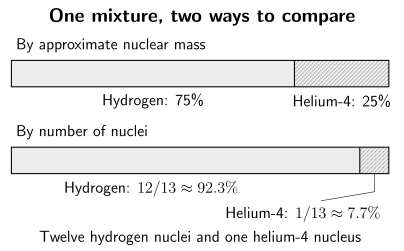
The same mixture gives different fractions when weighed or counted. Bar lengths are calculated for the rounded model with hydrogen mass fraction 0.75 and helium-4 mass fraction 0.25, taking nucleus masses in the ratio 1:4. Trace isotopes, electron masses, and nuclear binding-energy corrections are omitted. These are explanatory proportions, not a precision abundance measurement.
| Question about the model mixture | Hydrogen | Helium-4 |
|---|---|---|
| What fraction of its approximate nuclear mass? | 75% | 25% |
| What fraction of its nuclei? | 12/13, about 92.3% | 1/13, about 7.7% |
Try the mathematics: count neutrons before counting helium
Preparation: fractions and ratios. Treat proton and neutron masses as equal for this estimate.
Suppose the neutron-to-proton number ratio just before efficient nuclear assembly is approximately one to seven. Take two neutrons and fourteen protons as a small representative sample. If both neutrons enter one helium-4 nucleus, they use two protons, leaving twelve hydrogen nuclei.
Let be the neutron-to-proton ratio. If every neutron enters helium-4, there are helium nuclei, containing nucleons. The approximate helium mass fraction is
With , this gives . The approximation neglects trace isotopes and binding-energy corrections; precision BBN uses a reaction network rather than just this count (Fields, Molaro, and Sarkar 2025, §24.2, Eq. (24.1), PDF).
For a two-species mixture with hydrogen and helium mass fractions and , the nucleus-number ratio is
Setting and gives . The helium fraction of all nuclei is then , not : a ratio to hydrogen and a fraction of the total have different denominators.
Ancient chemistry is inferred from later observations
Section titled “Ancient chemistry is inferred from later observations”We do not scoop up a preserved sample from the first minutes. We observe much later gas and stars and ask how much their composition has changed.
Stars create and destroy nuclei. Astronomers therefore seek gas with little evidence of previous stellar processing and model the remaining effects. “Primordial abundance” is an inference with uncertainties, not simply the abundance measured in any convenient object.
Deuterium offers a particularly useful example. Its absorption lines are slightly displaced from hydrogen lines. A distant bright quasar supplies background light; intervening gas leaves absorption features in its spectrum. Comparing several lines helps separate deuterium from unrelated hydrogen absorption.
Cooke and colleagues’ 2018 analysis of seven selected absorption systems inferred about 25 deuterium nuclei per million hydrogen nuclei. This is a rounded description of that study’s result, not a new measurement or the latest combined estimate (Cooke, Pettini, and Steidel 2018, §§3–5.1, PDF).
Their analysis also checked consistency among systems and considered stellar processing, ionization, and dust. A trace isotope can be a powerful test because changing the ordinary-matter density changes how efficiently reactions consume it. Exact comparisons require nuclear reaction rates and their uncertainties, not just counting the lines.
Agreement matters, and discrepancies matter too
Section titled “Agreement matters, and discrepancies matter too”BBN predictions depend on the expansion rate, ordinary-matter density, and particle and nuclear physics. Comparing several abundances tests more than fitting one adjustable number. The microwave background provides a different way to constrain ordinary-matter density at a much later epoch.
The broad deuterium and helium agreement is a success of the hot-universe picture. Lithium is an important qualification: its abundance inferred from old, metal-poor stars is lower than the standard prediction when other data set the density. Stellar destruction, measurement systematics, and possible changes to the physics require investigation; a discrepancy alone does not identify its cause (Fields, Molaro, and Sarkar 2025, §§24.4–24.5, PDF).
A successful explanation of the lithium problem must also preserve the tests that already work. Conversely, successful deuterium and helium comparisons do not make the lithium discrepancy disappear. That is how several measurements can support a framework while still exposing an unresolved problem.
These conclusions concern a hot, early phase. They do not establish how matter first arose, why it outnumbers antimatter, or what happened at a first instant. Return to the three main hot-universe tests to see where this chemical evidence fits.
Predict the result of changing the denominator
Section titled “Predict the result of changing the denominator”Someone reads “25 percent helium by mass” and draws 25 helium nuclei beside 75 hydrogen nuclei. Does that drawing represent the stated mixture? What helium mass fraction would it actually have?
Answer and transfer
No. In the 1:4 nucleus-mass approximation, the helium contributes mass units and hydrogen contributes 75. The helium mass fraction is , about 57 percent.
To represent a 25-percent helium mass fraction, use twelve hydrogen nuclei for each helium-4 nucleus. Every abundance statement needs its denominator: mass of ordinary matter, number of hydrogen nuclei, or number of all nuclei are different choices.
Now ask whether a helium-rich star would be a good direct sample of the primordial mixture. Not by itself: its nuclear processing can change the composition. The calculation and the choice of an observational sample solve different parts of the problem.
For educators
Preparation and objective. Students need fractions and the supplied definitions of proton, neutron, and nucleus. The objective is to distinguish a mass fraction from a number fraction and explain why later observations need a processing model.
Short activity, about 10 minutes. Draw fourteen proton marks and two neutron marks. Group two of each into helium-4 and count what remains. Expected answers: twelve hydrogen nuclei, one helium nucleus, and approximately one-quarter of the mass in helium.
Longer extension, about 30 minutes. Compare two hypothetical samples: nearly unprocessed gas and material ejected by a star. Ask which is a better starting point for primordial chemistry and what measurements could reveal processing. Then solve the 25-out-of-100-nuclei problem above. Expected mass fraction: ; the counting fraction alone cannot answer it.
Misconception to discuss. “The Big Bang made every element in today’s proportions.” Students should separate early light nuclei, later stellar processing, and still later neutral-atom formation. Do not present this counting activity as a precision BBN simulation or a solution to the lithium problem.
References
Section titled “References”- Carroll, S. M. (2014). Spacetime and Geometry: An Introduction to General Relativity. Pearson New International Edition, §8.7, pp. 363–364. Author’s book page.
- Cooke, R. J., Pettini, M., and Steidel, C. C. (2018). “One Percent Determination of the Primordial Deuterium Abundance.” The Astrophysical Journal 855, 102. DOI; Open PDF.
- Fields, B. D., Molaro, P., and Sarkar, S. (2025). “Big Bang Nucleosynthesis,” revised August 2025. In the Particle Data Group’s Review of Particle Physics, S. Navas et al., Physical Review D 110, 030001 (2024), 2025 update. Review PDF, §§24.2–24.5.
Further reading
Section titled “Further reading”For an optional treatment of nuclear reaction rates, element abundances, and their uncertainties, read Big-Bang Nucleosynthesis. Preparation: thermodynamics, calculus, and statistical inference.