Why does the Sun keep shining?
Scrollable formula. Use Left and Right arrow keys to reveal hidden content.
Scrollable table. Use Left and Right arrow keys to reveal additional columns.
Scrollable figure. Use Left and Right arrow keys to inspect hidden content.
https://blackhole.org/universe/stars/nuclear-energy/
The Sun loses energy into space every second. A hot object can glow while it cools, and a shrinking object can release gravitational energy. Neither observation alone tells us what keeps the Sun shining for billions of years.
The long-lived supply comes mainly from nuclear reactions that transform hydrogen into helium deep inside it. To understand a steady star, however, we must answer two different questions: what replaces the escaping energy, and what prevents the material from rapidly collapsing?
Hydrogen becomes helium and releases energy
Section titled “Hydrogen becomes helium and releases energy”The Sun’s core is a hot plasma: atomic nuclei and electrons move separately rather than remaining in ordinary neutral atoms. A hydrogen nucleus is a proton. In the dominant solar reaction sequence, the proton–proton chain, four protons ultimately become a helium-4 nucleus containing two protons and two neutrons. Intermediate steps also produce positrons and neutrinos; positrons annihilate with electrons.
This is a sequence of reactions, not four protons colliding simultaneously. Its products have less total rest mass than the starting material. That difference appears as released energy. Nuclear fusion changes nuclei; it does not require oxygen or a flame (Fraknoi, Morrison, and Wolff 2022, §16.2, “The Proton-Proton Chain”).
Why does this happen mainly deep inside the Sun? Positively charged nuclei repel each other. High temperature increases the supply of energetic encounters, while quantum tunneling permits reactions through the electrical barrier even when the particles cannot classically pass over it. Density, composition, and reaction probabilities matter too. There is no single temperature switch that makes all hydrogen instantly fuse (Adelberger et al. 2011, Eqs. 6–8, PDF).
Most of the released energy joins the interior’s thermal energy and radiation. Neutrinos interact so weakly that most escape. Roughly seven parts in a thousand of the hydrogen fuel’s starting mass become released energy when it is fully converted to helium; the remaining mass is mostly still present in helium.
Try the mathematics: a small mass difference, a large energy release
Here we restore the speed of light explicitly and use SI units. If the products’ total rest mass is smaller by , the available energy is
For a rough hydrogen-to-helium estimate, . With one kilogram of hydrogen fuel and ,
The units work because is a joule. This is the total reaction energy, including the share carried away by neutrinos, not an immediate yield of visible sunlight. Only the small mass difference belongs in the equation; inserting the entire kilogram would overestimate the energy by about 140 times.
Pressure supports a layer; fusion supplies energy
Section titled “Pressure supports a layer; fusion supplies energy”Imagine a small layer inside a nearly steady star. Gravity pulls it inward. Pressure acts on both its inner and outer faces. Because the pressure is greater on the inner face, the two pressure forces do not cancel: their net force points outward.
When this net pressure force balances gravity, the layer has no large radial acceleration. This is hydrostatic balance. It does not say that every particle is motionless, or that the star stops radiating. The pressure includes contributions from matter and radiation; fusion helps maintain the energy supply underlying the hot interior (Fraknoi, Morrison, and Wolff 2022, §16.3, “The Sun Is Stable”).
Read the two parts of this diagram separately. The upper part compares forces on one layer. The lower part follows energy through the star.
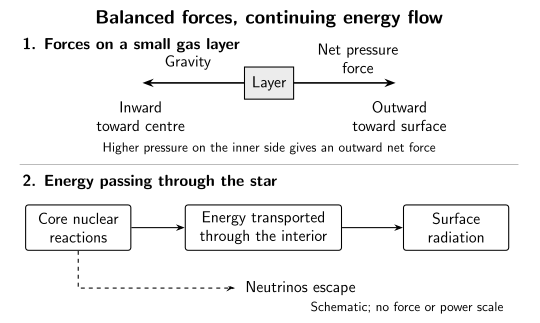
A main-sequence star can be nearly steady while energy continuously flows outward. Higher pressure on the inner side of a gas layer supplies its net outward force; nuclear reactions replenish energy carried away by surface radiation and escaping neutrinos. Schematic; arrow lengths are not measured force or power scales.
A forming star can be close to hydrostatic balance while contraction supplies much of its luminosity. A white dwarf can remain supported while gradually losing stored heat. “Pressure balances gravity” therefore does not, by itself, identify a star’s energy source.
Go further: the pressure must decrease outward
For this estimate, assume spherical symmetry, Newtonian gravity, and a layer changing slowly enough to neglect its acceleration. At radius , let be the enclosed mass and the density. A thin layer patch has area , thickness , and mass approximately .
The outward pressure force is . Its inward gravitational force is approximately . Equating them and taking the thin-layer limit gives
For positive density and enclosed mass, the negative sign requires pressure to decrease outward. A spatially uniform pressure could not support this layer: equal pushes on its two faces would cancel. The equation expresses force balance; an energy-production and transport model is still needed to determine a star’s temperature and luminosity.
Contraction and nuclear fuel give different timescales
Section titled “Contraction and nuclear fuel give different timescales”Gravitational contraction really does release energy. The question is whether its available supply can explain the Sun’s long history. Divide an energy supply by the power lost each second and you obtain a characteristic duration.
For a star of mass and radius , the gravitational energy scale is . The coefficient depends on how matter is distributed, and only part of released gravitational energy emerges as radiation. As an order-of-magnitude estimate, this supply could support today’s solar luminosity for tens of millions of years, far less than the Sun’s roughly 4.6-billion-year age (Fraknoi, Morrison, and Wolff 2022, §16.1, “Gravitational Contraction as a Source of Energy”; NASA, Sun Facts, “Formation”).
Nuclear energy offers a much larger supply. In a deliberately rough model, converting an amount of hydrogen equal to one-tenth of the Sun’s mass to helium provides enough energy for about ten billion years at today’s luminosity. That is a scale comparison, not a calculation of the Sun’s exact lifetime or remaining age: the fuel available to the core and the luminosity change as a star evolves.
Compare the two energy budgets
Use rounded solar values , , and , with and . These are coarse values, not precision measurements; the IAU provides standard solar conversion constants (IAU 2015, Resolution B3, p. 3, PDF). One year is about seconds.
Ignoring the order-one structure coefficient,
For the illustrative usable hydrogen mass ,
The second energy supply is about 330 times the first under these assumptions. We ignore the neutrino share in this rough duration comparison, hold luminosity fixed, and do not claim that precisely one-tenth of every star’s mass becomes usable hydrogen fuel. A more luminous star can exhaust a larger fuel supply sooner.
Neutrinos let us test the hidden core
Section titled “Neutrinos let us test the hidden core”The Sun’s visible surface does not show us its nuclear reactions directly. Energy is repeatedly exchanged between radiation and matter inside it; convection also transports energy in its outer interior. The visible photons leaving today are not intact messengers flying straight from the core (NASA, Sun Facts, “Structure”).
Solar neutrinos provide a more direct test of core reactions. In 2014 the Borexino experiment reported a measured spectrum of neutrinos from the Sun’s primary proton–proton process. That evidence tests the proposed power source using particles produced by the reactions themselves (Borexino Collaboration 2014, abstract and pp. 383–386). A convincing explanation combines the energy budget with observations that distinguish it from alternatives.
Diagnose two claims about a star
Section titled “Diagnose two claims about a star”Someone says, “A star in force balance cannot be losing energy.” Someone else says, “A star with twice the usable nuclear fuel must live twice as long.” What information is missing from each claim?
Answer and a changed example
Force balance concerns acceleration. Energy can flow through a mechanically balanced star and escape at its surface. A nearly steady main-sequence star replaces that loss mainly with nuclear energy; a contracting or cooling star can draw on a different supply.
The lifetime claim also needs the rate of energy loss. If two models release the same energy per kilogram of fuel, but the second has twice the fuel and twenty times the luminosity, its estimated lifetime is times as long. More fuel alone does not settle the comparison.
Now hold both the fuel supply and luminosity equal. These simple budget estimates then give equal durations, but they still omit changing luminosity, composition, and internal mixing. They are comparisons, not complete evolutionary histories.
For educators
No astronomy background is required. Prepare two headings, “forces on a layer” and “energy entering and leaving,” on paper. The objective is to explain why a star can remain supported while radiating; ratios are enough for the main activity, while the mathematical extensions use scientific notation or a derivative.
For a 5–10 minute activity, ask pairs to place gravity, the pressure difference, fusion, and escaping light under those headings. A successful explanation names pressure as the outward force and fusion as an energy supply. Address the misconception that fusion mechanically pushes against gravity or that balance means nothing changes.
For a 20-minute investigation, compare two imagined stars using the fuel and luminosity ratios in the question above, then add a third object powered by contraction. Ask what observation could distinguish the power sources. Expected reasoning combines an energy budget with evidence such as neutrinos; brightness alone is insufficient. The table headings and printed figure make the activity usable without a device.
Compare temperature, size, and luminosity on the H–R diagram, then follow how changing fuel supplies lead to different stellar remnants.
References
Section titled “References”- Adelberger, E. G., García, A., Robertson, R. G. H., et al. (2011). “Solar fusion cross sections II: the pp chain and CNO cycles.” Reviews of Modern Physics 83, 195–245. DOI; Open PDF.
- Borexino Collaboration (2014). “Neutrinos from the primary proton–proton fusion process in the Sun.” Nature 512, 383–386. DOI; collaboration summary.
- Fraknoi, A., Morrison, D., and Wolff, S. C. (2022). Astronomy 2e. OpenStax, Rice University, §§16.1–16.3. Gravitational energy, nuclear energy, and the solar interior.
- International Astronomical Union (2015). Resolution B3 on Recommended Nominal Conversion Constants for Selected Solar and Planetary Properties. Adopted 13 August 2015. Resolution; Open PDF.
- NASA. Sun Facts. Sections “Formation” and “Structure.” NASA Science. Solar structure and history.
Further reading
Section titled “Further reading”For the relativistic meaning of rest energy and the mass of a composite system, read Relativistic Energy, Momentum, and Mass Shells. This optional treatment develops the energy accounting used here. Preparation: mechanics, special relativity, calculus, and vectors.