What makes a world potentially habitable?
Scrollable formula. Use Left and Right arrow keys to reveal hidden content.
Scrollable table. Use Left and Right arrow keys to reveal additional columns.
Scrollable figure. Use Left and Right arrow keys to inspect hidden content.
https://blackhole.org/universe/life/habitable-worlds/
Imagine finding a planet that receives the same amount of starlight per square meter as Earth. Have we found another home for life? We have found a useful starting point. We still need to investigate its atmosphere, water, surface, and history.
Habitability asks whether an environment could support a specified kind of life. Inhabited means life is actually present. The first is a question about conditions; the second requires evidence of organisms or their activity. Here we focus on environments that might support life with liquid water, as all known life on Earth does.
A habitable zone is a conditional climate question
Section titled “A habitable zone is a conditional climate question”A star’s habitable zone is the range of distances where a rocky planet could maintain liquid water on its surface under suitable atmospheric conditions. It is not a belt in space where every planet has oceans.
Its boundaries come from physical models. Too much absorbed energy can make maintaining surface water difficult; too little can leave a planet cold even with substantial greenhouse warming. The answer depends on the star’s spectrum and the planet’s atmosphere, not just the distance marked on a diagram.
For example, Kopparapu and colleagues calculated boundaries using a specified climate model with water vapor, carbon dioxide, and background nitrogen. They explored how planetary mass and atmospheric assumptions affect the result. Such calculations are valuable precisely because their assumptions are stated and can be tested or improved (Kopparapu et al. 2014, §§1–3, PDF).
A habitable-zone label therefore means “worth investigating under these assumptions.” It does not establish that a planet has a solid surface, enough water, or a suitable atmosphere.
More luminous stars move equal-energy orbits outward
Section titled “More luminous stars move equal-energy orbits outward”Starlight spreads as it travels. At twice the distance from the same star, a square meter receives one-quarter as much energy per second. Around a star four times as luminous, an orbit twice as far away receives the original amount.
The following comparison isolates that geometry. It shows where three hypothetical stars would deliver the same incident energy flux as the Sun delivers at one astronomical unit, approximately Earth’s orbital distance.
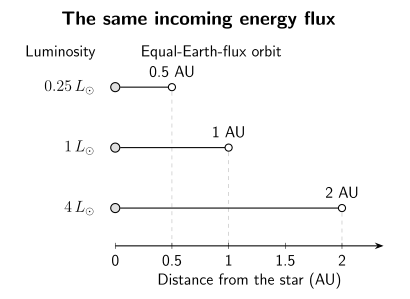
Equal incident flux requires distance to increase as the square root of stellar luminosity. These calculated markers compare 0.25, 1, and 4 solar luminosities on the same distance scale. They are not climate-model boundaries or locations where life is guaranteed; stellar and planetary sizes are symbolic.
| Stellar luminosity relative to the Sun | Distance giving Earth’s incident flux |
|---|---|
| 0.25 | 0.5 AU |
| 1 | 1 AU |
| 4 | 2 AU |
Equal total energy flux is only part of the climate problem. Different stellar spectra distribute that energy differently across wavelengths, which atmospheres and surfaces absorb and reflect differently. Equal-flux orbits around different stars need not have equal surface temperatures.
Try the mathematics: hold the flux fixed
Preparation: ratios, inverse squares, and square roots.
For a star radiating luminosity approximately equally in all directions, the incident flux at distance is
Relative to the Sun’s flux at one AU,
Setting the left side to one gives . Thus and .
A climate calculation adds a critical flux for a particular atmospheric model. The same geometry then converts that flux to a distance; this is the role of Eq. (5) in Kopparapu et al. 2014, §3.1, PDF. It does not make the critical flux universal.
An atmosphere changes what happens to the energy
Section titled “An atmosphere changes what happens to the energy”Some incoming light is reflected; some is absorbed. A planet also loses energy as thermal radiation. An atmosphere can absorb and emit that outgoing radiation, changing the surface temperature required for energy to escape to space.
Consequently, a planet’s simple radiative equilibrium temperature is not a measurement of its surface temperature. Cloud cover, atmospheric composition, pressure, circulation, and the surface all matter. Pressure also affects whether liquid water can persist at the surface.
The duration of favorable conditions matters too. A world may lose an atmosphere or water, or experience a changing stellar environment. A promising present-day orbit cannot establish its entire history. Even within one model family, changing the assumed atmosphere changes the result; the model comparisons in Kopparapu et al. 2014, §§2–3, PDF illustrate why a single distance cannot answer all these questions.
Measurements build the picture gradually. A transit can constrain a planet’s size relative to its star. Atmospheric spectra may constrain particular gases. Neither is a direct photograph of an ocean, and an uncertain atmospheric measurement should not quietly become a claim about surface conditions.
A world can offer water below an icy surface
Section titled “A world can offer water below an icy surface”The familiar stellar habitable zone concerns surface water. It does not rule out liquid-water environments underground or beneath ice, where internal energy can matter.
Saturn’s moon Enceladus provides a concrete example. Cassini flew through its plume and measured molecular hydrogen. In the context of other measurements, that result supports water interacting with rock in the moon’s interior. Such chemistry can supply energy that some terrestrial microbes use, even without sunlight (Waite et al. 2017, pp. 155–159, corrected PDF).
The instrument measured plume composition, not microbes. Connecting that composition to conditions in an ocean requires models and checks of other possible hydrogen sources. NASA’s mission explanation describes why the finding increased interest in Enceladus as a place to investigate habitability (NASA 2017, “Ingredients for Life at Enceladus”).
This broadens the search without removing its standards. Evidence for water, useful chemistry, and accessible energy is evidence about an environment. A claim that the environment is inhabited faces a further test, explored in Are we alone?.
Predict the energy, then identify what is missing
Section titled “Predict the energy, then identify what is missing”A hypothetical planet orbits a star four times as luminous as the Sun at one AU. First predict its incident flux relative to Earth. Then move it to two AU. Does the second orbit establish Earth-like surface conditions?
Answer and transfer
At one AU it receives four times Earth’s incident flux. At two AU, spreading over four times the area reduces that to Earth’s flux.
The second result still leaves the atmosphere, reflected fraction, stellar spectrum, surface, water inventory, and history uncertain. An atmospheric spectrum or thermal measurement would add useful evidence, but each would need its own interpretation.
For a second transfer, move a planet twice as far from an unchanged star. Its flux falls by four, but its surface temperature does not automatically fall by four. Energy input and temperature are different physical quantities.
For educators
Preparation and objective. The main text needs no prior astronomy; the table uses ratios and square roots. Students should separate equal incident flux, suitable conditions, and evidence of life.
Short activity, about 10 minutes. Give pairs the three luminosities in the table and calculate equal-flux distances. Expected answers: 0.5, 1, and 2 AU. Explain why the calculation alone cannot establish an ocean or inhabited surface.
Longer extension, about 30 minutes. Design two hypothetical worlds with identical incident flux but different reflected fractions or atmospheres. List the extra observations needed to compare their climates, then consider how an icy moon can have subsurface water outside the conventional surface habitable zone. The Enceladus example measures plume chemistry, not microbes.
Misconception to discuss. “Habitable zone means Earth-like.” Require students to state the atmospheric and surface assumptions. The explained four-luminosity example above checks both the inverse-square calculation and the distinction between an energy estimate and a life detection.
References
Section titled “References”- Kopparapu, R. K., Ramirez, R. M., SchottelKotte, J., Kasting, J. F., Domagal-Goldman, S., and Eymet, V. (2014). “Habitable Zones around Main-sequence Stars: Dependence on Planetary Mass.” The Astrophysical Journal Letters 787, L29. DOI; Open PDF.
- NASA (2017). Ingredients for Life at Enceladus. NASA Science, 13 April 2017. Mission explanation.
- Waite, J. H., et al. (2017). “Cassini Finds Molecular Hydrogen in the Enceladus Plume: Evidence for Hydrothermal Processes.” Science 356, 155–159. Corrected 1 June 2017. DOI; Open PDF.