How do we know the universe was hotter and denser?
Scrollable formula. Use Left and Right arrow keys to reveal hidden content.
Scrollable table. Use Left and Right arrow keys to reveal additional columns.
Scrollable figure. Use Left and Right arrow keys to inspect hidden content.
https://blackhole.org/universe/cosmology/big-bang/
The hot Big Bang model describes an observable universe that expanded and cooled from a much hotter, denser state. Astronomers did not reach that conclusion from one distant photograph. They combined evidence about cosmic expansion, a nearly thermal background of radiation, and the earliest light elements.
These tests concern a physical history. They do not establish creation from nothing, explain why the universe exists, or provide a complete account of a first instant.
Expansion connects distance with the past
Section titled “Expansion connects distance with the past”When we identify familiar patterns of spectral lines in distant galaxies, those patterns are generally shifted toward longer wavelengths. On sufficiently large scales, galaxy distances and these redshifts fit an expanding-universe description.
In that description, the average separation between objects following the cosmic expansion grows with a quantity called the scale factor. Running the model backward makes the average matter density larger. This does not mean everything expands together: gravitationally bound systems, including galaxies and the Solar System, do not simply stretch with the cosmic scale factor.
Expansion also changes freely traveling light. Its wavelength stretches and its photon energy decreases. A thermal radiation bath therefore cools as the scale factor grows. That reasoning predicts a relic background, and observations let us test its spectrum rather than merely assume it exists.
The microwave background preserves a thermal pattern
Section titled “The microwave background preserves a thermal pattern”The cosmic microwave background, or CMB, fills the sky. Its spectrum is extraordinarily close to thermal radiation at about 2.725 kelvin. COBE’s FIRAS instrument measured that spectrum; the public data description distinguishes the fitted blackbody from the small measured residuals (NASA/GSFC LAMBDA, “FIRAS CMB Monopole Spectrum”).
Today the radiation is cold, but an expanding universe connects it to a much warmer past. As the early universe cooled enough for neutral atoms to persist, free electrons became much less abundant and photons could travel long distances without scattering. The CMB photons were mostly already present; they were last scattered around this transition. The CMB is not mainly the glow of newly produced atomic recombination lines (Carroll 2014, §8.7, p. 364).
The radiation comes from every direction because the early hot material was not concentrated at one special explosion site in otherwise empty space. Every region we can observe participates in the history described by the model.
The earliest nuclei supply a different test
Section titled “The earliest nuclei supply a different test”During the first few minutes, nuclear reactions assembled light nuclei from protons and neutrons. The predicted mixture depends on the expansion rate, ordinary-matter density, and known reaction rates.
Astronomers compare those predictions with inferred primordial abundances, using environments where later stellar processing can be estimated or minimized. Deuterium and helium provide strong tests; helium-4 is roughly one-quarter of the ordinary matter by mass, not one-quarter of the nuclei by number. Lithium presents a significant discrepancy, so “every element agrees perfectly” would overstate the result (Fields, Molaro, and Sarkar 2025, §§24.2–24.4, PDF).
The primordial-element explanation develops the early reaction sequence and shows why a quarter by mass means a much smaller fraction by number of nuclei.
The diagram puts the three tests together. Their strength comes from requiring the same broad history to explain different kinds of measurement.
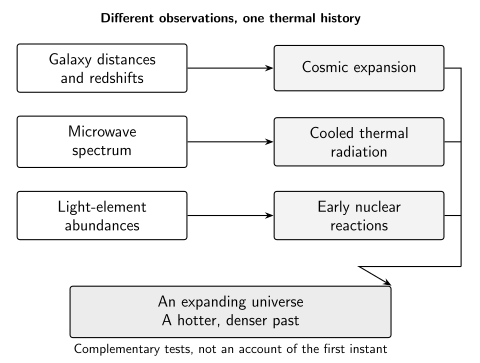
Three complementary observations support a hotter, denser past. This schematic compares kinds of evidence; it contains no measured spectra, abundance points, or time scale. It does not extend the evidence to an established account of the first instant.
| Observation | Connection to the model | A limitation to remember |
|---|---|---|
| Large-scale redshifts and distances | Expansion changes average separations and wavelengths | Local motions also affect redshift |
| Nearly thermal microwave spectrum | Radiation from a hot past cools with expansion | A spectrum alone does not determine every cosmological parameter |
| Light-element abundances | Early nuclear reactions depend on density and expansion | Stellar processing and measurement uncertainty matter; lithium remains problematic |
Try the mathematics: shrink the scale factor
Preparation: ratios, cubes, and powers. No calculus is needed for this comparison.
Normalize today’s scale factor to . For freely expanding thermal radiation, and for nonrelativistic matter whose mass is conserved in a comoving volume,
Here is radiation temperature and is mean matter density. Halving doubles the temperature and reduces the volume of a corresponding region by eight, giving eight times the matter density.
Cosmological redshift obeys under this normalization. For an illustrative value , a present temperature of K corresponds to about K. That multiplication is not an independent determination of the exact time or redshift of last scattering.
Predict two changes from one history
Section titled “Predict two changes from one history”Imagine the same expanding model at one-third of today’s scale factor. Before opening the answer, predict the radiation temperature and average matter density relative to today.
Answer and transfer
The radiation is three times hotter, and the matter density is twenty-seven times larger. Temperature follows one inverse power of scale factor; matter density follows three because volume has three dimensions.
Now reverse the question. If the radiation temperature drops by a factor of two during expansion, the conserved matter density drops by a factor of eight. These are related changes within the stated model. They are not rules for the temperature or density inside every bound star or planet.
Models of inflation address an earlier proposed period of accelerated expansion and help organize other questions. They are not interchangeable with the tested thermal history. To see how astronomers investigate much later expansion, continue to dark energy.
For educators
Preparation and objective. The main reading requires no prior cosmology; the optional calculation uses ratios and cubes. Students should explain how three different measurements test one hot, expanding history.
Short activity, about 10 minutes. Match redshift, a microwave spectrum, and light-element abundance to the quantity each measures. Then distinguish observation from the model linking it to the past. Expected answer: no one item alone is a complete account of cosmic history.
Longer extension, about 30 minutes. Calculate temperature and conserved matter-density ratios for scale factors one-half and one-third. Expected pairs are and relative to today. Ask what a lithium discrepancy challenges and what evidence it does not erase; compare with the primordial-element page.
Misconception to discuss. “The model establishes creation from nothing.” These observations constrain a hotter, denser past, not the origin of everything. If using a balloon analogy, explicitly separate its surface, center, and outside from the cosmological claims.
References
Section titled “References”- Carroll, S. M. (2014). Spacetime and Geometry: An Introduction to General Relativity. Pearson New International Edition, §8.7, p. 364. Author’s book page.
- Fields, B. D., Molaro, P., and Sarkar, S. (2025). “Big Bang Nucleosynthesis,” revised August 2025. In the Particle Data Group’s Review of Particle Physics, S. Navas et al., Physical Review D 110, 030001 (2024), 2025 update. Review PDF, §§24.2–24.4.
- NASA/Goddard Space Flight Center, LAMBDA. FIRAS CMB Monopole Spectrum. COBE/FIRAS data description and linked data products. Spectrum documentation.
Further reading
Section titled “Further reading”For an optional derivation of the different dilution laws for matter and radiation, read Equations of State and Scaling Laws. Preparation: calculus, energy conservation for fluids, and general relativity.