What does a telescope actually do?
Scrollable formula. Use Left and Right arrow keys to reveal hidden content.
Scrollable table. Use Left and Right arrow keys to reveal additional columns.
Scrollable figure. Use Left and Right arrow keys to inspect hidden content.
https://blackhole.org/universe/observing/telescopes/
A telescope gathers light and organizes it into a signal we can study. Two questions matter immediately: how much light can it collect, and how close together can two details be before they blur into one? Magnifying the resulting image is useful only when the original measurement contains enough information.
Predict first. Replace an ideal circular telescope aperture 10 centimetres across with one 20 centimetres across. Does it collect twice as much light? Does it separate details twice as well? Those two questions have different scaling rules.
Collecting light: area matters
Section titled “Collecting light: area matters”The aperture is the effective opening through which a telescope gathers light. An optical telescope uses a lens or mirror to bring that light toward a focus. A camera, spectrograph, or eyepiece receives the result. The diameter alone is not the collecting area: doubling the diameter of a circular opening multiplies its area by four. Fraknoi, Morrison, and Wolff 2022, § 6.1, “Telescopes”
Imagine light from a star arriving at a steady rate per square metre. Four times the area intercepts four times as many photons in the same exposure. This comparison assumes the same wavelength band, throughput, observing conditions, and detector efficiency. Obstructions and losses reduce the useful collecting area of real instruments.
Now compare the two circles below. Their diameter ratio is two, their area ratio is four, and their ideal angular-resolution numbers change in a third, precisely stated way.
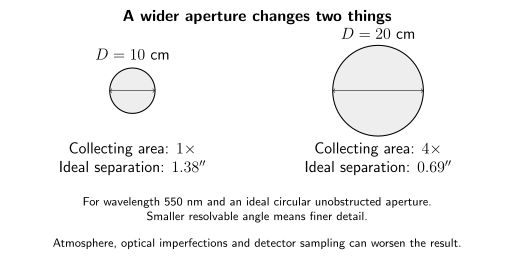
Aperture controls collection and diffraction differently. Circle diameters are proportional. The calculated separations use the Rayleigh criterion at wavelength 550 nanometres for ideal circular, unobstructed apertures. They are model values, not a promise of performance through Earth’s atmosphere.
Resolving detail: angle matters
Section titled “Resolving detail: angle matters”Angular resolution describes the ability to distinguish nearby directions in the sky. Two stars that are far apart in space can look close together if they are distant from us. A telescope must separate their incoming directions to record two distinct images.
Even perfect optics cannot focus a point of light into an infinitely small point. Light behaves as a wave, and a finite circular aperture produces a central bright spot surrounded by fainter rings. This is diffraction. For a fixed wavelength, a wider aperture makes that pattern narrower. Ling, Sanny, and Moebs 2016, § 4.5, “Circular Apertures and Resolution”
An arcsecond is 1/3600 of a degree. Smaller resolvable angles mean finer detail. The ideal 20-centimetre instrument below reaches half the angular separation of the 10-centimetre instrument.
| Circular aperture | Relative collecting area | Ideal Rayleigh separation at 550 nm |
|---|---|---|
| 10 cm diameter | 1 | 1.38 arcseconds |
| 20 cm diameter | 4 | 0.69 arcseconds |
Show the math: two scaling rules
For diameter , a circular aperture has area
For two comparable point sources and an ideal circular unobstructed aperture, the Rayleigh criterion uses the angular separation
in radians, where is wavelength. At this separation, one source’s central maximum coincides with the first dark ring of the other. It is a useful conventional criterion rather than a universal boundary for every possible measurement.
For metres and metres, radians. Multiplying by about 206,265 arcseconds per radian gives 1.38 arcseconds. Doubling halves this angle while quadrupling . The equation is Ling, Sanny, and Moebs 2016, § 4.5, Eq. 4.5.
Why magnification is not enough
Section titled “Why magnification is not enough”Enlarge a blurry photograph and its blurred patches get bigger. A stronger eyepiece or digital zoom can similarly enlarge a telescope image without recovering detail that was never resolved. Adequate sampling and magnification help us inspect the information; they do not replace collecting area or remove diffraction.
Earth’s turbulent atmosphere can distort the incoming wavefront and blur the image further. Optical imperfections, imperfect tracking, and detector sampling also matter. Longer exposures collect more photons, but an ordinary long exposure does not automatically undo that blur. Adaptive optics measures and corrects some atmospheric distortion, while space telescopes avoid the atmosphere. Fraknoi, Morrison, and Wolff 2022, § 6.2, resolution and adaptive-optics discussion
Wavelength matters too. Infrared and radio telescopes study information absent from visible-light photographs. Comparing two instruments’ diameters without their observing wavelengths can give the wrong impression of their angular resolution. Hubble and Webb were designed for complementary wavelength ranges, not simply as interchangeable cameras. NASA n.d., “Hubble vs. Webb,” §§ State of the Art Observatories and Mirrors
Try a different wavelength
Section titled “Try a different wavelength”Keep the ideal 20-centimetre telescope, but double the observed wavelength from 550 to 1100 nanometres. What happens to its collecting area and Rayleigh separation?
Answer
The geometric area stays the same. The ideal angular separation doubles from about 0.69 to 1.38 arcseconds, because it is proportional to wavelength. That does not mean the real photon count stays fixed: the source emits differently at different wavelengths, and the atmosphere, coatings, filters, and detector have wavelength-dependent responses.
For classrooms and clubs
Preparation: circle areas and the distinction between angle and distance. Objective: separate collecting area, angular resolution, and magnification. In 15 minutes, draw two circles with diameters in the ratio 1:2. Their areas are in the ratio 1:4, while the ideal resolvable angles at the same wavelength are in the ratio 1:1/2. The numerical table gives an equivalent nonvisual activity.
For a longer extension, predict a 40-centimetre ideal aperture at 550 nm: 16 times the collecting area of the 10-centimetre aperture and a Rayleigh separation of about 0.346 arcseconds. Double the wavelength and that separation doubles, while geometric area stays fixed. The common misconception is that extra magnification restores missing detail; it enlarges an existing measurement. This can be done entirely indoors with paper. If using a real telescope at a supervised evening event, follow the organizer’s setup instructions and never point it at the Sun.
Next, explore the information in a spectrum, or see how widely separated telescopes help image a black hole’s surroundings.
References
Section titled “References”- Fraknoi, Andrew, David Morrison, and Sidney Wolff. Astronomy 2e. Houston: OpenStax, 2022. § 6.1, “Telescopes”; § 6.2, “Telescopes Today”.
- Ling, Samuel J., Jeff Sanny, and William Moebs. University Physics, Volume 3. Houston: OpenStax, 2016. § 4.5, “Circular Apertures and Resolution”.
- NASA Science. “Hubble vs. Webb.” NASA, n.d. Design and observatory comparison. Accessed September 27, 2026.