Why does the Moon change shape?
Scrollable formula. Use Left and Right arrow keys to reveal hidden content.
Scrollable table. Use Left and Right arrow keys to reveal additional columns.
Scrollable figure. Use Left and Right arrow keys to inspect hidden content.
https://blackhole.org/universe/sky/moon-phases/
The Moon keeps its round shape. What changes is our view of its sunlit half. As the Moon travels around Earth, we see a thin crescent, a half-lit disk, a nearly full disk, and then the sequence in reverse. You can explain this monthly pattern with three objects, one light source, and a change of viewpoint.
Predict first. If the Sun lights about half the Moon, how can we sometimes see a completely dark disk and sometimes a completely bright one? Keep that question in mind as you compare the two views below.
One Moon, two viewpoints
Section titled “One Moon, two viewpoints”Imagine looking down on the Moon’s orbit from above its northern side. Sunlight comes from one direction, so the half of the Moon facing the Sun is bright at every orbital position. Now move your imaginary camera to Earth. You can see only the hemisphere facing you, and it does not always coincide with the hemisphere facing the Sun.
Compare the real lunar surface with a model of what illumination can change. The Galileo view uses enhanced colors to distinguish surface materials; the model below asks a different question about the sunlit portion we see.
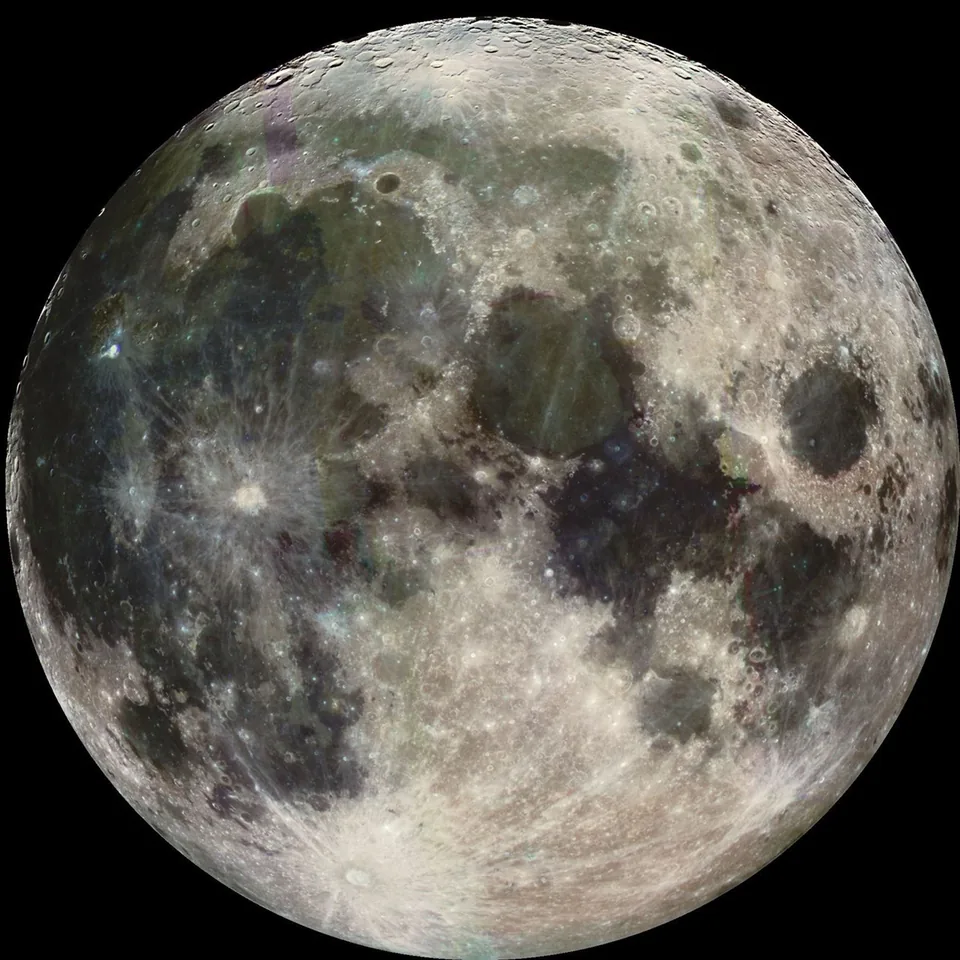
Galileo's Moon composite combines violet and near-infrared measurements; the displayed colour is enhanced. The dark plains and bright crater rays are surface features.
Credit: NASA/JPL/USGS. Image source · Reuse terms
Follow each orbital position, then compare its matching disk seen from Earth. Earth stays at the centre while sunlight arrives from the right.
New Moon
Orbit view · sunlight from the right
View from Earth · north up
0% of the visible disk is sunlitFirst quarter
Orbit view · sunlight from the right
View from Earth · north up
50% of the visible disk is sunlitFull Moon
Orbit view · sunlight from the right
View from Earth · north up
100% of the visible disk is sunlitLast quarter
Orbit view · sunlight from the right
View from Earth · north up
50% of the visible disk is sunlitSee the complete geometry on one sheet
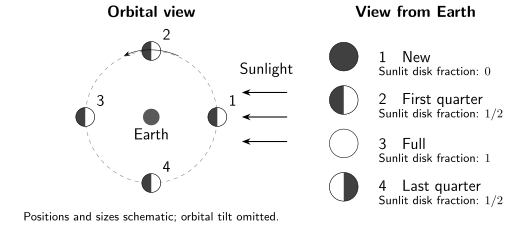
Changing viewpoint produces the phases. The orbital view is a schematic projection from above the northern side of the orbit; observer disks use north-up orientation. Sizes and distances are exaggerated, and orbital tilt is omitted. The real Moon’s orientation relative to your horizon depends on where and when you observe.
| Position | What we see from Earth | Sunlit fraction of the visible disk |
|---|---|---|
| New Moon | The sunlit hemisphere faces mostly away from us | About zero |
| First quarter | Half the visible disk is sunlit, and the bright portion is growing | One-half |
| Full Moon | The sunlit hemisphere faces almost directly toward us | About one |
| Last quarter | Half the visible disk is sunlit, and the bright portion is shrinking | One-half |
These are landmarks in a continuous change, not four shapes that the Moon jumps between. Waxing means that the bright portion is growing; waning means it is shrinking. Crescent describes less than half the visible disk being illuminated, and gibbous describes more than half. The familiar cycle takes about 29.5 days. USNO n.d., “Phases of the Moon,” phase definitions
Why a quarter Moon looks half lit
Section titled “Why a quarter Moon looks half lit”“First quarter” describes progress through the phase cycle: the Moon has moved roughly a quarter of the way around from new Moon. “Half lit” describes the appearance of its disk. The two phrases answer different questions.
At a quarter phase, the Sun and Earth lie in approximately perpendicular directions as seen from the Moon. From Earth, the boundary between lunar day and night crosses the middle of the disk. Near that boundary, low-angle sunlight makes crater shadows especially noticeable.
You can test the geometry in the Moon-phase laboratory. Before moving the Moon, predict which orbital position will show a full disk. The laboratory changes an idealized orbital angle; it does not forecast tonight’s Moon or an eclipse.
Phases are not Earth’s shadow
Section titled “Phases are not Earth’s shadow”At an ordinary crescent Moon, the dark region is the Moon’s own night side. Earth is not blocking the sunlight that would otherwise reach it. Earth’s shadow does fall on the Moon during a lunar eclipse, which is a different, less frequent alignment.
Why not an eclipse every month? The Moon’s orbital plane is tilted relative to Earth’s path around the Sun. At most new and full Moons, the alignment misses: the Moon passes above or below the direction needed for an eclipse. A flat diagram is useful for phases but hides that third dimension. NASA n.d., “Moon Phases,” § New Moon Explore the missing geometry in why eclipses are less frequent.
The Moon’s far side is also not a permanently dark side. “Far” means facing away from Earth; “night” means facing away from the Sun. The far side has days and nights too.
Show the math: how much of the disk is illuminated?
Let be the angle at the Moon between the direction toward the Sun and the direction toward the observer. Treat the Moon as a sphere illuminated by a distant Sun, and ignore eclipses. The illuminated fraction of its projected disk is
At full phase, and . At a quarter phase, and . At new phase, and . This describes illuminated area, not observed brightness: rough lunar terrain reflects light unevenly, and a half-lit disk is not necessarily half as bright as a full Moon.
Try a different observer
Section titled “Try a different observer”Two people observe the Moon from opposite hemispheres. One says the crescent looks tilted differently. Must they be seeing different phases?
Answer
No. Changing how observers stand relative to the sky changes the disk’s apparent orientation. It does not turn a waxing crescent into a full Moon. Their viewing directions differ slightly because Earth has a finite size, but that is much smaller than the difference between the major phase names. Rotation of a picture and change of illuminated fraction are different operations.
For classrooms and clubs
Preparation: a small ball and a steady room lamp, or the diagram and table above. Objective: distinguish the illuminated hemisphere from the hemisphere an observer sees. In 15 minutes, move the ball around a seated observer while keeping the lamp fixed; predict each view first. Keep the lamp away from faces and do not use the Sun as the light source to look toward. Describe which fraction of the visible disk is lit for a nonvisual version.
For a longer activity, use the laboratory indoors to predict and record eight successive positions. Learners should find a continuously changing visible fraction while approximately half the whole sphere remains sunlit. Ask them to explain the quarter/half distinction: it concerns position in the phase cycle versus visible area. The common misconception is that Earth’s shadow creates ordinary phases; in the model, keep the ball out of the observer’s shadow and show that phases still occur.
Next, connect the lunar cycle to spring and neap tides, or see why lunar cycles and calendar years do not fit neatly together.
References
Section titled “References”- NASA Science. “Moon Phases.” NASA, n.d. Article and phase descriptions. Accessed September 27, 2026.
- U.S. Naval Observatory. “Phases of the Moon and Percent of the Moon Illuminated.” Astronomical Applications Department, n.d. Definitions and geometry. Accessed September 27, 2026.